
Last updated September 17, 2026
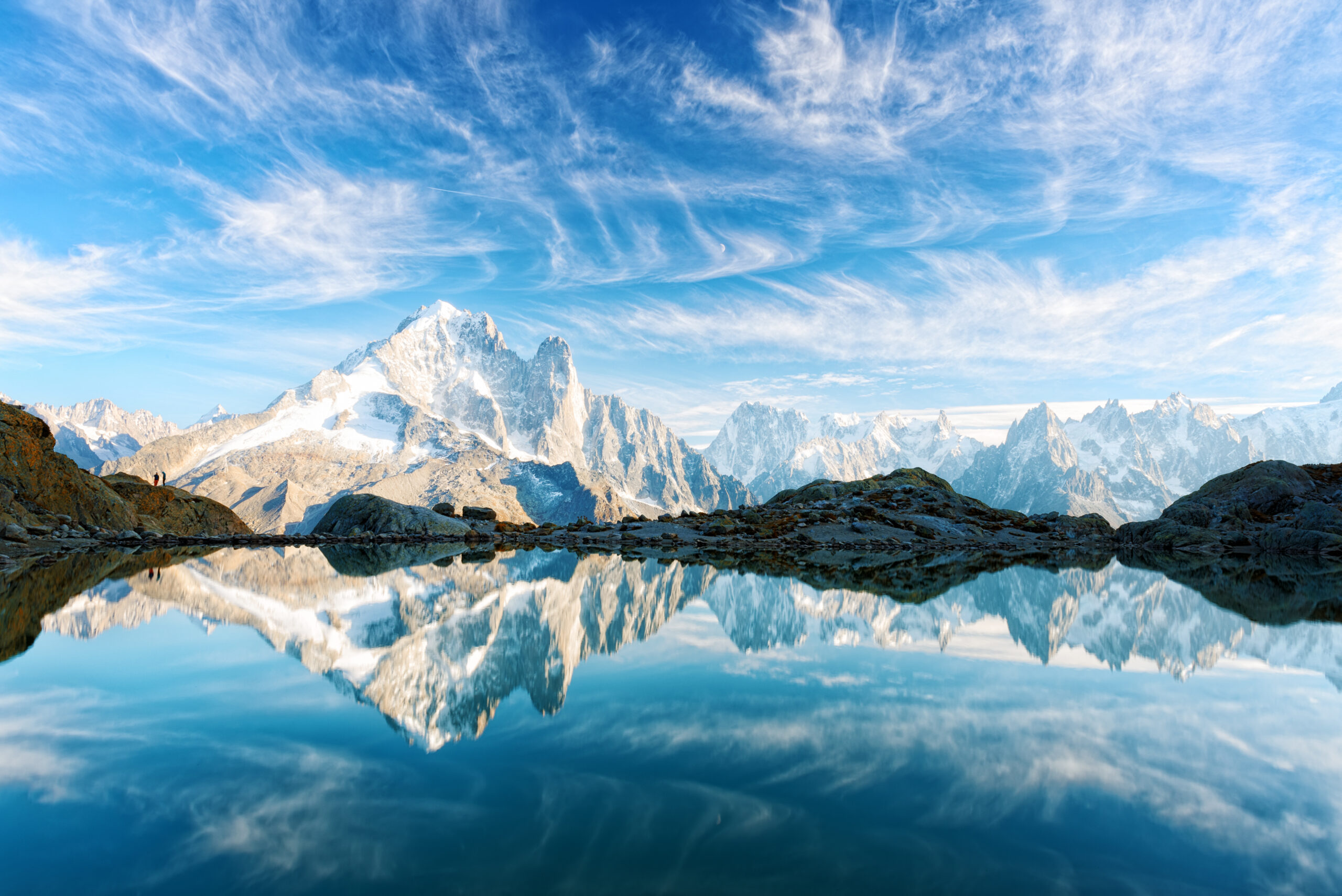
Mont Blanc vs Matterhorn vs Eiger: Which Alps Peak Fits You?
Choose Mont Blanc for altitude and glacier systems, the Matterhorn for sustained exposed rock, and the Eiger for an advanced technical ridge. Travelers who do not plan to climb should choose by base town and viewpoint instead: Chamonix, Zermatt and Grindelwald provide three very different Alpine trips.
Mont Blanc, Matterhorn or Eiger?
Choose Mont Blanc after building glacier skills and acclimatization for a first major Alpine summit. Choose the Matterhorn when you can move quickly on sustained exposed rock and descend without losing route efficiency. Choose the Eiger only after comparable technical Alpine ridges; the Mittellegi Ridge is the fair summit comparison, while the Nordwand belongs in an elite category of its own.
For sightseeing, choose Chamonix for the Mont Blanc Massif, Zermatt for the Matterhorn and Monte Rosa skyline, or Grindelwald for the Eiger–Mönch–Jungfrau landscape.
This page: choose
Side-by-side route, skill, trip and base-town comparison.
Ranking: judge
An opinionated hierarchy of the Alps’ greatest climbing mountains.
Collection: browse
A visual catalog linking to the individual Alpine peak guides.
First decide: climb or visit?
The same mountain produces two entirely different trip decisions.
I want to climb
- Compare the standard route—not the mountain’s hardest face.
- Match glacier, rock and mixed-terrain skills to the objective.
- Protect enough days for acclimatization and weather.
- Choose the progression step, not merely the most famous summit.
- Use guide and hut availability as a constraint, not an afterthought.
I want to see the mountains
- Choose the base town and transport network.
- Compare viewpoints, railways, cable cars and valley hikes.
- Use weather flexibility rather than committing to one summit day.
- Combine iconic scenery with family, lodging and mobility needs.
- Do not use climbing grades to select a sightseeing trip.
Mont Blanc vs Matterhorn vs Eiger
Equivalent standard summit routes—not Goûter versus the Eiger North Face.
| Decision | Mont Blanc | Matterhorn | Eiger |
|---|---|---|---|
| Fair comparison route | Goûter Route | Hörnli Ridge | Mittellegi Ridge |
| Indicative grade | PD / PD+ | AD | D |
| Primary skill | Glacier travel, altitude and endurance | Fast exposed rock movement and route finding | Technical ridge climbing, transitions and commitment |
| Best progression position | First major Alpine summit after training peaks | Technical graduation objective | Advanced ridge objective |
| Normal planning block | 6–7 days with preparation and reserve | 7–10 days including acclimatization climbs | 7–10 days with comparable ridge preparation |
| Best base town | Chamonix / Saint-Gervais | Zermatt | Grindelwald |
| Main route problem | Objective hazard, huts, weather and descent | Speed, exposure, route finding and descent | Technical ridge condition and escape complexity |
| Best non-climbing experience | Aiguille du Midi and Mont Blanc viewpoints | Gornergrat and Matterhorn viewpoints | Jungfraujoch, Kleine Scheidegg and Eiger Trail |
Mont Blanc
Best forFirst major Alpine summit and glacier-system development.
Not enough preparationGeneral hiking fitness without crampon, rope-team and altitude experience.
Matterhorn
Best forClimbers already efficient on sustained exposed Grade III terrain.
Not enough preparationMont Blanc alone without technical rock progression.
Eiger
Best forAdvanced climbers with comparable Alpine ridge days.
Not enough preparationTreating the mountain’s fame as evidence of readiness.
Use the dedicated comparisons for deeper decisions: Mont Blanc vs Matterhorn, Mont Blanc vs Eiger and Matterhorn vs Eiger.
Alps Peak Selector
Choose the trip type, current skill, time, budget and primary goal. The result is a planning match—not permission to climb.
Alps base towns and peak systems
The trip is easier to plan when peaks are organized by gateway rather than one giant list.
Standard routes versus legendary faces
Two tables prevent a distorted comparison.
| Peak | Standard comparison | General character | Who it fits | What it should not be compared with |
|---|---|---|---|---|
| Mont Blanc | Goûter Route · PD/PD+ | Glacier, altitude, endurance and objective hazard | Prepared intermediate Alpine climber | Elite north faces |
| Matterhorn | Hörnli Ridge · AD | Sustained exposed rock and complex descent | Efficient technical Alpine climber | A simple scramble or hiking peak |
| Eiger | Mittellegi Ridge · D | Technical ridge, mixed transitions and commitment | Advanced Alpine ridge climber | Mont Blanc by comparing only the Nordwand |
| Monte Rosa | Normal Dufourspitze route · PD+ | Major glacier journey and endurance | Intermediate glacier climber | A lift-assisted beginner outing |
| Jungfrau | Southeast Ridge · PD+/AD- | Glacier and mixed high-Alpine travel | Intermediate climber | The tourist journey to Jungfraujoch |
| Grossglockner | Normal route · PD+ or Stüdlgrat · AD | Mixed climbing and exposed summit ridge | Progressing Alpine climber | A nontechnical Austrian hike |
The Eiger Nordwand, Matterhorn North Face and Grandes Jorasses Walker Spur are career-level objectives. They deserve comparison with one another—not with the easiest standard route on Mont Blanc.
The Big Three profiles
A decision profile for the route, base town and progression step.
Mont Blanc
France / Italy · about 4,806–4,808 m
Choose it for: Altitude, glacier systems and the highest summit in the Alps.
Matterhorn
Switzerland / Italy · 4,478 m
Choose it for: Iconic shape and sustained exposed rock climbing.
Eiger
Switzerland · 3,967 m
Choose it for: History, commitment and a world-famous mountain wall.
The dedicated Mont Blanc vs Eiger comparison was identified as an archive/list-dependent weak page. It now receives a high-context link exactly where climbers need to compare glacier-heavy PD terrain against an advanced D-grade ridge.
Seven alternatives beyond the Big Three
The correct answer may be a progression peak or sightseeing icon rather than the most famous objective.
Monte Rosa / Dufourspitze
Switzerland / Italy · 4,634 m
Jungfrau
Switzerland · 4,158 m
Grossglockner
Austria · 3,798 m
Breithorn
Switzerland / Italy · 4,164 m
Gran Paradiso
Italy · 4,061 m
Zugspitze
Germany / Austria · 2,962 m
Tre Cime di Lavaredo
Italy · 2,999 m
Use the Alpine Peak Quick Reference Cards when you need compact route, elevation and progression comparisons across a larger set of summits. The orphan audit identified it as a high-priority archive/list-dependent page.
A defensible Alpine progression
A framework rather than a promise that every climber follows one exact ladder.
Start with the beginner climbing guide, add altitude acclimatization and use the dedicated Mont Blanc vs Matterhorn progression comparison before moving into the more technical peaks.
Best Alps base town by goal
For many travelers, the town is the true product and the summit is one optional day.
Chamonix
Best for Mont Blanc Massif access, mountaineering culture, lifts and technical variety.
Zermatt
Best for the Matterhorn skyline, Breithorn, Monte Rosa and a car-free rail trip.
Grindelwald
Best for Eiger history, Jungfraujoch and a combined hiking/sightseeing trip.
Cortina
Best for Dolomite hiking, via ferrata and Tre Cime scenery.
Kals
Best for a focused Grossglockner objective with Austrian hut culture.
Aosta Valley
Best for Gran Paradiso, Italian Mont Blanc access and a quieter progression trip.
Garmisch
Best for Zugspitze access, family travel and mixed transport choices.
Pontresina
Best for Piz Bernina, the Biancograt and a rail-supported advanced trip.
Season, cost and planning realism
Use relative frameworks because route condition and operator packaging change faster than the mountain names.
| Objective type | Typical planning season | Cost drivers | Most important booking constraint | Primary uncertainty |
|---|---|---|---|---|
| Introductory 4,000er | Generally June–September | Guide day, lift, hut and training | Guide and hut date | Glacier and weather condition |
| Mont Blanc program | Route- and hut-dependent summer window | Multi-day training, huts, guide ratio and alternatives | Named refuge reservation | Heat, rockfall, wind and acclimatization |
| Matterhorn Hörnli | Dry summer rock conditions | Guide ratio, preparation climbs and Zermatt costs | Guide assessment and hut plan | Snow/ice on the ridge and weather |
| Eiger Mittellegi | Dry technical-ridge conditions | Advanced guide time, preparation and hut logistics | Guide and Mittellegi access | Rock/ridge condition and retreat complexity |
| Sightseeing trip | Year-round by activity | Lifts, rail, lodging and peak-season demand | Flexible lodging rather than summit date | Visibility and lift operation |
Build the working budget with the mountain-climbing cost framework, confirm coverage using the mountaineering insurance guide, and read the six-factor mountain-weather framework before selecting a fixed summit date.
Alps comparison and planning cluster
This page should receive links back from every direct comparison and individual Big Three guide.
Alps hubs
Alps Classics collection Greatest Alps mountains ranking Alpine Peak Quick Reference Cards Global mountain directoryPreparation
Altitude acclimatization High-altitude training plan Mountain weather for climbers Mountaineering insuranceAlps peak comparison FAQ
Direct answers for climbing, sightseeing and progression searches.
Which is harder: Mont Blanc, Matterhorn or Eiger?
For their standard comparison routes, Mont Blanc is the least technical but highest and most glacier-dependent. The Matterhorn is a sustained exposed rock climb on the Hörnli Ridge. The Eiger by the Mittellegi Ridge is generally the most technical and committing of the three. The Eiger North Face belongs in a separate elite category and should not be used as the default Eiger comparison.
Which Alpine peak should I climb first?
For a first guided 4,000-meter summit, Breithorn or Gran Paradiso is usually a stronger starting point than the Big Three. Mont Blanc can follow after glacier skills, acclimatization and long-day fitness. The Matterhorn and Eiger require progressively stronger exposed-rock and route-finding ability.
Should I climb Mont Blanc before the Matterhorn?
For most climbers, yes. Mont Blanc builds glacier travel, altitude management and long summit-day systems. It does not by itself prepare a climber for the sustained rock movement and rapid route-finding required on the Matterhorn, so technical Alpine rock climbs must be added before the Hörnli Ridge.
Is the Eiger North Face the normal route?
No. The Nordwand is one of the most serious classic faces in alpinism. A fair summit comparison uses the Mittellegi Ridge or another standard summit route. The North Face should be compared with other elite Alpine faces, not with the Goûter Route or Hörnli Ridge.
What are the best Alps mountains for sightseeing?
Matterhorn from Zermatt, Eiger from Grindelwald and Kleine Scheidegg, Mont Blanc from Chamonix, Jungfrau from Jungfraujoch, Zugspitze by cable car and Tre Cime on the Dolomite circuit are among the strongest non-climbing experiences.
How many 4,000-meter peaks are in the Alps?
The UIAA officially classifies 82 recognized Alpine summits above 4,000 meters. That list is useful for collection goals, but elevation alone does not determine whether a peak is the best fit for a particular climber.
When is the best time to climb the Alps?
June through September is the general summer mountaineering season, but each route has its own snow, rock, glacier, hut and weather window. Dry rock routes such as the Matterhorn and Eiger ridges may need different conditions from glacier-heavy routes such as Mont Blanc or Monte Rosa.
Which Alps base town should I choose?
Choose Chamonix for Mont Blanc and technical Mont Blanc Massif access, Zermatt for Matterhorn, Breithorn and Monte Rosa, Grindelwald for Eiger and Jungfrau, Cortina for the Dolomites, Kals for Grossglockner and Garmisch-Partenkirchen for Zugspitze.
Can a beginner climb Mont Blanc?
A beginner to mountaineering should not treat Mont Blanc as a first day on crampons. A fit novice can work toward it through instruction, glacier practice, a progression peak such as Gran Paradiso and a sufficiently long guided program with weather flexibility.
Which page should I use for a ranked list instead of a comparison?
Use the Greatest Mountains in the Alps climber's ranking for an opinionated hierarchy and the Alps Classics collection for a browsable catalog. This page is designed to help a traveler or climber choose the right peak.
Sources, corrections and editorial limits
- UIAA: official classification of 82 recognized Alpine summits above 4,000 meters.
- Standard-route fairness: Mont Blanc Goûter, Matterhorn Hörnli and Eiger Mittellegi are compared separately from the great north faces.
- Alps Trilogy context: American Alpine Institute treats Mont Blanc, Matterhorn and Eiger as a progression requiring preparation, acclimatization and condition flexibility.
- Mont Blanc height: the snow summit changes. This page uses a range rather than mixing incompatible exact measurements throughout the article.
- No unsupported success-rate blend: operator-specific rates are not turned into one mountain-wide percentage.
- No unnamed expert review: the legacy “reviewed by IFMGA guides” claim was removed because no reviewer was identified.
- No firsthand claim: Global Summit Guide has not climbed all mountains compared here.
- Dynamic facts: current routes, huts, lifts, prices and weather must be verified on the dedicated mountain page and official local source.
UIAA Alpine 4,000ers · American Alpine Institute Alps Trilogy
Choose the next skill system—not just the next famous summit.
Use the selector for a shortlist, then move into the dedicated mountain guide, route comparison, weather, progression and operator pages before committing to dates.
Use the Peak Selector Browse Alps Classics Compare Mont Blanc and MatterhornWhich Alps Peak Fits Your Trip?
Mont Blanc is the strongest choice for a first major Alpine summit with glacier travel. Matterhorn demands faster, more exposed rock movement and is a bigger technical step. Eiger is the most route-dependent: the Mittellegi Ridge is a serious guided alpine climb, while the famous North Face belongs in an entirely different technical category.
Best First Big Alpine Summit
Glacier travel, altitude, crampons and long summit days without sustained technical rock climbing.
Best for Exposed Rock Movement
Fast scrambling, short-rope efficiency and sustained exposure make the Hörnli Ridge a major step up.
Best for Experienced Alpinists
The Mittellegi Ridge is the fair standard-route comparison; the Nordwand is a separate elite technical objective.
Was this helpful?
🏔Related peaks nearby
🧭Explore & compare
Global Summit Guide is an independent mountaineering resource founded in 2026. The team combines first-hand trekking and climbing experience with in-depth research and professional health and nutrition review to help climbers choose objectives, prepare properly, and stay safe.
Health, altitude, and nutrition content is reviewed by Taylor Ludlow (Registered Nurse) and Brigg Hoopes (Nutritionist).
What We Don't Know Yet
Mountain information changes quickly. This box explains the limits of what this page can responsibly promise.
- Route conditions, trailhead access, crevasse exposure, stream crossings, and rescue access may vary from published planning guidance.
- Comparisons simplify complex decisions; the better mountain depends on current conditions, skills, timing, budget, and risk tolerance.
- Route conditions, snowpack, closures, and weather can change quickly after this page is updated.
- Permit rules, fees, quotas, and reservation windows may change between review cycles.
- Operator availability, pricing, guide ratios, and cancellation terms can change by season.
Verify current conditions with official land managers, guide services, local forecasts, and current route reports before booking or climbing.
Mountaineering, rock and ice climbing, glacier travel, and high-altitude activity are inherently dangerous and can result in serious injury or death. The information on Global Summit Guide is provided for general informational and educational purposes only and is not a substitute for professional instruction, qualified guiding, proper equipment, or your own judgment and experience.
Route conditions, weather, snowpack, permits, regulations, and hazards change constantly and may differ from what is described here. Details may be incomplete, out of date, or contain errors. Always verify current information with local authorities, certified guides, and official sources before making any decision in the mountains.
Nothing on this site is medical, legal, or financial advice. Our fitness, acclimatization, altitude, and nutrition content is general in nature; consult a qualified physician before beginning any strenuous exercise program or exposing yourself to high altitude.
You are solely responsible for your own safety and decisions. To the fullest extent permitted by law, Global Summit Guide and its team accept no liability for any loss, injury, damage, or expense arising from use of, or reliance on, this information. By using this site you acknowledge these risks and accept these terms.
Some links on this site may be affiliate links. If you buy through them we may earn a small commission at no extra cost to you; this never affects our recommendations.
Global Summit Guide recommendation path
Next Best Mountain to Research
Use these recommendations to continue the right planning path instead of stopping on one page.
Use current permit, weather, route, and operator information before booking or climbing.
Explore Travel Options for Your Destination
Once your mountain, dates and route are taking shape, compare flights, hotels and other travel options that fit the trip.
Affiliate link. We may earn a commission at no additional cost to you.