Global Summit Guide logo featuring mountain imagery, symbolizing hiking and mountaineering resources for trip planning and safety.

Tag: Disappointment Cleaver

  • Rainier Late-Season 2026 Climbing Brief: Glacier Change, Guide Schedules & September Reality

    Mount Rainier above Washington during the late summer climbing season
    Home › Expedition Updates › Rainier Late-Season 2026
    Dated climbing brief · September 8, 2026 · Mount Rainier

    Rainier Late-Season 2026 Climbing Brief: Glacier Change, Guide Schedules & September Reality

    Rainier is still being climbed in September 2026, but the mountain has moved out of its midsummer operating rhythm. The latest ranger and guide reports show fresh snow, weather turnarounds, a heavily evolved Disappointment Cleaver line and guide calendars closing on different dates. For evergreen route, permit, cost and preparation planning, use the Mount Rainier Climbing Guide. This page is the dated late-season snapshot.

    NPS climbing blog checkedguide schedules checkedpark closures checkeddated archive, not evergreen advice
    Aug 26latest NPS DC route post
    Sep 3RMI fresh-snow turnaround
    Sep 7RMI final 2026 program
    Sep 16latest IMG listed DC finish
    Sep 15NPS seasonal transition
    14 daysuseful freshness window
    The current answer

    September Is Still Climbable. It Is No Longer Midsummer Rainier.

    The late-season shift is not one dramatic closure. It is the accumulation of smaller changes that remove margin: more exposed ice, older and abandoned boot packs, more complicated crevasse crossings, fresh snow on top of late-summer glacier terrain, fewer guide teams, shorter operating calendars and a higher premium on current route information.

    The latest NPS Disappointment Cleaver update, dated August 26, still described favorable climbing and successful summit teams. But that same update documented small crevasses and blue ice on the upper Muir Snowfield, a ladder at High Crack, a double-ladder crossing around 13,000 feet, deep penitentes, a reroute near 12,800 feet and multiple reports of climbers following old boot packs by mistake.

    Since then, September weather has changed the feel again. RMI reported on September 3 that one team could not travel above Camp Muir because of stormy weather and low visibility after a few inches of new snow. On September 7, RMI said its final Rainier program of the season had wrapped after another summit attempt turned around because of route conditions.

    DC statusViable, but highly evolved
    Muir SnowfieldBlue ice + small crevasses
    September weatherFresh snow already arrived
    Guide operationsWinding down unevenly
    Emmons sideHigher late-season complexity
    Planning ruleCurrent beta beats calendar
    This is not a summit clearance. Glacier crossings, ladders, snow bridges and fixed adjuncts can change after the latest published report. The NPS climbing blog itself says to use its reports as a baseline and plan for changing conditions.
    What changed on the standard route

    The DC Is Still There. The Summer Simplicity Is Not.

    Late season turns a familiar route into a sequence of specific glacier problems. The important question is not whether the DC exists, but what the current line now requires.

    Late-season featureLatest 2026 signalWhy it matters now
    Muir SnowfieldSmall crevasses beginning to show on the upper snowfield, with sections of blue ice.Surface conditions are no longer the uniform summer snowfield many climbers picture.
    High CrackLadder crossing around 11,200 ft remained in place in the August 26 update.Fixed features can save time, but their condition and security must be reassessed rather than assumed.
    Bowling AlleyRangers emphasized significant rockfall exposure and minimizing time in the hazard zone.Later melt exposes more loose rock and increases the importance of efficient movement through overhead hazard.
    Upper DCDeep penitentes developed alongside the boot pack and were reported awkward under crampons, especially descending.The descent can be more technically tiring even when the ascent line remains obvious.
    ~12,800-13,000 ftReroute climber’s left, then a double-ladder crossing with fixed handlines and pickets.One current track can differ materially from the route a climber remembers from July.
    NavigationMultiple parties reportedly followed old boot packs after the route moved.Late-season tracks can be misleading; the most visible line is not automatically the active line.
    Snow bridgesRangers warned that bridges may weaken, collapse or force rerouting with little notice.Anything crossed on ascent must still be defensible on descent hours later.

    For the evergreen route layout rather than this dated condition snapshot, use the Mount Rainier Routes Guide.

    Camp Muir and the Disappointment Cleaver climbing corridor on Mount Rainier
    Late-season DC

    A Route Can Still Be Open and Still Demand More Judgment.

    September does not turn the Disappointment Cleaver into a different mountain. It removes some of the predictable snow coverage and operational density that make midsummer feel more standardized.

    The calendar is fragmenting

    Guide Schedules Are Winding Down on Different Dates.

    That is a better description of September than saying the guide season is either fully open or fully closed.

    RMI

    Final 2026 Program Wrapped September 7

    RMI’s September 7 dispatch called its Expedition Skills Seminar – Muir the final program of its Rainier season. The team encountered fresh snow, practiced glacier systems and turned around on its summit attempt because of route conditions.

    Read the RMI dispatch →
    International Mountain Guides

    Scheduled DC Programs Extend to September 16

    IMG’s current 2026 schedule still lists Disappointment Cleaver programs ending September 10, 12, 14 and 16. That shows why there is no single date when commercial Rainier climbing simply stops.

    Check IMG schedule →
    What this means

    A Guide Date Is an Operating Window, Not a Summit Promise

    The same week can contain a successful summit, a weather turnaround at Camp Muir and a route turnaround higher on the mountain. The operator decides what the current mountain allows.

    Compare support

    Use the Operator Page for the Evergreen Decision

    If you are still choosing among RMI, IMG and Alpine Ascents, move to the Mount Rainier guide-company comparison. This dated brief only explains what September 2026 looks like.

    Do not use a guide calendar as route beta. A company may keep a date on its schedule while changing the route, changing the objective, shortening the program or turning around. The current guide decision is more important than the printed itinerary.
    East side reopened, glacier challenge remains

    White River Access Improved. The Emmons Did Not Become a Summer Route Again.

    Road access and glacier conditions are separate questions.

    August 8 ranger report

    The Emmons Was Already Becoming Broken and Circuitous

    Climbing rangers reported that teams were turning around around 12,000-12,500 feet where the upper glacier had become difficult to navigate. They also described problems getting from Camp Curtis onto the Emmons, fewer guided parties, little reliable boot pack and late-season exposed ice.

    September 5 access

    White River Road Reopened

    NPS reopened White River Road and campground on September 5 after the Grand Park 2 and Wonderland Complex fire closures. Sunrise Road remains closed to vehicles, and Grand Park-area trail closures remain in effect.

    Independent-team reality

    Late Emmons Means More Route-Finding Responsibility

    The August ranger guidance was explicit about reduced guide presence and the possibility of being the only team on that side of the mountain. That is a different operating environment from a crowded June or July glacier track.

    Do not confuse access with viability

    An Open Road Is Not a Green Light

    White River reopening removes one logistical obstacle. It does not close crevasses, restore a boot pack or reverse late-summer glacier breakup. Confirm the route itself before interpreting the road status as a climbing signal.

    Who September still fits

    Should You Still Climb Rainier This September?

    The answer depends much more on support model and current capability than on the fact that a date remains on the calendar.

    Your situationSeptember 2026 readBest next move
    Booked guided climber with a confirmed September programStill plausibleStay with the operator’s current instructions. Expect objective or route changes if the weather or glacier forces them.
    Independent DC team using current ranger beta and strong glacier systemsCondition-dependentRecheck the climbing blog, current route at registration and same-day forecast. Old GPX tracks and old boot packs need skepticism.
    Independent Emmons team expecting a June-style routePoor assumptionReassess the objective. The late-season Emmons report describes a materially more complex, less-supported glacier problem.
    First-time glacier climber trying to squeeze in a late bookingDo not force the calendarA confirmed guided program can still make sense, but September is not the time to improvise an independent first glacier climb because summer dates are gone.
    Climber with route skill but weak altitude preparationSolve the real gapLate season does not remove Rainier’s 14,410-foot altitude. Use the Rainier acclimatization guide to address that separate problem.

    For the permanent hazard profile rather than this week’s route state, use the Rainier Difficulty & Safety Guide. Historical mortality belongs on the separate Rainier Death Rate analysis; it should not be used as a shortcut for deciding whether a specific September day is safe.

    Camp Schurman and the Emmons Glacier corridor on Mount Rainier
    Emmons-Winthrop

    Late Season Rewards Teams That Can Solve a Glacier, Not Just Follow One.

    Fewer tracks, more exposed ice and a broken upper glacier change the standard for independent movement. White River reopening is useful logistics; it is not a route-quality report.

    September crosses operational boundaries

    Park Access and Registration Are Also Changing.

    This is another reason not to reuse a July checklist unchanged.

    NPS climbing registration

    September Sits Across a Seasonal Transition

    The NPS climbing page currently lists winter self-registration beginning September 15, while also listing summer walk-up registration through September 30. Because those published date ranges overlap, verify the current ranger-station process for your exact arrival rather than relying on a remembered summer workflow.

    Wilderness permit period

    September 15 Is a Key Administrative Date

    NPS describes May 1 through September 15 as the high-use wilderness-permit period for climbing. The permanent paperwork details belong on the Rainier Permits & Logistics Guide.

    East side

    White River Is Open; Sunrise Vehicle Access Is Not

    White River Road and campground reopened September 5. Sunrise Road remains closed to vehicles, although pedestrian and bicycle access resumed. Grand Park-area trail closures remain in place because of wildfire impacts.

    Paradise side

    The DC Uses a Different Access Problem

    The Grand Park fire closures do not mean the standard Paradise/Camp Muir approach is closed. Keep route access and regional park closures separate when reading a broad park alert.

    The late-season checklist

    What to Recheck in the Final 72 Hours

    September rewards current information more than a perfect planning document written months ago.

    01Route

    Read the latest climbing-ranger post and ask what changed since it was published.

    02Forecast

    Use the current mountain forecast and watch wind, precipitation and freezing-level trend, not a city forecast.

    03Operator

    If guided, use the guide service’s final briefing as the operational decision point.

    04Access

    Recheck NPS alerts, road status, fire closures and the ranger station you actually need.

    05Registration

    Confirm the current late-season registration and wilderness-permit workflow for your date.

    06Navigation

    Do not assume an old boot pack or old GPX line represents the active glacier route.

    07Descent

    Plan for penitentes, hard ice, tired crampon work and glacier crossings to matter again on the way down.

    08Turnaround

    Decide before leaving camp what conditions would make the summit no longer worth pursuing.

    Weather context: for the permanent month-by-month framework, use the Mount Rainier Weather & Best Season Guide. For outcome data, use the Rainier Summit Success Rate page. This brief stays focused on the September 2026 transition.
    Contextual next step

    If Rainier Is Already Booked, Move This Brief Into Your Climb Plan.

    Save Mount Rainier as your current objective, then use the final-prep stage to keep the route, guide contact, permit status, weather check and access alerts together. A dated conditions post is most useful when it changes a real departure decision.

    Current sources checked September 8

    Where This Snapshot Comes From

    Late-season claims are tied to dated ranger reports, current park alerts and published guide operations rather than generic seasonal averages.

    NPS climbing rangers

    Mount Rainier Climbing Blog

    Primary route-condition source. The latest DC post available when this brief was checked is August 26, 2026.

    Open ranger blog →
    NPS

    Climbing Regulations & Seasonal Registration

    Used for the current $82 climbing fee, seasonal registration date ranges and wilderness-permit framework.

    Open NPS climbing page →
    NPS

    Alerts & Conditions

    Used for the September 5 White River reopening, Sunrise vehicle closure and continuing Grand Park-area restrictions.

    Open park conditions →
    Guide field reports

    RMI September Dispatches

    Used for the September 3 fresh-snow/weather turnaround and September 7 final-program report.

    Open RMI Rainier reports →
    Guide schedule

    International Mountain Guides

    Used to confirm that IMG still lists 2026 DC programs through a September 13-16 departure.

    Open IMG schedule →
    Site hierarchy

    Expedition Updates

    Use the broader current-season dashboard when Rainier is only one part of a Cascade or expedition-planning question.

    Open all expedition updates →
    Archive rule: keep this post indexed after September 2026 because it documents the season transition. Correct factual errors if discovered, but do not convert it into the evergreen Rainier owner. A future season should receive a new dated brief.
    Direct answers

    Rainier September 2026 FAQ

    Can you still climb Mount Rainier in September 2026?

    Yes, but September is no longer behaving like peak summer. Some guide programs remain scheduled, while other guide services have already closed their Rainier season. Current reports show fresh snow, storm turnarounds and a highly evolved late-season glacier route.

    Is the Disappointment Cleaver still climbable?

    The latest NPS DC report on August 26 described favorable climbing and recent successful summits, but also blue ice, crevasses, ladders, penitentes, rockfall exposure, rerouting and weak snow bridges. September guide reports then added fresh snow and route/weather turnarounds. Use current route information at the time of your climb.

    Are guides still climbing Rainier in September?

    Some are. RMI reported its final Rainier program ending September 7. IMG still lists 2026 DC departures through September 16. Guide calendars close on different dates and a scheduled program can still turn around because of weather or route conditions.

    Is the Emmons Glacier a good late-season alternative?

    Not simply because White River Road has reopened. The August 8 ranger report described the Emmons as increasingly broken and difficult to navigate, with fewer guide teams and less reliable route infrastructure. Late-season Emmons is a more independent glacier problem, not an automatic backup for the DC.

    What changed at White River?

    White River Road and campground reopened September 5 after wildfire closures. Sunrise Road remains closed to vehicles, and Grand Park-area trail closures continue. Check current NPS alerts because fire conditions can change again.

    What should I check before leaving for Rainier?

    Check the latest climbing-ranger route report, current mountain forecast, park access alerts, your guide service if applicable, and the late-season registration/permit instructions. Independent teams should assume route details can change faster than an old trip report or downloaded GPX track.

    September 8, 2026 snapshot

    September Rainier Requires a Current Route, Not a Summer Assumption.

    The DC remained viable in the latest ranger report, but it had already become a late-season glacier line with ladders, blue ice, penitentes, rockfall exposure and reroutes. Fresh September snow and recent guide turnarounds add another layer. If your climb is still on the calendar, use the current route, current forecast and current guide/ranger decision rather than treating September as a cooler version of July.
    Was this helpful?

    Yes
    No
    Thanks for your feedback!
  • Mount Rainier Expedition Update 2026: Season, Disappointment Cleaver, Permits & Conditions

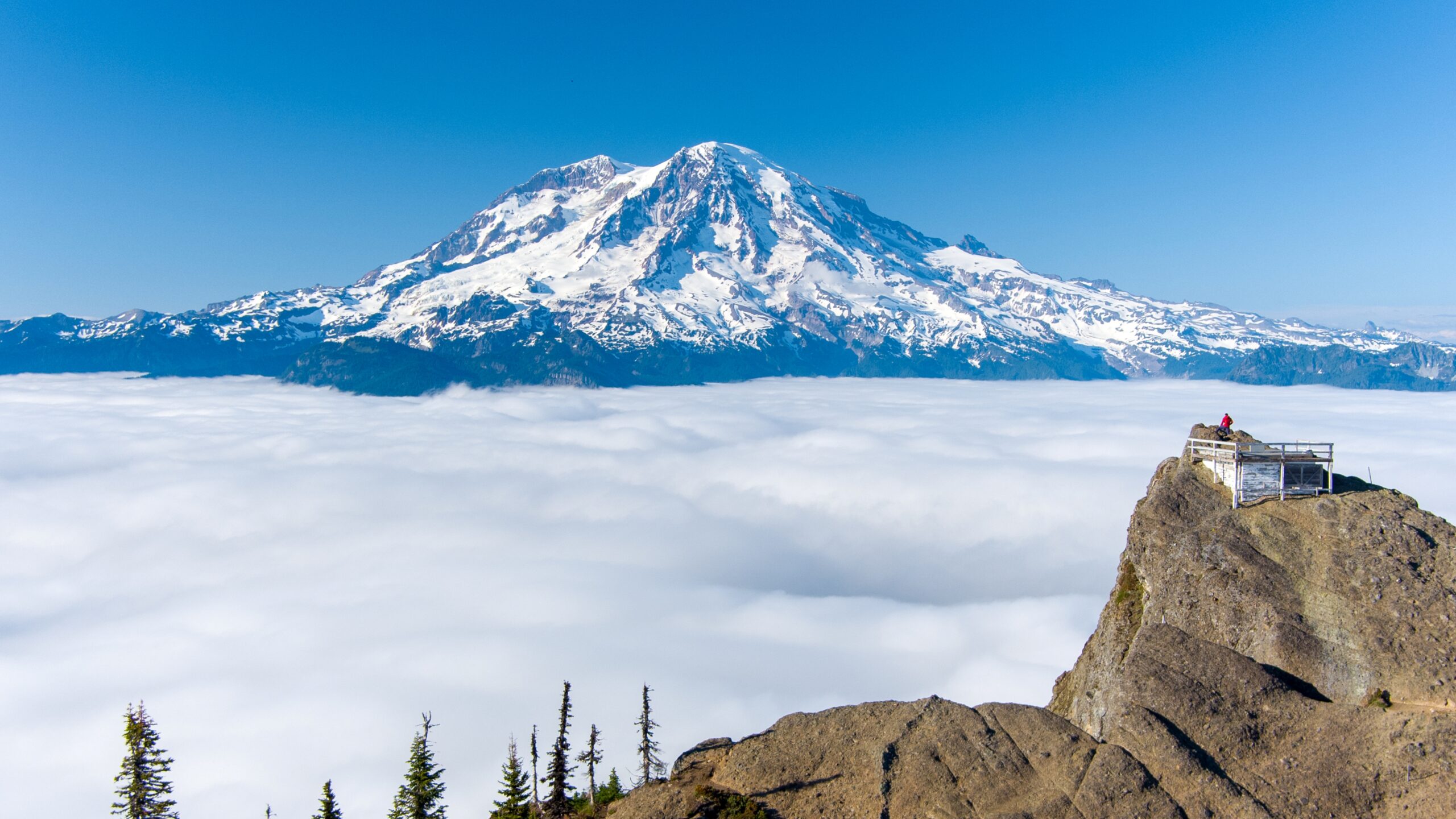
    Mount Rainier summit above cloud layer, snow-covered peak and rocky outcrop
    Mount Rainier is 14,411 ft (4,392 m), the most heavily glaciated peak in the contiguous US. This page tracks its season, with live weather below.
    Expedition Updates · Cascades

    Mount Rainier expedition update

    Where Rainier stands this season, plus the Disappointment Cleaver route, the NPS climbing permit, glacier hazards, and safety. A single-mountain page in our Expedition Updates directory. Elevations in feet (metres).

    Current status In season 14,411 ft (4,392 m)

    In season now. Peak summer conditions.

    Rainier’s climbing season runs late June through early September, and late July sits in the prime window. The standard Disappointment Cleaver route is being climbed and guided daily, though the exact line shifts week to week as crevasses open, so late-July conditions differ from late August.

    Rainier is a serious glacier climb, not a walk-up: a summit success rate near 50 percent, about 9,000 ft of gain, and its own violent weather. It is the classic first big glacier climb for American mountaineers, and the training ground for Denali and beyond.

    14,411 ft

    Summit (4,392 m)

    The most heavily glaciated peak in the contiguous US.

    Jun to Sep

    Climbing season

    In season now; the peak window is July and August.

    ~50%

    Summit rate

    Weather and crevasse conditions turn many teams back.

    Rainier rises alone above the Cascades southeast of Seattle, an active, ice-clad stratovolcano with more than two dozen glaciers. This page is the update view: where the mountain sits in its season, the route, and the rules that matter. For the full how-to on operators, cost, gear, and preparation, see our Mount Rainier climb guide and routes guide, and for the wider picture, the Expedition Updates dashboard.

    Current status and the season

    Where the mountain is today, and how the window works.

    Right now Rainier is in the heart of its season. Guide services are running Disappointment Cleaver programs daily, and independent teams are moving through Camp Muir for midnight summit pushes. The window runs from late June, once the upper mountain has consolidated, through early September, when opening crevasses, rockfall, and retreating snow bridges make the standard route harder and guide services begin winding down. The catch on Rainier is that the route is a living thing: the exact line through the Ingraham Glacier and over the Cleaver changes across the summer, so a report from late July is not a description of late August.

    Planning horizon. Reserve your climbing permit and any overnight camps through recreation.gov well ahead, and build glacier skills and fitness first. Start with our Rainier progression plan, fitness standards, and glacier travel basics.

    The Disappointment Cleaver

    The standard route, and the main alternative.

    Disappointment Cleaver (standard)

    From Paradise at 5,400 ft, the route climbs the Muir Snowfield to Camp Muir at 10,080 ft (3,072 m), where teams rest before a midnight start. Above Muir it crosses the Cowlitz Glacier, traverses the Ingraham Glacier, and climbs the rocky Cleaver rib to the upper mountain and the crater rim. Summit day is roughly 4,500 to 5,500 ft of gain. This is the most climbed and most guided line, and the exact path shifts as crevasses open through the season.

    Emmons Glacier (main alternative)

    On the northeast side, the Emmons-Winthrop route climbs from the White River trailhead to Camp Schurman, then up the broad Emmons Glacier. It is less crowded than the Cleaver and a fine objective for teams with solid glacier skills. For the full route breakdown, see the Mount Rainier routes guide.

    Climbers roped up on a glacier high on Mount Rainier
    Rainier is roped, crevassed glacier travel from Camp Muir up: crampons, ice axe, and rope-team skills are the price of entry.

    Weather and conditions

    Rainier makes its own weather. Here is a live read.

    Rainier is tall enough and close enough to the Pacific to generate its own storms, and the summit can be socked in while the lowlands are clear. Cloud caps over the peak are a classic warning sign. Even in peak season, a forecast window can close fast, which is one reason the summit rate stays near half. The live map below shows current wind and conditions for the massif; use it as a starting point and rely on the National Park Service ranger blog and a dedicated forecast for any real decision.

    Live wind and weather for the Mount Rainier massif. Source: Windy.com. For how to read it, see our mountain-weather guide.
    Mount Rainier, southeast of Seattle in the Washington Cascades. Map: OpenStreetMap contributors.

    For a fuller explanation of reading a mountain forecast, see mountain weather for climbers, and check avalanche awareness for climbers for early and late-season snow.

    Permits and access

    The NPS rules every Rainier climber works within.

    Mount Rainier is a national park, and climbing above the glaciers is permitted and reserved. A climbing permit is required for glacier travel or travel above about 10,000 ft, booked through recreation.gov, and overnight camps such as Camp Muir are managed through the wilderness reservation system. The permit funds the ranger and rescue program on the mountain.

    Mount Rainier climbing costs, 2026 (indicative; confirm current rates via recreation.gov).
    Item2026 cost
    Climbing permit (per climber)~$61
    Park entrance feeAdditional, per vehicle
    Guided Disappointment Cleaver program~$1,400 to $2,800

    What you need to climb

    • Climbing permit – reserved on recreation.gov for glacier travel or above ~10,000 ft.
    • Overnight reservation – Camp Muir, Ingraham Flats, or Camp Schurman via the wilderness system.
    • Glacier competence – crampons, ice-axe self-arrest, a rope team of three or more, and crevasse rescue.
    • A helmet – rockfall on the Cleaver is a real hazard, especially later in the day.

    Safety and hazards

    Why Rainier is respected, and where the risk sits.

    Rainier’s hazards are glacier and weather driven: crevasse falls, collapsing snow bridges, serac fall on the Disappointment Cleaver, rockfall as the day warms, avalanches early and late in the season, and storms that build fast. The mountain has caused around 100 deaths since 1897, averaging four to six climbers a year, and the 1981 serac collapse on the Cleaver killed 11, still the worst single mountaineering accident in US history. The protective habits are the usual ones: move early, rope up, carry rescue gear and know it, and turn around when the weather or the clock says so.

    âš  A glacier climb, not a hike

    Above Camp Muir, Rainier is crevassed glacier the whole way, with overhead serac hazard on the Cleaver. Roped travel and practiced crevasse rescue are non-negotiable, and helmets matter. This page is not medical or safety advice; build your skills with our glacier travel basics and acclimatization guides and a qualified guide.

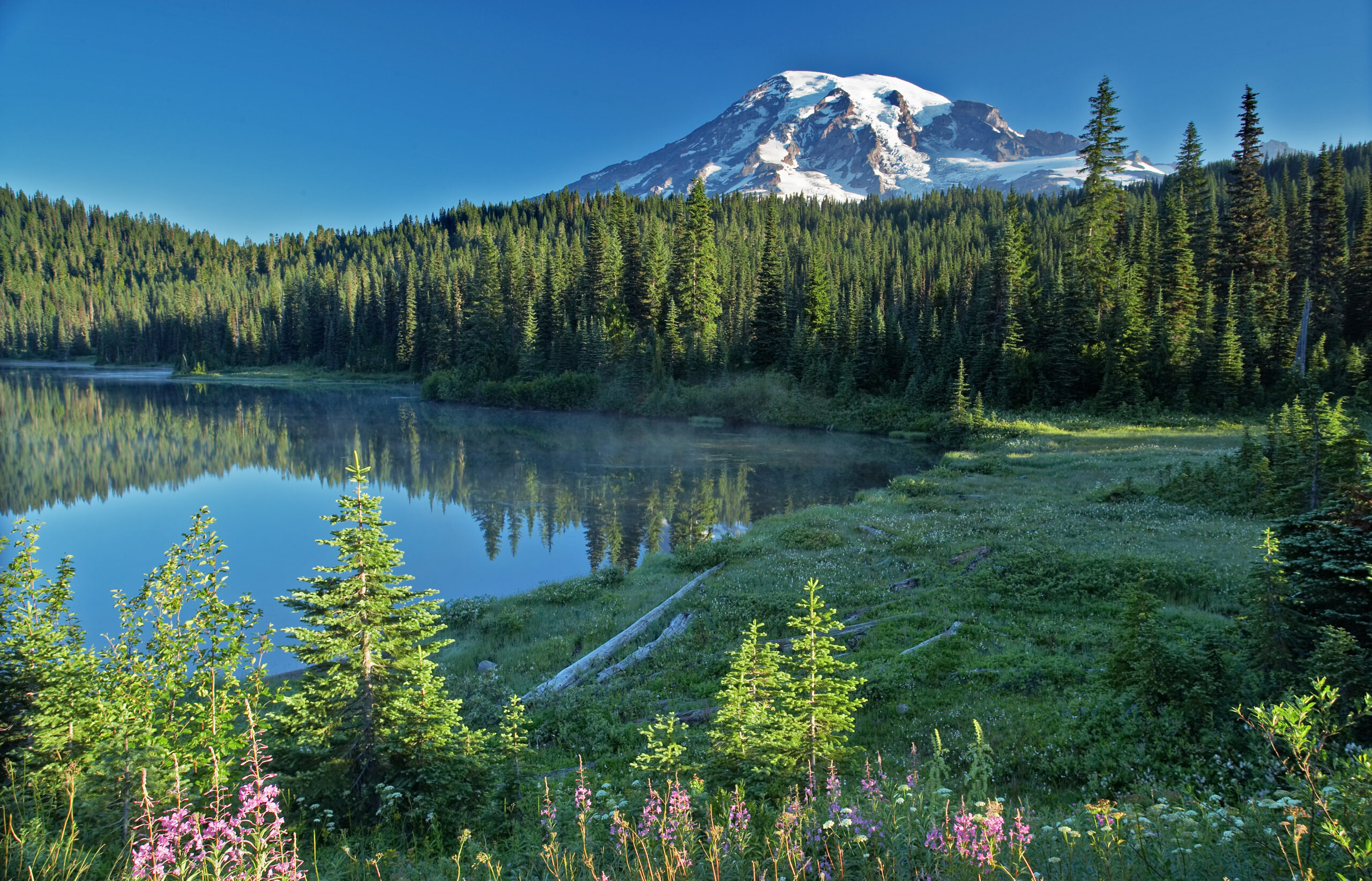
    Mount Rainier reflecting in a lake, surrounded by evergreen forest and alpine vegetation.
    Rainier stands alone above the Cascades and is the standard first big glacier climb for American mountaineers, and a proving ground for bigger peaks.

    Rainier by the numbers

    The context behind a single season, from grounded records.

    1870

    First verified ascent

    Hazard Stevens and Philemon Van Trump, August 17.

    ~9,000 ft

    Route gain

    Paradise to summit via Camp Muir and the Cleaver.

    25+

    Glaciers

    The most heavily glaciated peak in the contiguous US.

    Rainier is the standard training peak for bigger glaciated objectives. Our Rainier progression plan lays out the build-up, the Cascade Volcanoes collection covers its neighbours, and for climbers eyeing Alaska, Rainier is the classic step before Denali.

    Rainier update FAQ

    The questions climbers ask most about timing, permits, and conditions.

    When is the Mount Rainier climbing season?

    Late June through early September, with July and August the peak window, and the mountain is in season now. The Disappointment Cleaver line shifts through the summer as crevasses open and guides re-route, so conditions in late July differ from late August. Early and late in the season carry more avalanche and rockfall risk.

    Do I need a permit to climb Mount Rainier?

    Yes. A climbing permit is required for glacier travel or travel above about 10,000 ft, reserved through recreation.gov, and it runs around $61 per climber for 2026 plus the park entrance fee. Overnight camps such as Camp Muir are managed through the wilderness reservation system. Fees and reservation rules change, so confirm current details with the National Park Service.

    What is the standard route on Rainier?

    The Disappointment Cleaver, climbed from Paradise at 5,400 ft up the Muir Snowfield to Camp Muir at 10,080 ft (3,072 m), then across the Cowlitz and Ingraham Glaciers and up the Cleaver to the crater rim. It is the most climbed and most guided line. The Emmons Glacier via Camp Schurman is the main alternative on the northeast side.

    How hard is Mount Rainier to climb?

    It is a serious glacier climb, not a hike: roughly 9,000 ft of gain over about 15 miles round trip, with a summit success rate near 50 percent because weather and conditions turn many teams back. It demands crampons, practiced ice-axe self-arrest, rope-team travel, and crevasse-rescue skill, which is why it is the classic first big glacier climb for American mountaineers.

    Do I need a guide for Mount Rainier?

    First-time climbers are strongly advised to go with a guide service such as RMI, IMG, or Alpine Ascents, or with an experienced team. Guided Disappointment Cleaver programs run three to five days and cost roughly $1,400 to $2,800, including guiding, group gear, and hut access. Independent climbers need proven glacier skills and their own rescue capability.

    What is the current status of Rainier?

    As of late July the 2026 season is in full swing and the mountain is in season. Conditions on the Disappointment Cleaver change week to week as crevasses open through the summer. Check the National Park Service ranger climbing blog and the Northwest Avalanche Center, plus this page, before you commit to a plan.

    📋 How this update is built

    This page is compiled by Travis Ludlow, Founder and Head of Research at Global Summit Guide, from US National Park Service data, the ranger climbing blog, and published season reporting, with sources named below. It was reviewed for safety by Dawson Ludlow, our Climbing & Mountaineering Lead (Wilderness First Aid), whose highest first-hand summit is Kilimanjaro. Where our team has no first-hand experience of Rainier, we report the cited records rather than personal anecdote, and we confirm fees and rules against the NPS.

    Sources and further reading

    • US National Park Service, Mount Rainier – climbing permits, the ranger climbing blog, and route conditions.
    • Recreation.gov – Mount Rainier climbing permit and wilderness camp reservations.
    • Northwest Avalanche Center – Cascade snowpack and avalanche forecasts.
    • Our own Mount Rainier climb guide and Mount Rainier routes guide.
    • We report published figures and named sources rather than posting unverified live conditions.

    Planning a Rainier climb?

    Start with the full Mount Rainier climb guide, work through the Rainier progression plan, and read how to choose an expedition operator before you book a guide service. For flights and lodging around Seattle and Ashford, browse travel on Expedia.

    Disclosure: the Expedia link above is a sponsored affiliate link. We may earn a commission at no extra cost to you.

    Was this helpful?

    Yes
    No
    Thanks for your feedback!
Language »