
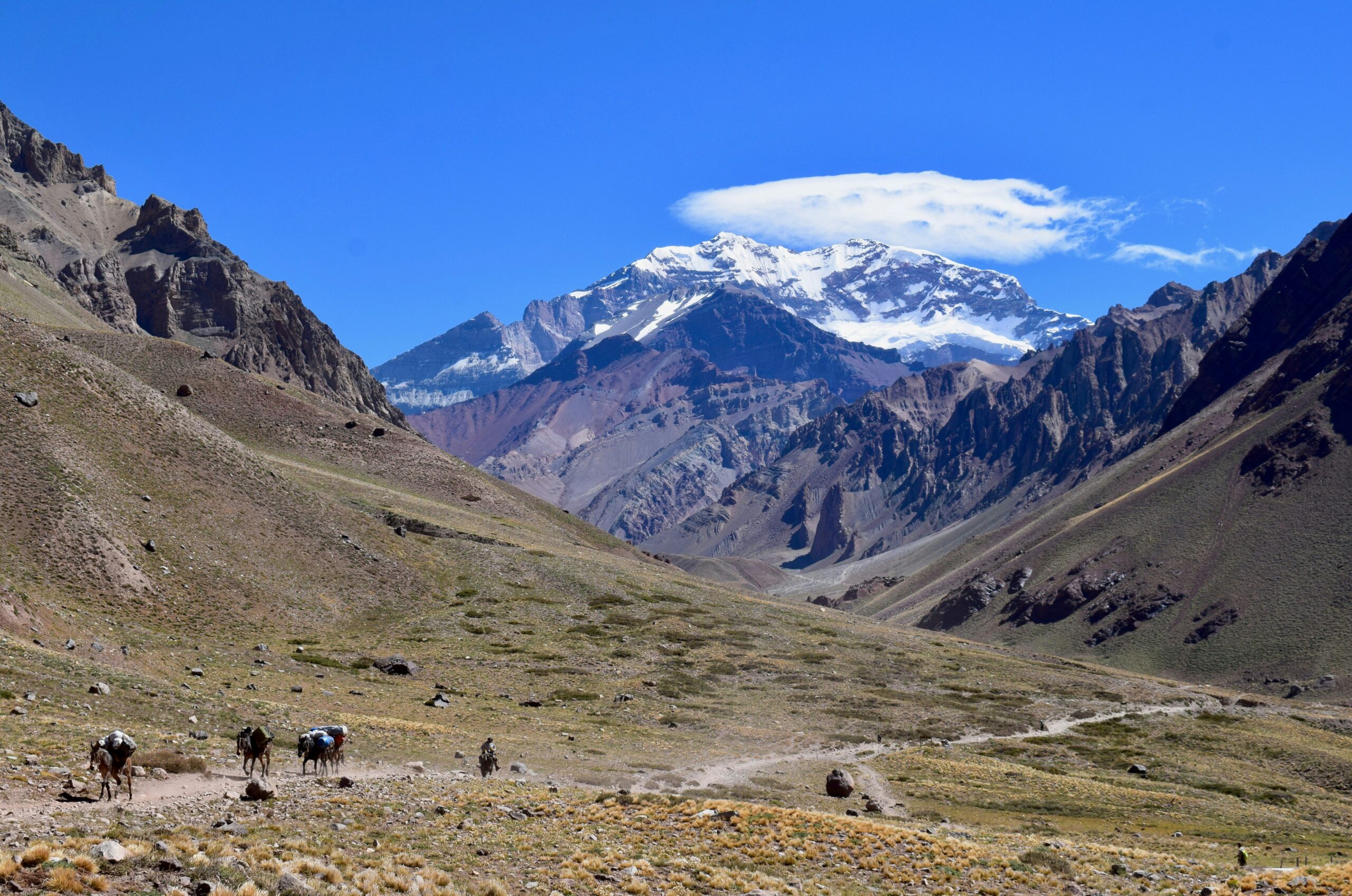
Aconcagua vs Denali: which should you climb after your first 6,000m peak?
After Kilimanjaro and a first 6,000m peak, the next decision in a 7-Summits progression is Aconcagua or Denali. The two mountains feel similar in a list. Both are non-technical by their standard routes. Both are roughly 18-21 day expeditions. Both require serious cold-weather skills. The reality is that they are different climbs with different demands, and the right one depends on what you’ve already done and where you want to end up. We summited Aconcagua in January 2024 with a team of four. Three of those climbers went on to attempt Denali. Two summited. The difference between the two mountains turned out to be larger than the planning literature had prepared us for. The full peak-by-peak progression context lives in our Seven Summits guide, with foundational decision criteria in our master mountaineering hub.
Head to head at a glance
Aconcagua
The altitude exam. A long, exposed, cold trek that tests whether your body works above 6,000m for three weeks.
Denali
The expedition exam. Sub-arctic cold, glacier travel, sled hauling, and full self-support from a Kahiltna landing.
The honest reality: these are not equivalent peaks
The full 7-Summits sequencing rationale lives in our master mountaineering hub. Aconcagua and Denali get bracketed together because they sit near each other on a 7-Summits checklist. They are next to each other in altitude. They are both standard-route non-technical. They both run roughly three weeks. Looking at it that way, they look like substitutes. They are not. Aconcagua is a high-altitude trek with cold weather and self-supported expedition logistics. Denali is a sub-arctic mountaineering expedition that happens to have an altitude challenge. The skills and conditions overlap by maybe 40 percent.
Six axes of comparison
Altitude exposure
Aconcagua higherHigher summit at 6,961m. Climbers spend 5-7 nights above 5,000m, multiple nights at 5,500m+. The altitude challenge is the dominant difficulty. Symptom progression detailed in our altitude sickness guide.
Lower summit at 6,194m, but Denali sits at 63 degrees north. The “physiological altitude” feels closer to 7,300m due to atmospheric thickness changes near the poles. Three to four nights at 5,200m to 5,700m.
Technical demand
Denali harderNon-technical Normal Route. Confident crampon use on the Canaleta and ice axe self-arrest skills required, but no rope work, no glacier travel, no crevasse exposure. Most climbers can prepare adequately on Cascade volcanoes.
Technical glacier travel from the Kahiltna landing onward. Roped travel, crevasse rescue skills, sled hauling, snow anchor construction. Real mountaineering skills. Most operators require demonstrated competence before accepting climbers.
Cold and weather
Denali colderCold at high camps reaches -25°C to -30°C. Summit night windchill commonly -35°C. Famous Viento Blanco can shut the mountain down for 3-5 days. Detailed in our frostbite prevention guide.
Sustained cold of -30°F to -40°F (-34°C to -40°C) at high camps. Summit-night windchill can reach -60°F to -80°F. The Alaska Range generates its own weather; teams commonly hold for 7-10 days at 14,000-foot camp waiting for windows.
Self-support requirements
Denali heavierMules carry duffels to Plaza de Mulas at 4,300m. Above base camp, climbers carry 35-50 lb in coordinated team rotations. Camps are pre-built or shared with other teams. Operator dining tents at base camp.
Climbers haul sleds from the Kahiltna landing strip at 7,200 feet. All gear, food, fuel, and waste carried up and down by the team. No outside support above the landing. The expedition is more self-supported than any other 7-Summit.
Cost
Denali costlierGuided expeditions run 5,500 to 9,500 USD. Permit fees during high season run 800-1,000 USD. Total trip cost from a North American departure typically lands at 9,500-13,000 USD. Cost framework in our mountain climbing costs reference.
Guided expeditions run 8,500 to 12,500 USD. National Park permit is 405 USD. Total trip cost typically lands at 12,000-16,000 USD. Gear delta from an Aconcagua kit is modest but technical climbing gear adds 600-1,200 USD.
What it teaches
Different skillsTolerance to sustained altitude above 6,000m. Self-supported high-camp logistics. Cold-weather camp craft. Weather decision-making. Whether your body works at expedition altitudes for 3 weeks at a time.
Sub-arctic survival skills. Glacier travel, crevasse rescue, sled hauling. Multi-week cold tolerance. Storm-bound camp psychology. Whether you have the skills and durability for the most demanding non-Himalayan mountaineering.
Side by side at full detail
Climbers approaching this decision benefit from reading both peaks’ detailed planning guides side by side. The master mountaineering hub indexes them.
| Factor | Aconcagua | Denali |
|---|---|---|
| Summit altitude | 6,961m / 22,838 ft | 6,194m / 20,310 ft |
| Latitude effect | Tropical Andes (-32° S) | Sub-arctic (63° N) |
| Trip length on mountain | 18-21 days | 18-21 days, often 24+ with weather holds |
| Total trip from N. America | 21-26 days | 24-32 days |
| Technical demand | Crampons, ice axe, no rope | Roped glacier, crevasse rescue, sled, anchors |
| Cold range at high camps | -25°C to -30°C | -34°C to -40°C |
| Self-support level | Mules to base camp, climbers carry above | Sleds from landing, full self-support |
| Success rate (guided) | 50-60% | 65-75% |
| Cost (guided) | $5,500-9,500 | $8,500-12,500 |
| Total trip cost | $9,500-13,000 | $12,000-16,000 |
| Best season | December to February | May to early July |
| Required prior experience | Kilimanjaro or 5,000m+ peak | Glacier school + 5,000m+ peak |
Five reader profiles
You’ve done Kilimanjaro and one 5,000m peak
You need altitude tolerance proven before adding glacier travel and sub-arctic cold. Aconcagua first, Mount Rainier glacier school in between, then Denali 12-18 months later.
You have extensive Cascade volcano and glacier experience
Even with strong technical skills, the altitude variable above 6,000m is real and unproven. Aconcagua gives you that data point before Denali adds back the technical layer.
You’re committed to the full 7-Summits including Everest
Both, in this order: Aconcagua first, then Denali, then Everest. Each peak builds the specific skill the next one requires. The chain is optimal.
You have limited time and want to do one of the two
Aconcagua. The cost is lower, technical prerequisites smaller, and success probability with a quality operator is reasonable. Denali requires a year of preparatory work for climbers without prior glacier experience.
You want to be tested at the highest level of non-Himalayan mountaineering
Denali. With proper preparation. The mountain is harder, colder, and more demanding than any 7-Summit short of Everest. Required gear at the highest end of any non-Himalayan expedition. See our complete gear list and boots guide.
Aconcagua first for 75% of climbers
The altitude exam comes before the expedition exam. Aconcagua proves your body works at 6,961m, which is the largest unknown variable in the 7-Summits progression past Kilimanjaro. Denali after, with a Mount Rainier glacier school in between. The full progression framework lives in the master mountaineering hub. The other 25 percent are climbers with significant existing winter mountaineering experience who can credibly skip Aconcagua, and climbers who specifically want the Denali experience as their next major climb.
What climbing each peak feels like
Aconcagua feels like a long, exposed, cold hike that gradually reveals itself as a real mountain. The first ten days are a slow grind through acclimatization rotations. Summit night is a 12-hour test of altitude tolerance and willpower. The Canaleta in the final 200m is the hardest single hour. Cold injury risk is real but manageable with proper kit covered in our layering systems guide. Most failed climbs come from compressed schedules, weather windows that close, or climbers who pushed too fast in early rotations and never recovered. Our January 2024 Aconcagua trip report covers the actual day-by-day reality, with the most common failure pattern in our Camp 2 mistake guide.
Denali feels like an Arctic expedition that happens to climb a mountain. You drag a 60-pound sled for the first week. You build snow walls around your tents because the wind comes in fast and stays for days. You sleep at camps that disappear under fresh snow overnight. The summit ridge is exposed and serious. The cold is the thing climbers underestimate most consistently. Most failed Denali climbs come from weather windows, frostbite forcing turn-around, or teams running out of time after extended camp holds. The acclimatization framework that ties Aconcagua, Denali, and Everest together is foundational reading.
Continue your research
Detailed peak-specific guides for both mountains: our Aconcagua routes guide and our Denali climbing guide. Our broader 7-Summits planning context is in the Seven Summits guide. The introductory comparison for first-time climbers is our Kilimanjaro vs Aconcagua guide. The bigger climb path toward Everest is laid out in our Everest climbing guide, with Everest cost detail in our Everest cost breakdown and route comparison in our South Col vs North Ridge guide.
Get the complete 7-Summits planning framework
Operator selection, training timelines, gear lists, permit logistics, and the full 7-Summits progression in one hub.
Visit the Master Hub →Common questions about Aconcagua vs Denali
Should I climb Aconcagua or Denali first?
For most climbers, Aconcagua first. It teaches altitude tolerance up to 6,961m without requiring crevasse rescue, sled hauling, or technical glacier travel. Denali demands all of those skills plus 21+ days at sustained cold of -30°F to -40°F. Climbers who do Aconcagua first arrive at Denali with the altitude tolerance already proven.
Is Denali harder than Aconcagua?
Yes, in nearly every measurable way except summit altitude. Denali tops out at 6,194m versus Aconcagua’s 6,961m, but Denali sits at 63 degrees north which makes its weather, cold, and altitude effects dramatically harsher. Denali requires technical glacier travel, crevasse rescue skills, sled hauling between camps, and tolerance for sustained -30°F to -40°F cold.
What’s the success rate on Denali?
Denali success rates run 50-60% across all climbers, with quality guided expeditions reaching 65-75%. The numbers are higher than Aconcagua’s 30-40%, which surprises climbers who think Denali is harder. The reason is route discipline. Most Denali expeditions take 18-21 days with extensive acclimatization, while many Aconcagua climbers compress their itinerary and fail.
How much does Denali cost?
A guided Denali expedition runs 8,500 to 12,500 USD. Add 1,500 to 2,500 USD in flights to Anchorage and Talkeetna, the 405 USD National Park permit, gear costs, and tipping. Total trip cost typically runs 12,000 to 16,000 USD. The cost is roughly 30-40% above a comparable Aconcagua expedition.
Do I need glacier travel skills for Denali?
Yes. Denali requires confident roped glacier travel, crevasse rescue (Z-pulley systems, prusik ascending, ice axe arrest), and team self-rescue protocols. Most quality operators require demonstrated competence via prior expeditions or accredited training courses before accepting registration.
What does the typical climber do between Aconcagua and Denali?
The most common bridging step is Mount Rainier in Washington for glacier school and a guided summit. Many climbers also build mileage on Cascade volcanoes (Hood, Adams, Baker). The bridge takes 8-12 months and 3,000 to 5,000 USD.
How long is each climb?
Aconcagua expeditions run 18-21 days on the mountain with 21-26 days door-to-door. Denali runs 18-21 days on the mountain but requires a flight to Talkeetna and a glacier landing on the Kahiltna, plus weather hold days that can extend the trip by 5-10 days. Total Denali trip length: 24-32 days.
Leave a Reply