
Patagonia in 10 days: Torres del Paine, Perito Moreno, and Mount Fitz Roy
We had been talking about Patagonia for years before we actually booked it. The reality of getting there from Salt Lake City is what keeps most people away: it takes nearly 24 hours of flying to land in Punta Arenas, and the trip needs to be at least 8 days to justify the travel. We carved out 10 days at the end of March 2025, picked up Taylor and Helena in Santiago on Day 3, and ran the Chilean and Argentine highlights back to back: Torres del Paine for two days, Perito Moreno glacier, then Mount Fitz Roy from El Chaltén. This is the unedited trip report. What we actually paid, what we wish we had done differently, and the moment at Laguna de los Tres that none of us will forget. The broader expedition context for South American climbing lives in our master mountaineering hub, with the Andes climbing arc in our Aconcagua routes guide.
The route at a glance
Patagonia is two countries: Chilean Patagonia (Torres del Paine, Puerto Natales, Punta Arenas) and Argentine Patagonia (El Calafate, Perito Moreno, El Chaltén, Mount Fitz Roy). The standard 10-day trip works one country at a time, crossing the border at Cancha Carrera between Days 5 and 6. We flew into Santiago, transferred south to Punta Arenas the same day Taylor and Helena landed (Day 3), drove 2.5 hours to Puerto Natales, spent 2 full days in Torres del Paine, drove 3.5 hours across the Argentine border to El Calafate on Day 6, ran Perito Moreno on Day 7, drove 3 hours to El Chaltén for Day 8, then reversed back to Punta Arenas and Santiago for the return. Total ground covered: roughly 1,400 km of driving, two international border crossings, and four national parks.
If you only have a week, pick one country. The Chile-only version (Torres del Paine focus) is roughly 7 days and skips El Calafate and Fitz Roy. The Argentina-only version (Perito Moreno plus El Chaltén) is also 7 days and skips Torres del Paine. Doing both in under 10 days is possible but feels rushed. Ten days was the right amount of time for our group, with one buffer day for weather or fatigue.
Phase 1: getting there (Days 1-3)
Salt Lake City to Santiago, Chile
The LATAM nonstop from Salt Lake to Santiago is the cleanest US-Patagonia routing if you live in the Mountain West. It is an 11-hour overnight flight that lands at 6:40 AM the next morning, putting you on the ground with most of Day 2 still ahead. We left SLC on Friday, March 28 at 11:35 AM and landed in Santiago at 6:40 AM Saturday morning. We had pre-booked the Holiday Inn Santiago Airport for an early check-in so we could clean up and grab a few hours of horizontal sleep before exploring.
Recovery day in Santiago
We took the Day 2 buffer instead of trying to push straight to Patagonia. After the overnight flight, the smart play is to use the half-day to walk around Santiago (Plaza de Armas, Cerro San Cristóbal, the Bellavista neighborhood) and reset your sleep cycle before heading south. The Holiday Inn Santiago Airport made airport return easy the next morning. We slept early to be ready for the Day 3 departure to Punta Arenas.
Santiago to Puerto Natales
Taylor and Helena landed in Santiago at 8 AM after their overnight flight from Salt Lake. We met at the gate, grabbed lunch at the airport, and flew LATAM to Punta Arenas (PUQ) departing at 12:40 PM. The flight is a one-stop, just under 5 hours total. Punta Arenas is the southernmost city of Chile and the gateway to Torres del Paine. We picked up the rental VW at the airport (booked through Expedia for the week), grabbed dinner at La Forastera Burgers in Puerto Natales (closes at 9:30 PM), stopped at the local grocery store for breakfast and lunch supplies, and checked into our Airbnb in Puerto Natales.
The 2.5-hour drive from Punta Arenas to Puerto Natales runs through open Patagonian steppe. Guanacos grazing along the road, the occasional rhea, and very little traffic. The terrain feels like Wyoming high plains turned up to a different scale. We arrived in Puerto Natales just before sunset and the light over Lago Sofía was the first proper “we are in Patagonia” moment of the trip.
Phase 2: Torres del Paine (Days 4-5)
Base Torres Hike: the three towers
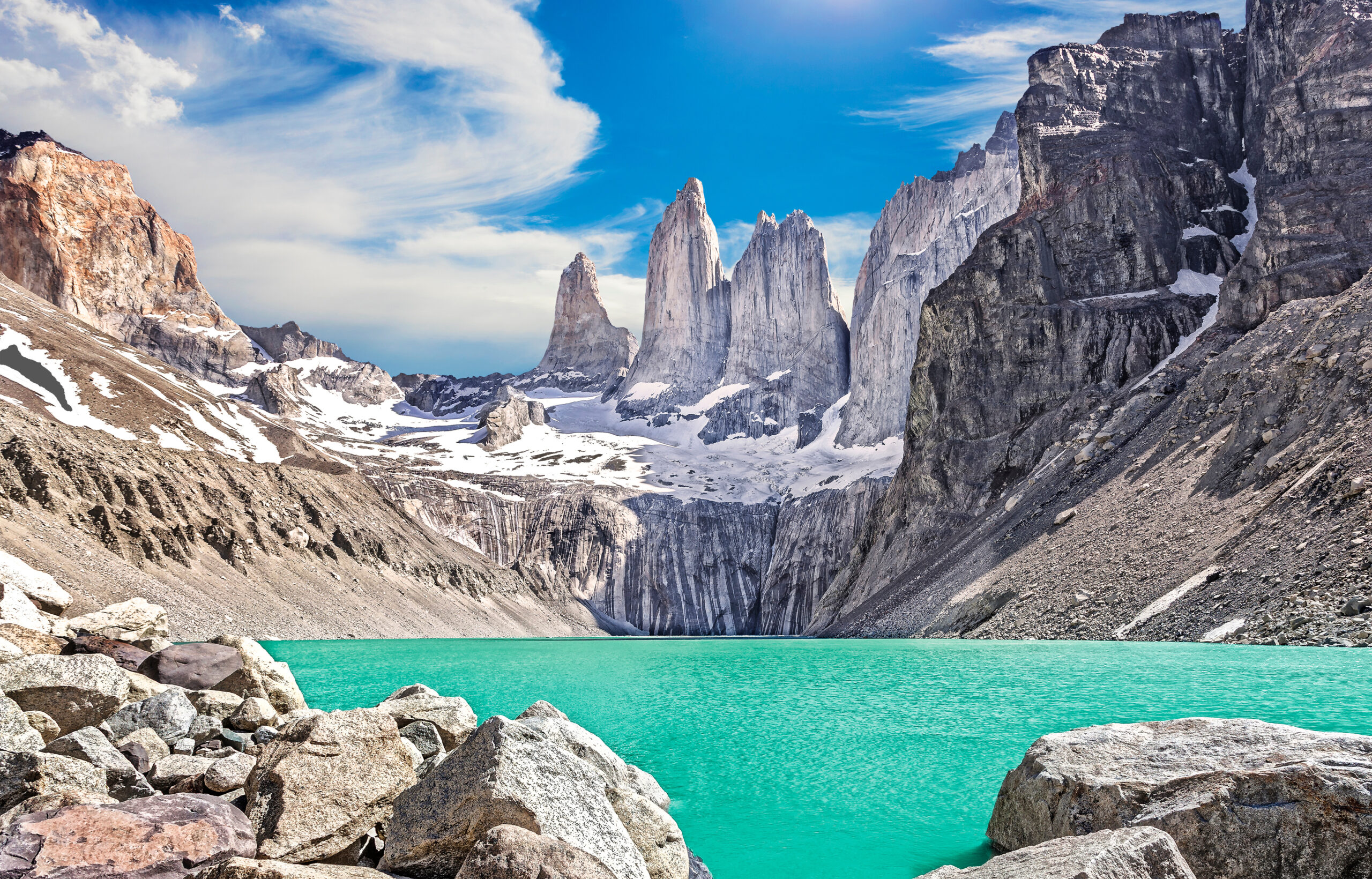
This was the hike we had come for. The Base Torres trail starts at the Hotel Las Torres parking area (1.5-hour drive from our Airbnb in Puerto Natales, including the park entry on the 3-day pass we had bought online). The hike is roughly 20 km round trip with 800 meters of elevation gain. The first two-thirds is moderate climbing through Patagonian beech forest along the Ascencio river. The final hour is a steep rock and boulder scramble up to the lake at the base of the towers. The payoff is one of the most photographed views on the planet, and it earns its reputation.
We started at 7:30 AM, hit the lake around 11:30 AM, spent 90 minutes at the towers, and were back at the car by 4 PM. The wind on the final scramble was strong enough that we hunched against the gusts on the way up. The towers themselves emerged from morning cloud cover at the exact moment we crested the final ridge, which felt cinematic in a way we did not deserve. The three granite spires (Torre Norte, Torre Central, Torre Sur) rising vertically out of the lake do not photograph the way they feel in person. The scale is the part that surprises everyone.
We had been climbing for four hours, mostly looking at our feet on the final scramble. Then the trees opened, the wind hit us square, and the three towers were just there. Right there. No filter, no edit, no zoom. The kind of view that makes you sit down on a rock for ten minutes before you can talk about anything else.
The descent was harder than the ascent on the knees. We were grateful for poles. Back in Puerto Natales by 6 PM, we ate at a restaurant on Avenida Manuel Bulnes and were asleep by 9. The full Torres del Paine route framework and the broader peak-by-peak hiking arc lives in our mountaineering for beginners guide, our expedition gear list, and the multi-day trek preparation framework in our EBC and trekking training plan. The cross-region mountain travel context lives in our master mountaineering hub.
Grey Glacier boat excursion
The Grey Glacier boat tour through Fiordos del Sur was the right Day 5 choice. It is a 2-hour drive from Puerto Natales to the boat dock at Lago Grey, then a 3-hour boat journey across Lago Grey to the glacier face. The boat costs about 100 to 110 USD per person and you book online ahead of time. We saw icebergs floating in the lake on the inbound leg, watched the boat thread between bergs the size of houses, and reached the 30-meter ice wall at the glacier face about 90 minutes in. The crew handed out whiskey on the rocks (literal glacier ice in the glass) and we stood on deck in the cold wind for the better part of an hour just watching.
The drive back to Puerto Natales runs through the heart of the park. We stopped at the Mirador Salto Grande for the waterfall view, drove past Lago Pehoé and Lago Nordenskjöld, and hit the Mirador Condor overlook for a panoramic view of the Paine Massif at sunset. The Paine Horns, the dark sedimentary spires that the park is famous for beyond the Towers, are unreal in late-afternoon light. By the time we got back to Puerto Natales for dinner, we had spent nearly 12 hours seeing the park from a different angle than Day 4, and it felt complete.
Phase 3: crossing into Argentina (Days 6-8)
Puerto Natales to El Calafate
The drive from Puerto Natales to El Calafate runs through the Cancha Carrera-Cerro Castillo border crossing between Chile and Argentina. Plan for 60 to 90 minutes at the border on top of the driving time. The actual paperwork is straightforward for US citizens (no visa for either country, just stamps in and out), but the queues can be slow and the two countries each have separate posts on either side of the dirt road. We left Puerto Natales at 8 AM, cleared both borders by 11 AM, and rolled into El Calafate around 1 PM.
El Calafate is a tourist town built around Perito Moreno tourism. The main street, Avenida del Libertador, has restaurants, gear shops, and tour offices. We checked into our El Calafate Airbnb, explored the main strip, ate dinner at one of the parrilla restaurants, and called it an early night to be ready for the Perito Moreno full-day on Day 7.
Perito Moreno Glacier full day
Perito Moreno is the headline attraction of Argentine Patagonia and it earned the billing. The glacier is one of the only major glaciers in the world that is still advancing rather than retreating, and the calving events (where house-sized chunks break off the 70-meter ice face) happen every 30 to 60 minutes during daytime. We drove from El Calafate at 8 AM, reached the park entrance gates around 9:30, and spent the next 5 hours on the boardwalk system that gives you multi-angle viewing of the glacier face.
The Nautical Safari boat tour (around 90 USD per person, also booked through the official site) takes you within 200 meters of the south face of the glacier. The boat journey is about 1 hour. We stood on the deck the entire time, listened to the ice crack like artillery, and watched a piece the size of a small apartment building fall into the water in front of us. The wave it made traveled across the entire channel and rocked the boat noticeably ten seconds later. We were back at our Airbnb in El Calafate by 7 PM.
The cracking sound is what surprises you. Not a chunk falling, just the ice itself flexing under its own weight. Like a building working in a thunderstorm. You stand there long enough, you start to hear the glacier as a living, breathing thing rather than a postcard image.
Laguna de los Tres at Mount Fitz Roy
The 3-hour drive from El Calafate to El Chaltén runs along Ruta 40 with the Southern Patagonian Ice Field on the horizon for the last hour. El Chaltén is a small mountain town at the trailhead for Mount Fitz Roy and Cerro Torre. We arrived at 9 AM, parked at the southern trailhead, and started the Laguna de los Tres hike at 9:30. The trail runs 12 km one-way through forest, then opens onto an exposed Patagonian valley, and finishes with the most brutal final climb of the entire trip: roughly 400 meters of vertical gain in the last 1.5 kilometers, on loose rock and scree, almost straight up to the lake at the base of Fitz Roy.
The view at the top is the reason we came. Mount Fitz Roy is one of the most dramatic mountain spires on Earth, a vertical granite tooth rising 1,500 meters above the Laguna de los Tres lake. The three peaks (Aguja Saint Exupery, Fitz Roy itself, and Aguja Poincenot) form a continuous ridge that looks impossible to scale. On a clear day the reflection in the lake doubles the drama. We had two hours of clear weather before clouds rolled in, which was enough.
Dawson opened his mission call at the lake. We had carried the envelope all the way up from El Chaltén, sealed and folded in his pack, waiting for the moment. With Fitz Roy reflected in the water behind him and our group standing around in the wind, he read the assignment out loud. The kind of moment that makes a place mean something for the rest of your life.
The descent took us four hours. We were back at the car by 6 PM, drove the 3 hours back to El Calafate, and rolled into the Airbnb around 9:30 PM. Easily the longest single day of the trip but the highest-payoff hike of the ten days. The full peak-by-peak hiking framework that prepares climbers for days like this is detailed in our high-altitude training program, with the cold-weather kit context in our layering systems guide.
Phase 4: the return (Days 9-10)
El Calafate to Punta Arenas to Santiago
We left El Calafate at 8 AM, drove back through the Cancha Carrera border (90 minutes total this direction), reached Puerto Natales for lunch, and drove the final 2.5 hours to Punta Arenas to drop the rental car. The 5:10 PM LATAM flight from Punta Arenas to Santiago lands at 8:35 PM. From Santiago, we caught the 11:05 PM LATAM flight back to Salt Lake City. A long travel day, but the only one of the trip where every hour was transit rather than experience.
Landing in Salt Lake City
The LATAM flight from Santiago arrived in Salt Lake City at 1 PM on Sunday. Total trip time door to door: 10 days. We were home before dinner with photographs we still look at every week, a rental car in our driveway that needed unloading, and a sense that we had done Patagonia about as efficiently as a 10-day itinerary allows.
What it actually cost us
Total: roughly $2,800 to $3,200 per person for 10 days. The breakdown below is what we actually paid for our group of family and friends, with a shared rental car and shared Airbnbs distributing the lodging cost. Solo travelers should expect to pay 30-40% more on lodging and transport. Couples land in the same per-person range as our group of 5.
| Line item | Per person | What it covered |
|---|---|---|
| International airfare (LATAM SLC-SCL) | $1,483 | Round trip, direct nonstop |
| Domestic flight (Santiago-Punta Arenas) | $297 | LATAM, one stop, ~5 hours |
| Airbnb lodging (shared, 7 nights) | $361 | Puerto Natales + El Calafate |
| Rental car (VW, shared 5 ways, 6 days) | $166 | Punta Arenas pickup and return |
| Torres del Paine 3-day pass | $50 | pasesparques.cl online |
| Grey Glacier boat tour | $105 | Fiordos del Sur 3-hour boat |
| Perito Moreno Nautical Safari | $90 | Boat tour to glacier face |
| Los Glaciares NP entry (2 days) | $40 | El Chaltén + Perito Moreno |
| Food, snacks, dinners (10 days) | ~$350 | Mix of groceries and restaurants |
| Hotel night in Santiago + transit incidentals | ~$90 | Holiday Inn airport |
| ALL-IN PER PERSON | ~$3,030 | 10-day trip total |
The two biggest cost levers are international airfare (40-50% of the total) and group size (the rental car and lodging savings from sharing 5 ways were significant). If you can find shoulder-season airfare under $1,200, or if you travel as a group of 4-6, your per-person all-in can drop to $2,500. Going solo or paying peak summer airfare can push it past $4,000. The broader expedition cost reference framework lives in our mountain climbing costs guide, and the comparable South American expedition cost in our Aconcagua cost breakdown.
What we would do differently
Five honest takeaways from our trip that we wish someone had told us before we booked:
- Start the Base Torres hike earlier. We started at 7:30 AM and that was good. Hikers who start at 9 AM hit the final scramble in the heat of the day and run out of time for photographs. The towers light up best in the morning. Aim for a 7 AM start at the trailhead.
- Build in a weather buffer day. We were lucky. The weather held for both Torres del Paine and Fitz Roy days. The standard pattern is roughly 60% of days have good visibility on the Towers and 40-50% on Fitz Roy. If we had hit two consecutive cloudy days, our highlights would have been cancelled. Future trips, we would build in one extra day in each location as weather buffer.
- Pack for wind, not just for cold. Patagonia is windy in a way that surprises Mountain West hikers. Wind chill on the Base Torres scramble was meaningfully colder than the temperature alone suggested. Bring a windproof shell layer even if the forecast looks mild.
- Do not skip the Grey Glacier boat. A surprising number of trip reports skip this in favor of more hiking. It is genuinely one of the highlights of the trip. The boat tour gives you a perspective on the Patagonian Ice Field that you cannot get from any trail.
- Stay in El Chaltén overnight for Fitz Roy. We day-tripped from El Calafate and it worked, but driving 3 hours each way on Day 8 with the Laguna de los Tres climb in the middle was punishing. If we had built one more night into the itinerary and stayed in El Chaltén, we could have done the hike fresher and had time for a second hike (Laguna Capri or Cerro Torre viewpoint).
Weather and what we actually packed
Late March is the beginning of Southern Hemisphere autumn in Patagonia. Daytime highs in Torres del Paine and El Chaltén ran 8 to 14°C (mid 40s to high 50s Fahrenheit). Nights dropped to 0 to 4°C in the parks, slightly warmer in the towns. The wind was constant, especially on Day 4 at the Base Torres viewpoint and on Day 8 above tree line near Laguna de los Tres. Rain showed up exactly twice on our 10 days and never enough to cancel anything.
What we packed and used heavily: lightweight wool base layers (top and bottom), a midweight fleece, a windproof shell jacket, water-resistant hiking pants, gloves and a warm hat for the Base Torres scramble, leather hiking boots that were already broken in (not the lightweight trail runners some people recommend; the rocks and roots punish thin soles), trekking poles for the descents, a 35L day pack, a 1L water bottle plus 1L collapsible refill, sun glasses and high-SPF sunscreen (UV is intense even in autumn), and a phone with offline maps from Maps.me downloaded for the Torres del Paine and Los Glaciares park areas. The full gear breakdown that applies to trips like this is in our expedition gear list, our mountaineering boots guide, and our trekking poles guide.
Patagonia in the broader South American climbing arc
Patagonia is not Aconcagua. The two regions get conflated by climbers planning their first South American trip, and they should not be. Patagonia is a hiking, glacier, and photography destination with technical climbing reserved for the world’s best mountaineers (Fitz Roy, Cerro Torre, Torres del Paine main faces are not commercial peaks). Aconcagua is a high-altitude expedition climb on a non-technical route. A 10-day Patagonia trip is the right introduction to South American mountain travel for hikers and photographers. Aconcagua is the introduction to South American high-altitude expedition climbing for mountaineers. Many climbers do both across multiple trips. Our team’s Aconcagua experience is in our Aconcagua summit trip report, with the route framework in our Aconcagua routes guide and the cost breakdown in our Aconcagua expedition cost breakdown.
The decision logic for picking between a Patagonia trip and an Andes expedition like Aconcagua is essentially: how much altitude exposure, technical mountaineering, and commitment are you ready for? Patagonia is the lower commitment with photography-grade payoff. Aconcagua is the higher commitment with 7-Summits resume payoff. Both are worthwhile. The bigger 7-Summits framework that puts both in context lives in our Seven Summits guide, our Kilimanjaro vs Aconcagua first-7-summit framework, and the entry-point trekking option in our Kilimanjaro climbing guide. The cross-peak peak progression reference lives in our conquer-peaks mountaineering hub.
The bottom line on a 10-day Patagonia trip
If you have the budget and you have 10 days, do Patagonia. It is the most photogenic mountain region we have visited, the autumn shoulder season is the ideal time to go, and the logistics work cleanly from the Mountain West with the LATAM direct routing. Plan for at least one weather buffer day, start hikes early, do not skip the Grey Glacier boat tour, and consider staying overnight in El Chaltén for the Fitz Roy day. The full peak-by-peak travel framework that places this trip alongside other major mountain travel destinations lives in our master mountaineering hub, with the broader expedition planning context across the global mountain ranges in our mountaineering for beginners guide.
Plan your next mountain trip
Routes, training timelines, gear lists, cost frameworks, and trip reports from every major mountain region we cover.
Visit the Master Hub →Frequently asked questions
Is 10 days enough for a Patagonia trip?
Ten days is the minimum to see both the Chilean and Argentine highlights without rushing. Our trip covered Santiago arrival, Torres del Paine for two full days (Base Towers hike plus the Grey Glacier boat), El Calafate and Perito Moreno, and El Chaltén for the Mount Fitz Roy area. If you have less time, pick one country. If you have 14 days, add the W Trek in Torres del Paine and one extra Fitz Roy area hike.
What is the best month to visit Patagonia?
We went in late March and early April (Southern Hemisphere autumn) and the weather was outstanding. Crowds were noticeably lighter than peak summer (December to February), trails were still fully open, and autumn colors on the Patagonian shrub were vivid red and orange. December to February is the most stable weather window but draws the largest crowds. Late March through mid-April is the sweet spot for fewer people with still-stable weather.
How much does a 10-day Patagonia trip cost per person?
Our group spent approximately 2,800 to 3,200 USD per person all-in for 10 days. The breakdown: international airfare from Salt Lake City around 1,483, domestic flights Santiago to Punta Arenas around 297, lodging across Airbnbs roughly 361, shared car rental around 166 per person, park passes and boat tours around 250, and food across 10 days around 350. Solo travelers spend more (no shared lodging or car), couples land in the same per-person range as groups.
Do you need a car to see Patagonia?
Yes for the way we did it, no if you book guided tours. We rented a VW in Punta Arenas and used it for the Torres del Paine days and the cross-border transit to El Calafate. Without a car, you can use Buses Fernandez between Puerto Natales and El Calafate (about 5 to 6 hours), and book Torres del Paine day tours from Puerto Natales. The car gives flexibility on hike start times and saves on tour booking costs.
What is the Base Torres hike actually like?
The Base Torres hike is an 8-hour out and back to the three iconic granite towers and their reflective lake. About 20 km round trip with roughly 800 meters of elevation gain. The final climb to the lake is a steep, rocky scramble that takes 1 to 1.5 hours. Most hikers underestimate the descent (especially knees) and run out of time if they leave the trailhead after 9 AM. We started at 7:30 AM and were back at the car by 4 PM.
Is the Perito Moreno Glacier worth the day trip?
Yes. Perito Moreno is one of the few glaciers in the world that is still advancing rather than retreating, and the calving events (where house-sized chunks of ice break off the face) happen visibly every 30 to 60 minutes during daytime. The walkways give you 3 to 4 hours of multi-angle viewing time. The nautical safari boat tour adds another perspective at close range for about 90 USD per person. Plan a full day from El Calafate.
Which Fitz Roy hike should you do: Laguna de los Tres or Laguna Capri?
Laguna de los Tres if you have the day and the fitness (8 to 9 hours, 25 km round trip, brutal final climb in the last hour). Laguna Capri if you want the views with less commitment (about 4 hours total, easier terrain, still excellent Fitz Roy panorama). We did Laguna de los Tres and it was worth every step, but the final climb is genuinely hard and most hikers do not warn you adequately about it.