
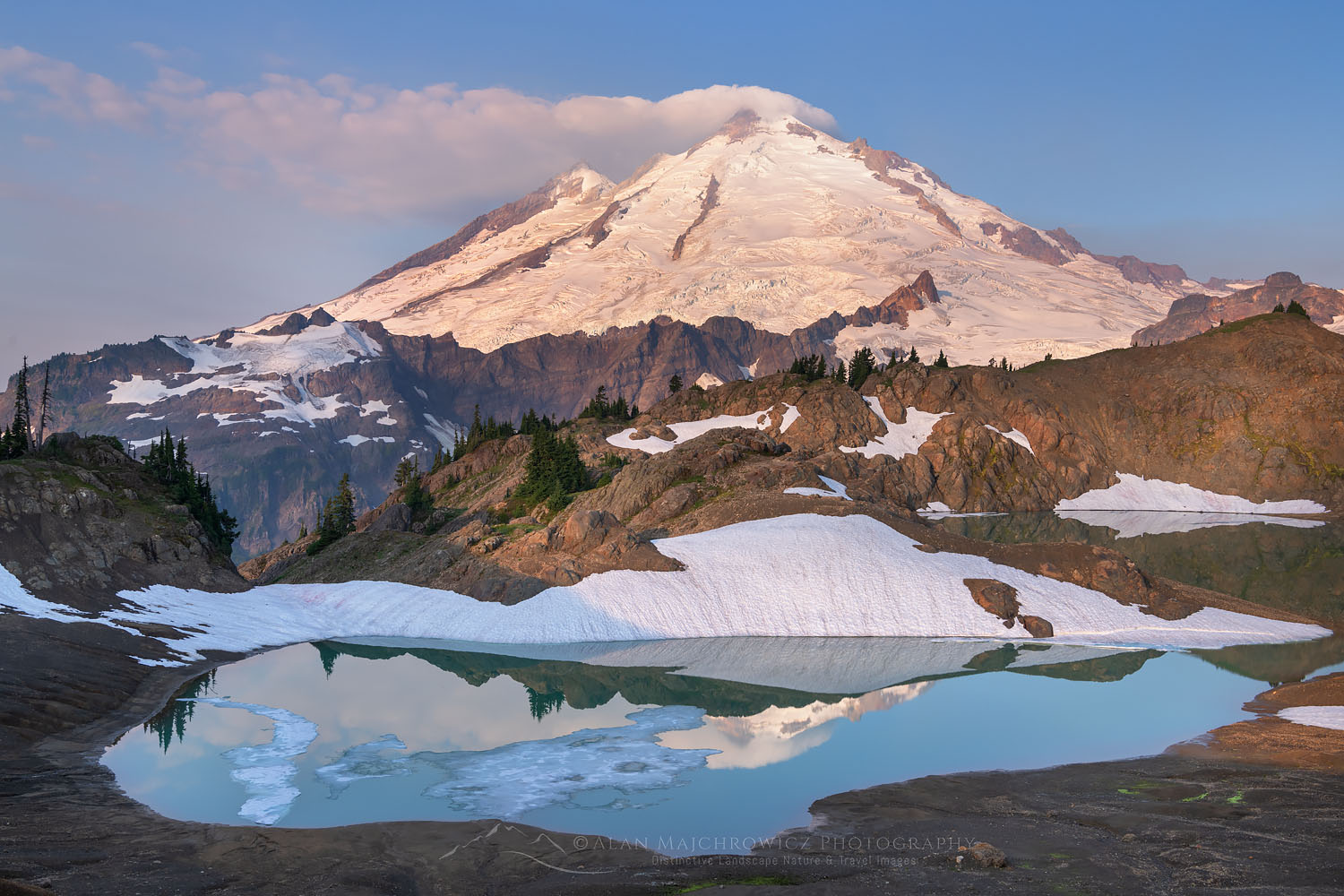
Mount Baker climbing update
The Cascades’ glacier-mountaineering classroom, and the best first glaciated volcano in the Lower 48. This page tracks the season, the two standard routes, the permits and access, the cost, the hazards, and where Baker fits your progression. A single-mountain page in our Expedition Updates directory. Heights in feet (metres).
The best classroom in the Cascades, with no climbing fee to get in.
Baker is where climbers learn glacier travel, crevasse rescue, and roped movement before Rainier, Denali, and the Alps. Its two standard routes, the Coleman-Deming and the Easton Glacier, are moderate glacier climbs run heavily as skills-and-summit courses.
Unlike Rainier, Baker charges no climbing permit or fee, just a Northwest Forest Pass to park and a free self-issued wilderness permit. What it does ask for is skill: over 7,000 ft of gain, a long summit day, and real crevasse and avalanche hazard. Beginner-friendly is not the same as easy.
Summit (3,286 m)
Third-highest in Washington, second-most glaciated in the Lower 48.
Climbing permit
Just a Northwest Forest Pass to park; no climbing charge.
Prime season
Best snow and firmest crevasse bridges.
Mount Baker, known by its Indigenous name Kulshan, dominates the skyline north of Seattle and east of Bellingham. It is one of the snowiest places on earth, holding a world-record single-season snowfall, and its deep glaciation is exactly what makes it such a good place to learn. This page owns the current picture, the season, the routes, the access, and where Baker sits in a climbing progression. For the full history, route detail, and gear, see our Mount Baker climb guide.
Season and status
A long summer window, with the best conditions early.
Baker is climbed from late spring through summer, roughly May to September. May to July usually brings the best snow cover and the firmest crevasse bridges, which is why the guided skills courses cluster there, while later in the summer the glaciers open up, route-finding gets harder, and crevasse hazard rises. Weather is the deciding factor on any given summit day, so teams build in flexibility rather than betting on a single date.
The glacier classroom
Why Baker is the peak climbers learn on.
More than a summit in its own right, Baker is the Pacific Northwest’s teaching mountain. Its moderate, heavily glaciated routes are the ideal place to learn the core skills of glaciated mountaineering: roped glacier travel, crevasse rescue, cramponing, and self-arrest, in real terrain but without extreme technical difficulty. Guide services run constant skills-and-summit courses here for exactly that reason, and climbers routinely use Baker as the proving ground before Rainier, Denali, and bigger objectives in the Alps and the Andes. If you want one mountain to build glacier competence on, this is the one.
The two standard routes
Coleman-Deming and Easton, plus a step up.
Coleman-Deming (north side)
The most popular and most guided route, from the Heliotrope Ridge trailhead. It climbs to Hogsback Camp around 6,000 ft, then up the Coleman Glacier, across the Deming Glacier, and finishes up the steep Roman Wall, the crux, to the summit plateau and Grant Peak. Expect over 7,000 ft of gain and a summit day near 5,000 ft.
Easton Glacier (south side)
From the Schriebers Meadow trailhead, a gentler, broad-glacier ascent that is popular for skills courses and ski descents. A slightly more forgiving introduction to the mountain, with its own long summit day.
North Ridge (a step up)
A steeper, more technical ice route for experienced climbers, and a natural next objective once the standard routes feel comfortable. Not an introductory line.
Permits and access
Simpler and cheaper than Rainier.
Baker’s access is refreshingly straightforward. There is no climbing permit and no climbing fee for the mountain, which sets it apart from Rainier. What you need is a Northwest Forest Pass to park at the trailhead, at $30 for the year or $5 for the day, or an equivalent Interagency pass, plus a free self-issued wilderness permit that you fill out at the trailhead. The Mount Baker Wilderness rules apply: a maximum party size of 12, no campfires, and packing out all human waste. Passes and information are available at the Glacier Public Service Center on the Mount Baker Highway.
Cost
One of the most affordable big glaciated climbs anywhere.
| Item | Cost | Notes |
|---|---|---|
| Northwest Forest Pass (parking) | $30 per year or $5 per day | Required at the trailheads; an Interagency or America the Beautiful pass also works. |
| Climbing permit or fee | None | Unlike Rainier, Baker charges no climbing fee; you self-issue a free wilderness permit at the trailhead. |
| Guided climb or skills course | $1,000 to $1,600 | A 2 to 3 day Coleman-Deming or Easton climb, usually including glacier training. |
| Self-guided direct cost | Pass, gear, and travel | The real requirement is not money but glacier-travel and crevasse-rescue skill. |
Hazards
A moderate climb with real, serious dangers.
Baker is rated as an introductory glacier climb, but that describes the technical difficulty, not the seriousness. The Coleman-Deming route gains over 7,000 ft with a summit day close to 5,000 ft, the glaciers are heavily crevassed, the Roman Wall is steep, avalanche hazard is real, and the weather changes fast enough to end summit bids without warning. Baker is also an active volcano, with steam venting from Sherman Crater and lahars as its greatest geologic hazard.
It demands glacier-travel and crevasse-rescue competence, sound turnaround discipline, and respect for the forecast. Learn or refresh the fundamentals with our crevasse rescue basics guide. This page is educational and is not a substitute for training or a guide.
Weather and timing
A live look at one of the snowiest mountains on earth.
Baker sits directly in the path of Pacific storms and collects extraordinary amounts of snow, and its weather can turn from clear to whiteout quickly. Summit day success hinges on catching a settled window. The live map below shows current conditions for the massif; use it as background and rely on the Northwest Avalanche Center and a mountain forecast for the actual go decision.
Where Baker fits your progression
The rung below the bigger glaciated peaks.
Baker’s real value is as a stepping-stone. It is the natural place to build glacier competence before stepping up to a bigger, more committing objective, and the skills transfer directly. Once Baker feels controlled, the usual next steps are its Cascades neighbour Mount Rainier, with its longer summit day and glacier complexity, and from there the far bigger commitment of Denali in Alaska. See how the pieces fit together in our progression plans, and track current conditions on the next objectives in our Rainier and Denali updates.
Go or no-go checklist
Work through these before you climb.
Before you go
- Have the glacier skills – roped travel, crevasse rescue, and self-arrest, or book a guide who teaches them.
- Buy the Northwest Forest Pass – and self-issue the free wilderness permit at the trailhead.
- Pick the route for the conditions – Coleman-Deming or Easton, based on snow, season, and crowds.
- Check the forecast and avalanche report – weather is the main reason summit days fail here.
- Respect the beginner rating – 7,000+ ft of gain and a long summit day are serious regardless of grade.
- Pack it out – carry out all waste; the wilderness rules are strict for good reason.
Cascades expedition updates
Baker’s neighbours in the range, each with its own update page. Back to the full Expedition Updates dashboard.
Mount Baker update FAQ
The questions climbers ask most about permits, routes, and the season.
Do you need a permit to climb Mount Baker?
There is no climbing permit or climbing fee for Mount Baker itself. What you need is a Northwest Forest Pass to park at the trailhead, which costs $30 for the year or $5 for the day, or an Interagency or America the Beautiful pass, plus a free self-issued wilderness permit filled out at the trailhead. Wilderness rules apply: a maximum party size of 12, no campfires, and packing out all waste. This is simpler and cheaper than Rainier, which does charge a climbing pass.
Is Mount Baker a good first glaciated peak?
Yes. Baker is the classic first glaciated volcano and one of the best glacier-mountaineering training grounds in the Lower 48. Its two standard routes are ideal for learning roped glacier travel, crevasse rescue, cramponing, and self-arrest, which is why guide services run so many skills-and-summit courses on it and why it is standard preparation for Rainier, Denali, and the Alps. The one caveat is that beginner-friendly does not mean easy.
Which Mount Baker route should I climb?
The Coleman-Deming route, from the Heliotrope Ridge trailhead on the north side, is the most popular and most guided line, climbing the Coleman and Deming Glaciers to the steep Roman Wall crux and the summit. The Easton Glacier route, from Schriebers Meadow on the south side, is a gentler, broad-glacier climb popular for skills courses and ski descents. The North Ridge is a steeper, more technical ice route for experienced climbers.
How hard is it to climb Mount Baker?
It is a moderate glacier climb rather than technical rock, but it is a serious mountain day. Expect over 7,000 ft of elevation gain from the trailhead, a summit day of close to 5,000 ft, real crevasse and avalanche hazard, the steep Roman Wall, and famously fast-changing weather. It requires glacier-travel and crevasse-rescue skills, or a guide who has them. As the guide services put it, do not be fooled by the beginner rating.
When is the Mount Baker climbing season?
Late spring through summer, roughly May to September. May to July usually offers the best snow and the firmest crevasse bridges, while later summer opens more crevasses and makes route-finding harder. Weather is the single biggest factor in whether a summit day succeeds, so build in flexibility.
How much does it cost to climb Mount Baker?
A guided two or three day climb or a combined skills-and-summit course runs roughly $1,000 to $1,600. If you have the skills to go self-guided, the direct costs are just the Northwest Forest Pass, your gear, and travel, which makes Baker far cheaper and more accessible than Rainier or Denali. The real prerequisite is competence on a glacier, not a big budget.
Is Mount Baker an active volcano?
Yes. Baker is an active stratovolcano monitored by the USGS Cascades Volcano Observatory. Steam vents from Sherman Crater just south of the summit, activity that increased noticeably in 1975 and 1976, and lahars, volcanic mudflows, are considered its greatest geologic hazard. It is not currently erupting, and it is climbed routinely, but it is a living volcano rather than an inert peak.
How high is Mount Baker and where is it?
Mount Baker is 10,781 ft (3,286 m), the third-highest peak in Washington and the second-most glaciated mountain in the Lower 48 after Rainier. It stands in the North Cascades near Bellingham, about two and a half hours north of Seattle. Its Indigenous name is Kulshan, and it is one of the snowiest places on earth, holding a world-record single-season snowfall from the winter of 1998 to 1999.
📋 How this update is built
This page is compiled by Travis Ludlow, Founder and Head of Research at Global Summit Guide, from US Forest Service access rules, USGS Cascades Volcano Observatory monitoring, and guide-service route information, with sources named below. It was reviewed for safety by Dawson Ludlow, our Climbing and Mountaineering Lead (Wilderness First Aid), whose highest first-hand summit is Kilimanjaro.
Our team has not climbed Mount Baker, so we report official rules and route information rather than personal experience, and we review this page through the climbing season. Passes, rules, and volcanic status can change, so confirm current access and conditions with the Forest Service and USGS before you plan around them.
Sources and further reading
- Mount Baker-Snoqualmie National Forest, US Forest Service – trailhead access, passes, and wilderness rules.
- USGS Cascades Volcano Observatory – Mount Baker monitoring and volcanic status.
- Guide-service route information for the Coleman-Deming, Easton, and North Ridge routes.
- Our own Mount Baker climb guide.
- We report official rules and route information; our team has not climbed Mount Baker.
Planning a Baker climb?
Start with our Mount Baker climb guide, build the skills with our first glacier climb training guide, and see where it leads in our progression plans. Most climbers stage through Bellingham or Seattle, so for flights and lodging, browse travel on Expedia.
Disclosure: the Expedia link above is a sponsored affiliate link. We may earn a commission at no extra cost to you.
Mount Baker: Plan the Whole Climb
Permits, routes, difficulty, weather and logistics all decide the day. Start with the main guide, then go deeper below.