
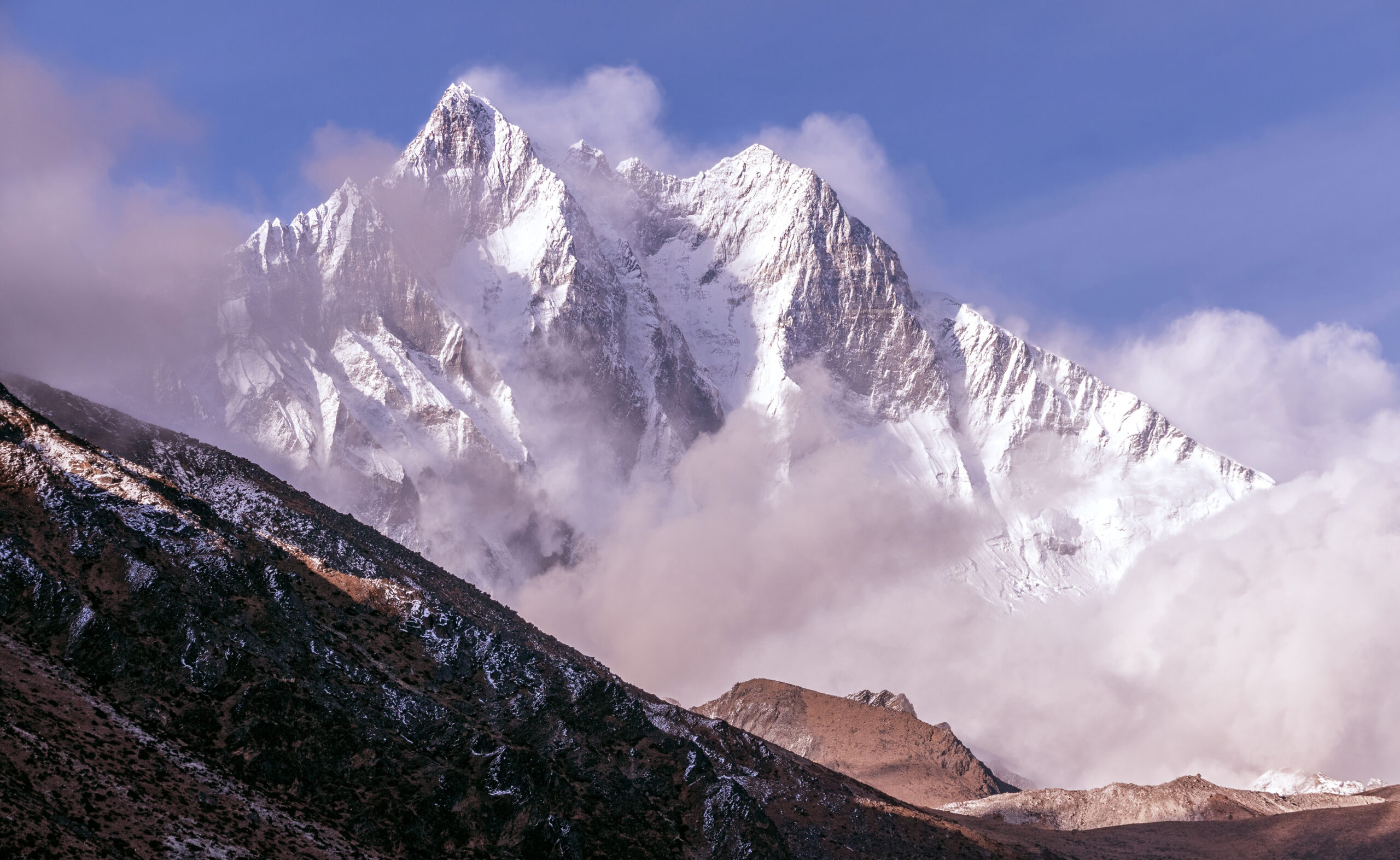
Lhotse expedition update
The 8000er next door to Everest, at a fraction of the permit. This page tracks the spring season, the 2026 Nepal permit, the shared Everest route, the Lhotse Couloir crux, full expedition cost, and a go or no-go checklist. A single-mountain page in our Expedition Updates directory. Elevations in metres (feet).
Everest’s neighbour, at one-fifth the permit, but not an easy Everest.
Lhotse shares Everest’s line through the Khumbu Icefall, the Western Cwm, and up the Lhotse Face to around Camp 3 and Camp 4, in the same spring season, before the routes split. You climb a genuine 8000er with far less crowding high on the mountain.
The 2026 spring permit is $3,000 per person, against $15,000 for Everest. That gap is the draw. The honest caveat is that Lhotse is still a full death-zone expedition, and its summit crux, the steep Lhotse Couloir, is a serious climb in its own right.
Summit (27,940 ft)
The fourth-highest mountain on earth, south of Everest.
Spring permit
One-fifth of Everest’s $15,000 royalty for 2026.
Prime season
Spring, on the same rhythm as Everest.
Lhotse sits immediately south of Everest, joined to it by the South Col, and for much of the climb the two mountains are the same route. That connection is the key to understanding Lhotse: it offers a true Himalayan 8000er in Everest’s shadow, sharing its approach and its season but not its price or its crowds. This page owns the current picture, the season, the permit and rules, the cost, and the route. For the full history, the deeper route detail, and gear, see our Lhotse climb guide and its best-time-to-climb breakdown.
Season and status
Spring, and tied to Everest’s rhythm.
Lhotse is a spring mountain, climbed in April and May, with summit pushes timed to the settled weather windows that usually open in May. Because it shares the route, the whole Lhotse season moves in step with Everest: the same teams fix the same lines through the Khumbu Icefall, the same forecasts govern the summit windows, and Base Camp is the shared Everest Base Camp. Autumn attempts happen but are uncommon, and winter or monsoon climbs are rare and far more serious.
The Everest connection
Why Lhotse is best understood as Everest’s neighbour.
From Base Camp, the Lhotse route is the Everest route: up through the Khumbu Icefall, along the Western Cwm, and up the Lhotse Face toward the high camps. The two only part company high on the mountain, where Everest climbers traverse toward the South Col and southeast ridge, and Lhotse climbers head into the couloir that splits the face to the summit. This shared line is why combined Everest and Lhotse expeditions exist, with strong climbers attempting both within a day or two.
The 2026 permit and Nepal rules
Higher than it was, but still far below Everest.
Nepal revised its climbing royalties effective September 1, 2025, the first change in a decade. For Lhotse and the other 8000m peaks, the spring fee rose from $1,800 to $3,000 per person, with lower rates in the quieter seasons. Everest rose further, to $15,000 in spring, which is what opened the price gap that now defines Lhotse’s appeal.
| Season | Lhotse royalty | Notes |
|---|---|---|
| Spring (Mar to May) | $3,000 per person | Up from $1,800. The main Lhotse season, shared with Everest. |
| Autumn (Sep to Nov) | $1,500 per person | Up from $900. A quieter, less common window. |
| Winter and monsoon | $750 per person | Up from $450. Rarely attempted. |
| Garbage deposit | $3,000, refundable | Standard for 8000m peaks, returned when waste is brought out. |
| Everest, spring, for comparison | $15,000 | Five times the Lhotse spring fee. |
Full expedition cost
Cheaper than Everest, still a major commitment.
The permit is only a small slice of the total. A guided Lhotse expedition typically runs in the region of $20,000 to $35,000 or more, depending on the operator, the level of support, oxygen, and Sherpa ratios. That sits well below a comparable Everest expedition, which commonly runs $45,000 to $65,000 or higher, and the lower permit is one reason, but the bulk of the cost on either mountain is logistics, staff, oxygen, and time. Budget for international flights to Kathmandu, the flight to Lukla, gear, and tips on top.
The route and the Lhotse Couloir
Shared hazards below, a distinct crux above.
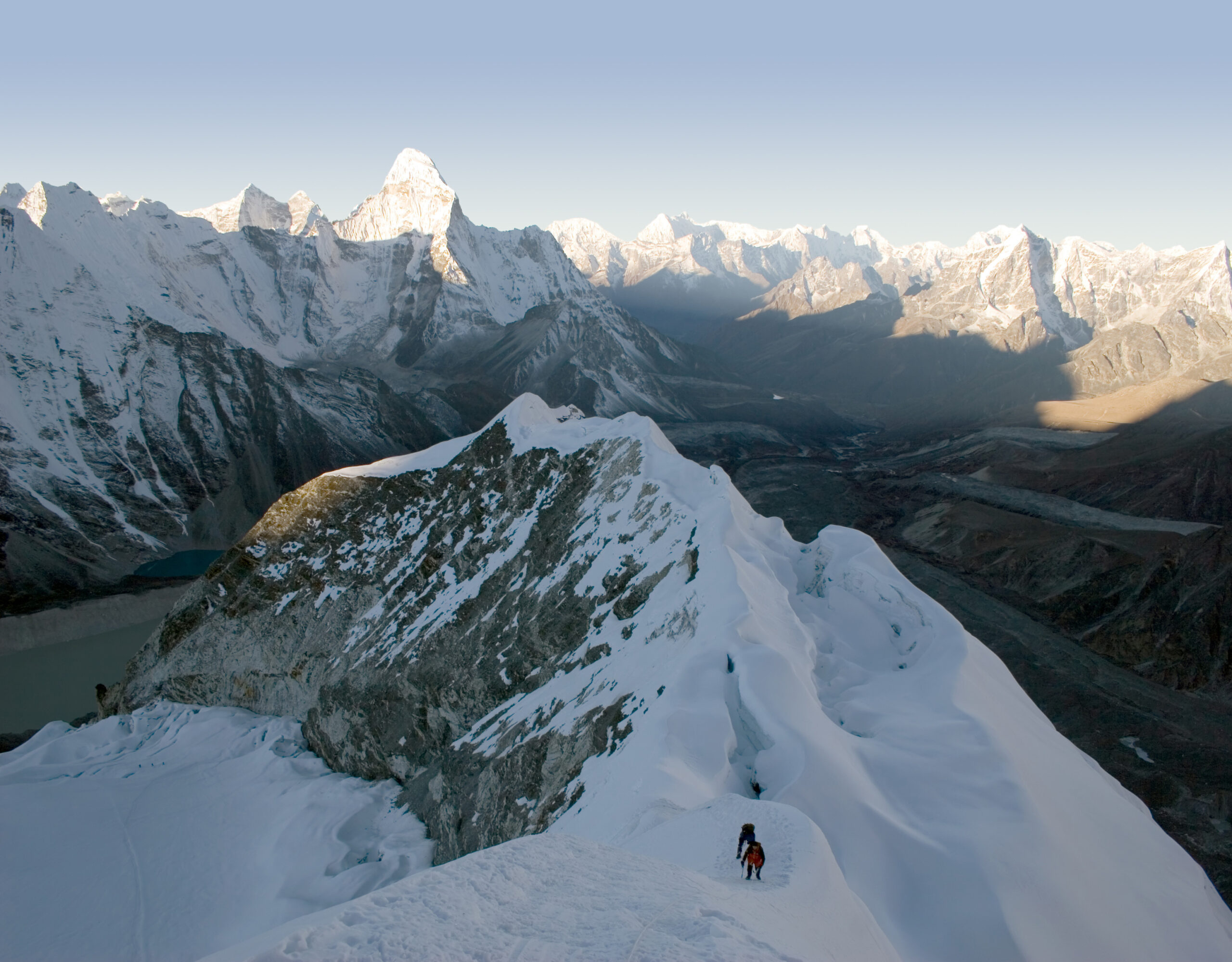
The normal route
From Everest Base Camp the climb follows the Khumbu Icefall, the Western Cwm, and the Lhotse Face through the high camps, the same ground as Everest. Above the high camps it enters the Lhotse Couloir, a steep snow and ice gully of roughly 40 to 50 degrees that leads to the summit, narrowing toward the top with a short, exposed final section. Fixed lines are in place in season, and supplemental oxygen is standard. The climbing is not extreme in isolation, but it is sustained, at extreme altitude, with the same objective hazards as Everest on the shared lower route. See fixed lines and jumars explained for the techniques.
Altitude and the death zone
Above 8,000 m, the environment is the hazard.
Lhotse’s summit is deep in the death zone above 8,000 m, where the body deteriorates and clear thinking is hard. The shared lower route carries the Khumbu Icefall, one of the most dangerous stretches in Himalayan climbing, and the couloir adds steep, exposed climbing at altitude. The lower permit does not make it a lower risk.
It expects prior high-altitude experience, strong acclimatization, and disciplined turnaround judgment. Read our acclimatization guide and check your base against our fitness standards. This page is educational and is not medical advice.
Weather and timing
The same windows that govern Everest.
Lhotse lives and dies by the spring jet stream, exactly as Everest does. For most of April the winds are too high on the summit, and teams acclimatize and wait; the climbable windows open when the jet lifts, usually in May, and everyone moves at once. The live map below shows current conditions for the massif; rely on your expedition’s forecasting for the actual summit call.
Go or no-go checklist
Work through these before you commit.
Before you book
- Have the 8000m base – prior high-altitude experience and strong acclimatization are expected, not optional.
- Budget the whole expedition – the $3,000 permit is minor next to logistics, oxygen, staff, flights, and tips.
- Choose a registered operator – solo and independent attempts are no longer allowed; vet the team’s Icefall and oxygen protocols.
- Confirm the required insurance – death-repatriation cover is now mandatory; check the fine print.
- Respect the couloir – the steep, exposed summit gully is a real crux at extreme altitude.
- Decide on Everest-plus-Lhotse honestly – the combined climb is only for the strongest, most acclimatized climbers.
Himalaya expedition updates
Lhotse’s neighbours in the range, each with its own update page. Back to the full Expedition Updates dashboard.
Lhotse update FAQ
The questions climbers ask most about the permit, the Everest link, and the climb.
How much is the Lhotse climbing permit in 2026?
The spring royalty is $3,000 per person, up from $1,800 after Nepal’s revision that took effect on September 1, 2025. Autumn is $1,500 and the winter and monsoon rate is $750. On top of that, expeditions post a refundable garbage deposit of $3,000 for an 8000m peak. For comparison, the spring Everest royalty is now $15,000, five times the Lhotse fee, which is a large part of why Lhotse draws climbers who want a Himalayan 8000er without the Everest price tag.
Why climb Lhotse instead of Everest?
Because for much of the climb they are the same mountain. Lhotse shares Everest’s approach through the Khumbu Icefall, the Western Cwm, and up the Lhotse Face to around Camp 3 and Camp 4, in the same spring season, before the two routes split. You get a genuine 8000m Himalayan expedition at roughly a fifth of the Everest permit and with far less crowding high on the mountain. What you do not get is an easy Everest, because Lhotse is still a full death-zone climb with its own steep summit crux.
Can you climb Everest and Lhotse together?
Yes, and combined Everest and Lhotse expeditions are a well-established option. Because the routes share the same line to the South Col area, climbers can attempt both within a day or two, going up the southeast ridge for Everest and into the Lhotse Couloir for Lhotse. It is a serious undertaking that only strong, acclimatized climbers should consider, but it is far more efficient than two separate trips.
How hard and technical is Lhotse?
Lhotse carries the same objective hazards as Everest on the shared lower route, the Khumbu Icefall and the death zone above 8,000 m, where supplemental oxygen is standard. Its distinct crux is the Lhotse Couloir, a steep snow and ice gully of roughly 40 to 50 degrees leading to the summit, narrowing near the top with a short, exposed final section. It is a demanding climb that expects prior high-altitude experience.
When is the Lhotse climbing season?
Spring, essentially April and May, matching Everest, with the summit pushes timed to the calm weather windows that usually open in May. The whole mountain runs on the same rhythm as Everest because they share the route. Autumn attempts happen but are uncommon, and winter or monsoon climbs are rare and far more dangerous.
What are the 2026 Nepal climbing rules?
Alongside the higher royalties, Nepal cut permit validity from 75 to 55 days, and it no longer allows solo or fully independent alpine-style attempts, so climbers must go through a registered operator with support. Expeditions must carry out human waste in biodegradable bags, and rules now require death-repatriation insurance and higher cover for high-altitude workers. Your operator handles most of the paperwork, but the requirements are stricter than they were a couple of years ago.
How much does a full Lhotse expedition cost?
A guided Lhotse expedition typically runs in the region of $20,000 to $35,000 or more, depending on the operator, the level of support, oxygen, and Sherpa ratios. That is well below a comparable Everest expedition, which commonly runs $45,000 to $65,000 or higher, but it is still a major financial commitment, and the permit is only a small slice of the total.
How high is Lhotse and where is it?
Lhotse is 8,516 m (27,940 ft), the fourth-highest mountain on earth, on the border of Nepal and Tibet immediately south of Everest and connected to it by the South Col. It was first climbed in 1956 by a Swiss team, and its main summit sits above two lower subsidiary tops, Lhotse Middle and Lhotse Shar.
📋 How this update is built
This page is compiled by Travis Ludlow, Founder and Head of Research at Global Summit Guide, from Nepal Department of Tourism royalty rules, reporting on the 2025 permit revision, and operator-published logistics, with sources named below. It was reviewed for safety by Dawson Ludlow, our Climbing and Mountaineering Lead (Wilderness First Aid), whose highest first-hand summit is Kilimanjaro.
Our team has not climbed Lhotse, so we report official rules and operator logistics rather than personal experience, and we review this page before each spring season. Permit rates and rules change, so treat every figure here as a starting point and confirm current costs and requirements with your operator and the Department of Tourism before committing.
Sources and further reading
- Nepal Department of Tourism – 2025 and 2026 royalty rates and expedition regulations.
- Reporting on the September 2025 permit revision across Nepal’s 8000m peaks.
- Operator-published Lhotse and combined Everest-Lhotse expedition logistics and pricing.
- Our own Lhotse climb guide.
- We report official rules and operator logistics; our team has not climbed Lhotse.
Planning a Lhotse expedition?
Start with our Lhotse climb guide, weigh it against its big neighbour in our Everest guide and the Everest expedition update, and compare teams in the operator directory. Every climb starts in Kathmandu, so for flights and hotels there, browse travel on Expedia.
Disclosure: the Expedia link above is a sponsored affiliate link. We may earn a commission at no extra cost to you.
Lhotse Update & the Everest-Region 8000ers
Lhotse shares its route with Everest to the South Col. See the full guide and the wider 8000er season below.