
Last updated September 15, 2026
Rappel Accidents: 12 Failure Modes Every Climber Should Recognize
The American Alpine Club’s 2025 accident report recorded 15 reported rappel incidents involving 23 climbers and five fatalities. Those numbers do not represent every rappel performed—or even every rappel accident—but the case reports repeatedly expose the same weak points: rope ends, anchors, device setup, transitions, communication, loss of control and human error under fatigue.
Why do rappel accidents keep happening?
Rappelling concentrates several critical tasks into a transition where climbers are often tired, descending, moving between anchors and depending almost entirely on the system they have just assembled.
American Alpine Club accident reviews repeatedly identify inadequate anchors, unsecured rope ends, unequal or short ropes, incorrect device setup, inadequate backups and transition mistakes. The human-factors literature adds distraction, assumption, familiarity and fatigue.
The safety lesson is therefore not that one magic device or one checklist makes rappelling safe. It is that multiple independent checks should prevent one ordinary mistake from becoming a fall.
23 climbers involved; five fatalities.
Eight were fatal in the 2023 ANAC reporting cited by AAC.
AAC says lowering has overtaken rappelling as the probable leading roped-climbing accident category.
Case reports teach mechanisms better than a fake universal percentage.
What the AAC numbers tell us—and what they cannot tell us
ANAC is exceptionally useful for learning how accidents happen. It is not a complete census of climbing activity.
| Source | Published information | Useful conclusion | Do not conclude |
|---|---|---|---|
| 2023 ANAC reporting cited by AAC | 14 published rappel accidents; 8 fatal. | Fatal rappel errors remained a recurring accident category. | That 14 was every rappel accident in North America that year. |
| 2025 ANAC | 15 reported rappel incidents involving 23 climbers; 5 fatalities. | Serious rappel incidents continued to appear in the annual record. | That rappelling has a known per-rappel fatality rate. |
| 2026 AAC accident-trends update | AAC reported a 30% increase in climbing-related accident reports received. | More reports were submitted to the accident program. | That actual climbing accident incidence increased exactly 30%. |
| August 2026 AAC guidance | Lowering described as having replaced rappelling as the probable leading cause of roped-climbing accidents. | Rappelling should not be described as the current No. 1 roped-climbing accident category. | That rappelling is now unimportant or low risk. |
Which sources answer which safety questions?
Accident reports identify mechanisms. Manufacturers define equipment limits. Instruction teaches execution.
American Alpine Club
ANAC and The Prescription provide case reports, annual accident tables and expert analysis of recurring rappel and transition failures.
Manufacturer instructions
Petzl and other manufacturers define rope, device and technique limitations and repeatedly warn that mastery requires specific training.
Qualified instruction
A webpage cannot verify your anchor, demonstrate your specific rappel setup or correct a mistake before you commit to the system.
The failure modes that repeatedly appear in accident reports
These are categories for recognition and discussion—not a substitute for learning the actual techniques in person.
Rappelling off a rope end
A climber reaches an unsecured rope end before reaching the intended stance or ground. AAC case reports repeatedly document this mechanism.
Unequal or insufficient rope length
Rope ends are uneven, the rappel is longer than expected or the wrong rope length was carried. These problems can create both falls and stranded climbers.
Anchor failure
Fixed slings, cord, pitons, bolts, blocks or removable protection can be weaker than they appear. AAC reports include fatal failures of old rappel material and marginal single anchors.
Incorrect device setup
A device may be misthreaded, attached incorrectly or used in a configuration the climber does not fully understand.
Rope and device mismatch
Modern rope diameters vary widely. Friction and control can change when a rope is thinner, wet, icy, new or outside the intended range of the descender.
Loss of control
The climber accelerates or becomes unable to control the descent because of setup, rope condition, injury, impact or an unexpected movement.
Backup incorrectly configured—or absent when needed
AAC technical guidance identifies ineffective or absent rappel backups among recurring problems. A backup can also fail if configured incorrectly or allowed to interfere with the device.
Clothing, hair or equipment entanglement
Loose material can enter the rappel device and immobilize the climber in a difficult position.
Transition error
A climber disconnects from one system before being securely connected to the next, or removes an element that was providing critical security.
Rope damage and edge hazards
Sharp rock, abrasion, falling debris and loaded edges can damage a rope or change the consequences of a descent.
Communication failure
Partners may misunderstand whether a climber is secure, whether the rope is ready or whether someone has left the system.
Fatigue, distraction and familiarity
Experienced climbers can become vulnerable precisely because routine systems feel automatic. AAC human-factors analysis repeatedly emphasizes transitions, assumptions and distraction.
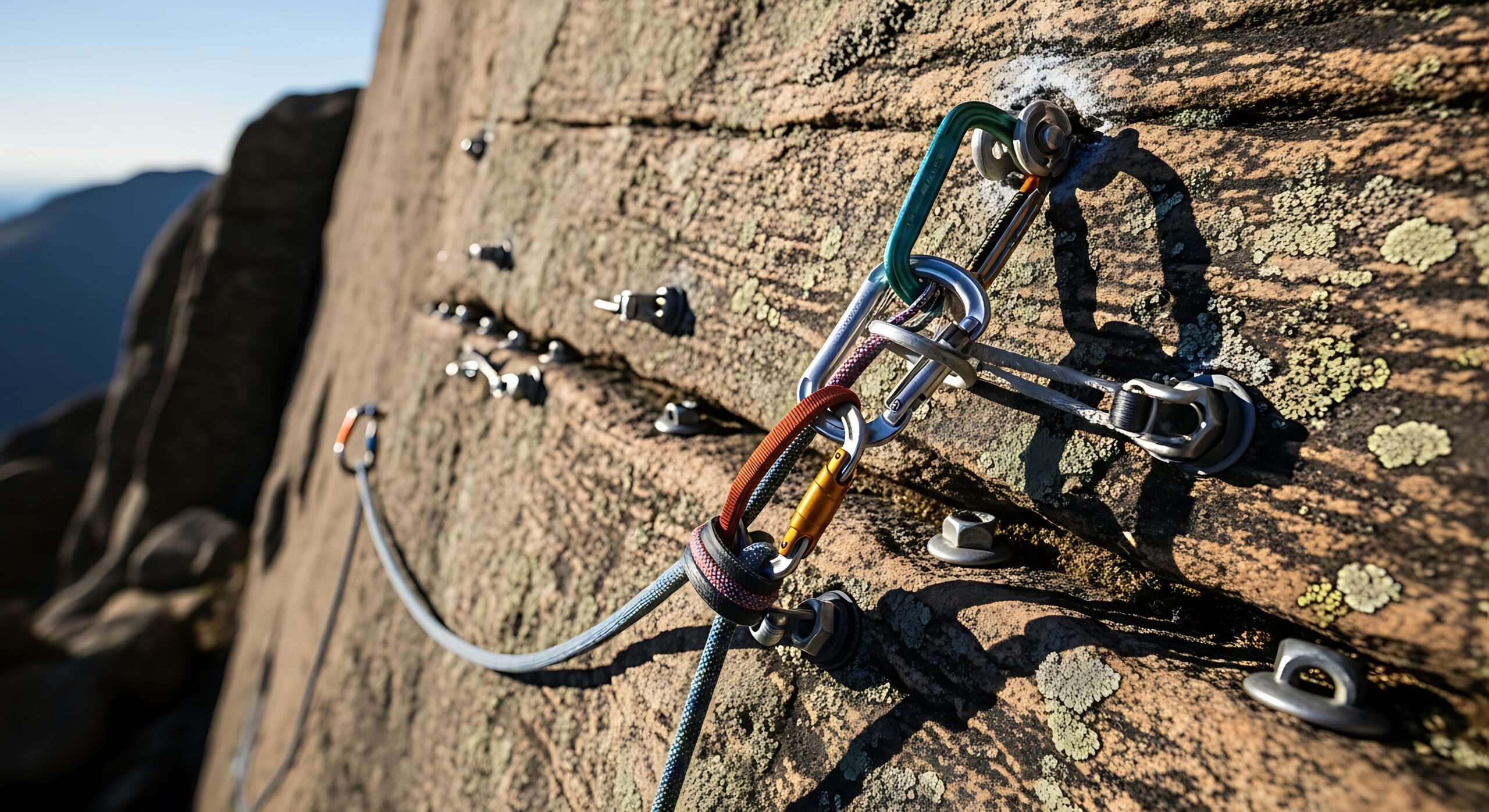
The dangerous moment is often when one system becomes another.
Arriving at an anchor, threading the rope, changing attachment, checking the rappel and moving to the next station creates a sequence of state changes. Accident reports repeatedly show that assumptions during those transitions can be more consequential than the climbing difficulty that came before them.
Rappelling is not the only descent problem climbers should study
Current AAC analysis highlights lowering as an increasingly important accident category.
In August 2026, the American Alpine Club described lowering as having replaced rappelling as the probable leading cause of roped-climbing accidents.
That distinction matters. Rappelling and lowering may occur at the same anchors, but they are different systems with different responsibilities and failure modes. Mixing the categories makes both harder to understand.
This page therefore focuses only on rappel-system accidents. Cleaning sport anchors, top-rope lowering and belayer lowering errors should be studied separately.
Failure modes center on anchor, rope, device and transition systems.
Different equipment and communication failure modes apply.
A “descent accident” total can hide very different mechanisms.
Seven questions your rappel system should answer
These are verification prompts, not technical instructions for constructing a rappel.
Do I understand what is carrying the load, and have I identified any damaged, marginal or unknown components?
Do I know the rope length, rope condition and where the ends are relative to the intended destination?
Is this rope/device combination being used within the manufacturer’s instructions?
Does the chosen backup system match the device, terrain and technique I have actually been trained to use?
Am I securely connected while building and checking the next system?
Does my partner understand the plan, commands and sequence of the descent?
Have wind, darkness, rockfall, stuck-rope terrain, wet or icy ropes, fatigue or poor visibility changed the safest plan?

Rappel accident questions
The evidence is strongest for recurring mechanisms, not universal incident probabilities.
How many rappel accidents occur each year?
No complete North American count exists. The 2025 ANAC recorded 15 reported rappel incidents involving 23 climbers and five fatalities. Because reporting is incomplete and the number of rappels performed is unknown, that cannot be converted into a per-rappel accident rate.
What are the most common rappel failure mechanisms?
AAC technical reviews repeatedly identify inadequate anchors, inadequate rappel backups, rappelling off rope ends, unequal or insufficient rope length and device/setup problems. Human-factors analysis adds transitions, fatigue, distraction and assumptions.
Should I always tie stopper knots in rappel rope ends?
Securing rope ends is a powerful defense against rappelling off the end. AAC strongly emphasizes this hazard. Manufacturer guidance also notes that the exact method should account for terrain and rope-retrieval hazards. Learn the appropriate closed-system techniques through qualified instruction.
Does a friction-hitch backup make a rappel safe?
No single component makes a rappel safe. AAC guidance identifies inadequate backups as a recurring problem, but backups themselves must be configured correctly and must not interfere with the descender. Follow current manufacturer guidance and hands-on instruction.
Are fixed rappel anchors safe?
Fixed does not mean verified. Accident reports include degraded sling material, marginal protection and single fixed pieces that failed. Evaluate the complete anchor and do not assume unknown equipment is reliable merely because it is already there.
Is rappelling more dangerous than lowering?
There is no exposure-normalized dataset that lets us calculate a universal risk comparison. Current AAC commentary says lowering has become the probable leading cause of roped-climbing accidents. Both deserve dedicated training and separate failure-mode analysis.
Where the evidence comes from
Case reports are used for accident mechanisms; manufacturer sources are used for equipment guidance.
2025 Rappel Fatalities Review
AAC reporting gives the 2023 ANAC and 2025 ANAC incident counts used on this page and discusses recurring fatal rappel mechanisms.
Know the Ropes: Rappelling
AAC technical review identifying inadequate anchors, inadequate backups, rope-end errors and rappel-device issues among recurring causes.
Human Factors Behind Climbing Accidents
Current AAC analysis of transition errors, assumptions, lack of backups and the role of human behavior in technical-system failures.
Rappelling Technical Advice
Manufacturer guidance emphasizing vigilance, remaining connected during anchor maneuvers, rope-end precautions and the need for specific training.
Current Accident Trends
AAC’s 2026 accident program reported a 30% rise in reports received and separately noted that lowering has overtaken rappelling as the probable leading roped-climbing accident category.
What we do not calculate
We do not publish a universal rappel fatality rate, percentage of all climbing accidents, or probability of injury per rappel because the required exposure denominator is unavailable.
Continue through the accident and safety system
A rappel accident rarely exists in isolation. Fatigue, route finding, weather, communication and emergency planning often determine whether one small mistake becomes serious.
Was this helpful?
Global Summit Guide is an independent mountaineering resource founded in 2026. The team combines first-hand trekking and climbing experience with in-depth research and professional health and nutrition review to help climbers choose objectives, prepare properly, and stay safe.
Health, altitude, and nutrition content is reviewed by Taylor Ludlow (Registered Nurse) and Brigg Hoopes (Nutritionist).
What We Don't Know Yet
Mountain information changes quickly. This box explains the limits of what this page can responsibly promise.
- Visa, passport, vaccination, border, insurance, and local transportation rules may change before your trip.
- Route conditions, snowpack, closures, and weather can change quickly after this page is updated.
- Permit rules, fees, quotas, and reservation windows may change between review cycles.
- Operator availability, pricing, guide ratios, and cancellation terms can change by season.
- Your fitness, altitude response, risk tolerance, and experience level may change what is safe or realistic.
Verify current conditions with official land managers, guide services, local forecasts, and current route reports before booking or climbing.
Mountaineering, rock and ice climbing, glacier travel, and high-altitude activity are inherently dangerous and can result in serious injury or death. The information on Global Summit Guide is provided for general informational and educational purposes only and is not a substitute for professional instruction, qualified guiding, proper equipment, or your own judgment and experience.
Route conditions, weather, snowpack, permits, regulations, and hazards change constantly and may differ from what is described here. Details may be incomplete, out of date, or contain errors. Always verify current information with local authorities, certified guides, and official sources before making any decision in the mountains.
Nothing on this site is medical, legal, or financial advice. Our fitness, acclimatization, altitude, and nutrition content is general in nature; consult a qualified physician before beginning any strenuous exercise program or exposing yourself to high altitude.
You are solely responsible for your own safety and decisions. To the fullest extent permitted by law, Global Summit Guide and its team accept no liability for any loss, injury, damage, or expense arising from use of, or reliance on, this information. By using this site you acknowledge these risks and accept these terms.
Some links on this site may be affiliate links. If you buy through them we may earn a small commission at no extra cost to you; this never affects our recommendations.
Global Summit Guide recommendation path
Next Best Mountain to Research
Use these recommendations to continue the right planning path instead of stopping on one page.
Use current permit, weather, route, and operator information before booking or climbing.