
Gasherbrum I expedition update
Hidden Peak, the harder of the Gasherbrum twins. This page tracks why it earned the name, how it compares to Gasherbrum II, the Japanese Couloir route, its honest safety record, the Karakoram summer season, and a go or no-go checklist. A single-mountain page in our Expedition Updates directory. Elevations in metres (feet).
The hidden one, and the harder one.
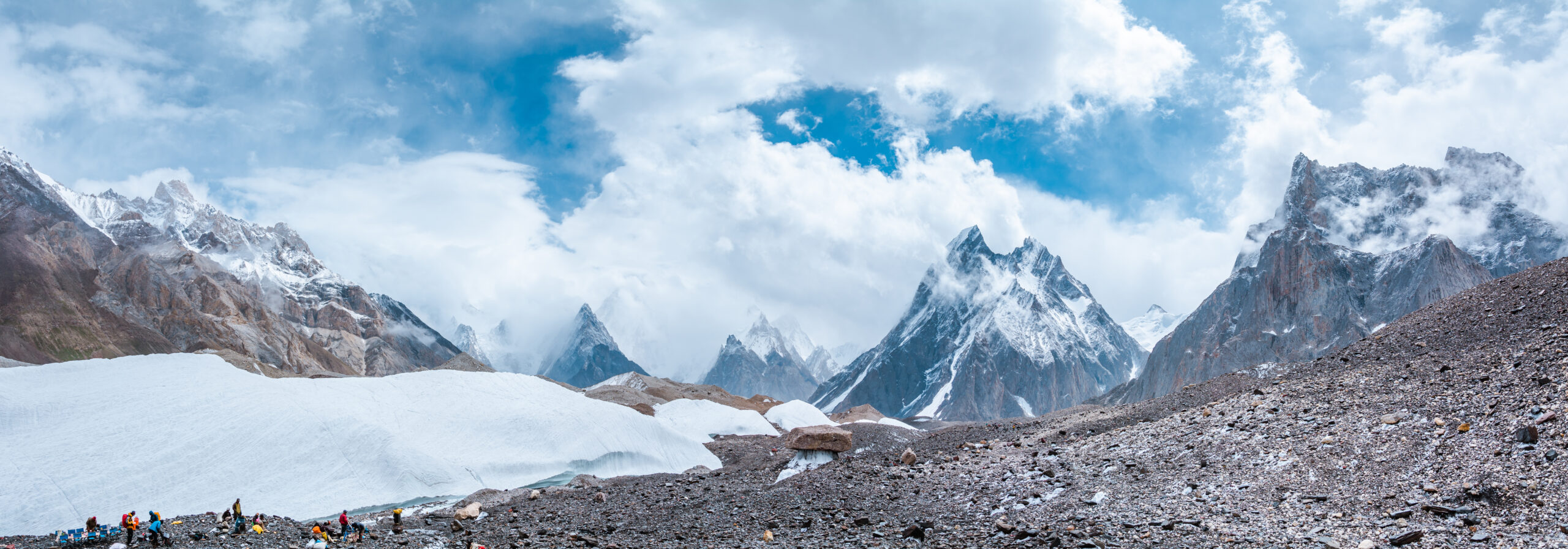
Gasherbrum I is the eleventh-highest mountain in the world, tucked so deep in the Karakoram that a British surveyor named it Hidden Peak in 1892. It is the harder of the two Gasherbrum 8000ers, steeper and more technical than its twin Gasherbrum II, and the least-visited of all fourteen 8000-metre peaks.
It carries history out of proportion to its fame: the only 8000er first climbed by an American team, in 1958, and the site of the first alpine-style ascent of an 8000er, in 1975. For the full route, camps, and cost, see our Gasherbrum I climb guide.
Summit (26,509 ft)
Eleventh-highest in the world; Hidden Peak, or K5.
Karakoram season
Summer, the opposite of the Himalayan seasons.
Of the 8000ers
Remote, technical, and for experienced climbers.
Gasherbrum I stands at the head of the Baltoro Glacier, on the Pakistan and China border, part of a cluster of high peaks that includes its twin Gasherbrum II. It is a serious mountaineer’s objective rather than a commercial trophy, drawing far fewer climbers than K2 or Everest, and rewarding those who make the long journey with solitude as well as difficulty. This page owns the current picture, the twins comparison, and the honest safety record. For the Japanese Couloir route detail, camps, gear, and cost breakdown, see our Gasherbrum I climb guide.
Season and status
A Karakoram summer peak.
Gasherbrum I is climbed from June to August, the Karakoram summer, which is the opposite of the spring and autumn seasons used across the Nepalese Himalaya. Every one of Pakistan’s 8000ers is a summer peak. A full expedition runs 45 to 60 days, taking in the trek, several acclimatization rotations, and a long wait at base camp for a safe summit window. Each year the mountain hosts only a handful of teams, often alongside climbers on its twin, so the status that matters is simply whether a season’s weather opens a window at all.
The British surveyor William Martin Conway gave Gasherbrum I the name Hidden Peak in 1892, because the mountain is set so far back in the range, screened behind Gasherbrum IV and II, that it cannot be seen from the lower Baltoro Glacier where expeditions approach. Its survey label was K5. The word Gasherbrum, often mistranslated as shining wall, actually comes from the Balti rgasha, meaning beautiful, and brum, meaning mountain. Hidden and beautiful is a fair description of a peak most people, even many climbers, would struggle to point to.
The Gasherbrum twins
Two 8000ers, one base camp, very different climbs.
| Aspect | Gasherbrum I | Gasherbrum II |
|---|---|---|
| Height | 8,080 m (26,509 ft), 11th-highest | 8,035 m (26,362 ft), 13th-highest |
| Difficulty | Steeper and more technical | The easier, safer twin |
| Normal route | The Japanese Couloir, north-east face | The south-west ridge |
| Typical role | The harder prize | Often a climber’s first 8000er |
| Objective hazard | Relatively low, few seracs | Low |
| Base camp | Shared with Gasherbrum II | Shared with Gasherbrum I |
The two Gasherbrum 8000ers sit side by side and share the same base camp, but they are not the same climb. Gasherbrum II is one of the more approachable 8000ers and is often a climber’s first, while Gasherbrum I is steeper, more technical, and the bigger prize. Because they share the lower mountain, many strong climbers attempt both in a single season, a challenge known as the Gasherbrum Double, first achieved as a traverse by Reinhold Messner and Hans Kammerlander in 1984. If you are eyeing GI, its twin is worth understanding too.
The Japanese Couloir route
A direct line, but a technical one.
From the Gasherbrum La to the summit
The normal route climbs the north-east face via the Japanese Couloir, reached from the Gasherbrum La, the col between GI and GII. It shares base camp and Camp 1 with Gasherbrum II, then works up crevassed glacial slopes to the col before the steeper couloir and face above, with three high camps to reach the summit. It is a direct line to the top, but the couloir and the upper face are genuine technical climbing at extreme altitude. For the full camp-by-camp detail, see our Gasherbrum I climb guide.
How dangerous it really is
A low death rate that needs explaining.
Gasherbrum I carries one of the lower fatality records among the 8000ers, which sounds reassuring until you look at why. Part of the reason is that only experienced climbers attempt a peak this technical and this remote, so the pool is self-selected. The other part is that the normal route has relatively few of the objective hazards, such as collapsing seracs, that make neighbours like K2 and Broad Peak so lethal.
In other words, the statistic reflects who climbs Gasherbrum I and the character of its route, not a forgiving mountain. Crevasses, avalanches, severe storms, extreme cold, and altitude remain ever-present. Treat the low death rate as a fact about the climbers, not an invitation to underestimate the peak. This page is educational and is not a substitute for experience.
Access, cost and the Baltoro trek
The great glacier highway, away from the K2 crowds.
The approach is one of the finest in mountaineering. From Islamabad you fly to Skardu, drive to the village of Askole, then trek six to eight days up the Baltoro Glacier, past Paiju and Urdukas to Concordia, before branching away from the K2 crowds into the quieter Gasherbrum sanctuary and base camp. A guided expedition runs roughly $15,000 to $25,000, less than K2, and the permit sits in Pakistan’s 8000er band below K2, broadly in line with Broad Peak and Gasherbrum II; climbers doing the Gasherbrum Double often arrange a custom combined royalty. Confirm the current figures with your operator, and vet teams with how to choose an operator.
Weather and timing
A live look at the Gasherbrum massif.
Karakoram weather is fierce and fast-moving, and a summit push depends on a settled window in the short summer season. The live map below shows current conditions for the massif; a real attempt relies on expedition forecasting for every move above base camp.
Go or no-go checklist
Work through these before you commit.
Before you go
- Bring 8000er experience – GI expects solid 7,000 m ability and ideally a previous 8000er, not a first trip to extreme altitude.
- Respect the couloir – the Japanese Couloir and upper face are technical ground high on the mountain.
- Do not misread the low death rate – it reflects who climbs it, not a safe peak; the hazards are real.
- Consider the Double – if strong, pairing GII from the shared base camp is efficient, but plan the royalty and time.
- Plan the long trek – six to eight days up the Baltoro before the climb, and 45 to 60 days total.
- Carry proper cover – helicopter evacuation and high-altitude rescue insurance are essential in this remote range.
Karakoram expedition updates
Gasherbrum I’s neighbours on the Baltoro, each with its own update page. Back to the full Expedition Updates dashboard.
Gasherbrum I update FAQ
The questions climbers ask most about the name, the twins, and the difficulty.
Why is Gasherbrum I called Hidden Peak?
The British surveyor William Martin Conway gave it the name in 1892 because the mountain is tucked deep in the Karakoram, hidden behind Gasherbrum IV and II and not visible from the lower Baltoro Glacier. Its survey designation was K5. The name Gasherbrum itself comes from the Balti words rgasha, meaning beautiful, and brum, meaning mountain, so it means beautiful mountain, not shining wall as is often wrongly claimed.
How does Gasherbrum I compare to Gasherbrum II?
They are twins that share a base camp, but Gasherbrum I is the harder of the two. Gasherbrum II, at 8,035 m, is regarded as one of the easier and safer 8000ers and is often a climber’s first, taken on the south-west ridge. Gasherbrum I, at 8,080 m, is steeper and more technical, the bigger prize of the pair. Many strong climbers attempt both in a single season from the shared base camp, a challenge known as the Gasherbrum Double.
What is the normal route on Gasherbrum I?
Most climbers take the Japanese Couloir on the north-east face, reached from the Gasherbrum La, the col that separates Gasherbrum I and II. The route shares base camp and Camp 1 with Gasherbrum II, then climbs crevassed glacial slopes up to the col before the steeper couloir and face above, with three high camps used to reach the summit. It is a direct line, but a technical one at extreme altitude.
How dangerous is Gasherbrum I?
It is technically demanding and remote, yet it carries one of the lower fatality records among the 8000ers, and the reason matters. Part of it is that only experienced climbers attempt a peak this hard and this far from help, and part of it is that the normal route has relatively few objective hazards such as seracs. So the low death rate reflects who climbs it and the character of the route, not that the mountain is forgiving. It is hard, not safe.
When is the Gasherbrum I climbing season?
June to August, the Karakoram summer, which is the opposite of the spring and autumn seasons used in the Nepalese Himalaya. All of Pakistan’s 8000ers are summer peaks. A full expedition usually runs 45 to 60 days including the trek in, acclimatization rotations, and waiting at base camp for a safe summit window, so it is a long commitment as well as a hard one.
What experience do you need for Gasherbrum I?
Prior high-altitude experience is essential: solid ability on 7,000 m peaks and ideally a previous 8000er. Gasherbrum I is an advanced expedition peak, not a first 8000er, and its steeper, more technical ground at extreme altitude is unforgiving of climbers who arrive underprepared. It is often climbed by mountaineers working through the fourteen 8000ers rather than by those new to the death zone.
How do you get there, and what does it cost?
From Islamabad you fly to Skardu, drive to the village of Askole, then trek six to eight days up the Baltoro Glacier past Concordia to base camp, branching away from the K2 crowds into the quieter Gasherbrum sanctuary. A guided expedition runs roughly $15,000 to $25,000, less than K2, and the Gasherbrum Double with GII is a popular value option, often arranged with a custom combined royalty.
How high is Gasherbrum I and where is it?
Gasherbrum I is 8,080 m (26,509 ft), the 11th-highest mountain in the world and the second-highest in the Karakoram after K2, on the Pakistan-China border at the head of the Baltoro Glacier. It was first climbed in 1958 by an American team, the only 8000er with an American first ascent, and in 1975 it became the first 8000er climbed in pure alpine style, by Reinhold Messner and Peter Habeler.
📋 How this update is built
This page is compiled by Travis Ludlow, Founder and Head of Research at Global Summit Guide, from Pakistan Ministry of Tourism permit rules, route guides for the Japanese Couloir, and operator-published expedition records, with sources named below. It was reviewed for safety by Dawson Ludlow, our Climbing and Mountaineering Lead (Wilderness First Aid), whose highest first-hand summit is Kilimanjaro.
Our team has not climbed Gasherbrum I, so we report official rules and expedition records rather than personal experience, and we review this page before each Karakoram season. Permit fees and rules change, so confirm the current royalty and requirements with your operator and the Ministry of Tourism before planning around them.
Sources and further reading
- Pakistan Ministry of Tourism and Gilgit-Baltistan – climbing royalty and the mandatory Islamabad briefing.
- ExplorersWeb and operator route guides on the Japanese Couloir and the Gasherbrum La.
- Operator-published Gasherbrum expedition itineraries, camps, and the Gasherbrum Double.
- Our own K2 and Karakoram resources.
- We report official rules and expedition records; our team has not climbed Gasherbrum I.
Planning a Gasherbrum expedition?
Start with our Gasherbrum I climb guide for the full route and cost, compare the giant next door in our K2 climb guide and K2 update, and follow the range live in the K2 2026 season tracker. Every expedition stages through Islamabad and Skardu, so for flights and hotels, browse travel on Expedia.
Disclosure: the Expedia link above is a sponsored affiliate link. We may earn a commission at no extra cost to you.