
The highest mountains in Africa: a complete ranking of the 10 tallest African peaks
Africa contains some of the most distinctive mountains in the world — equatorial glaciers, dormant volcanoes rising from savanna plains, the dramatic Ruwenzori range straddling the Uganda-DRC border, and the Ethiopian Highlands. Mount Kilimanjaro at 5,895 meters is not just the highest peak in Africa but also one of the most accessible major mountains anywhere in the world — a non-technical hike rather than a true climbing objective. But Africa’s high mountain landscape extends far beyond Kilimanjaro. This guide ranks the 10 highest peaks in Africa with detail on each, plus regional context for the rest of the continent’s notable mountains. For broader context see our Africa’s highest peaks master collection.
The geography of African mountains where the high peaks are
African mountaineering is dominated by East Africa. All 10 of the highest African peaks are in the eastern third of the continent, concentrated in four distinct geographic areas:
- The Tanzanian volcanoes: Kilimanjaro (5,895m), Mount Meru (4,562m), and several smaller peaks. The classic African mountain climbing experience.
- Mount Kenya: the second-highest peak in Africa, sitting alone in central Kenya near the equator with no other major peaks immediately adjacent.
- The Ruwenzori range: the dramatic “Mountains of the Moon” straddling the Uganda-DRC border. Contains 6 of the top 10 highest African peaks including Mount Stanley at 5,109m.
- The Ethiopian Highlands: Ras Dashen (4,550m) and the Simien Mountains, a distinct ecosystem in northern Ethiopia.
Outside East Africa, two notable mountain regions deserve mention. Mount Toubkal (4,167m) in the Moroccan Atlas is the highest peak in North Africa. Mount Cameroon (4,040m) is the highest peak in West Africa. Both are dramatically lower than the East African giants but represent the continental high points of their respective regions.
One of the most distinctive features of African mountains is the presence of glaciers directly on the equator. Mount Kenya, the Ruwenzori, and Kilimanjaro all have (or had) permanent ice despite sitting between 0 and 3 degrees south latitude. This is possible because of the extreme altitude — temperatures decrease approximately 6.5°C per 1,000 meters of elevation. Climate change has dramatically reduced these equatorial glaciers since the 1990s, with most scientific projections suggesting they will disappear within decades. The remaining ice on Kilimanjaro is approximately 85% smaller than its 1912 extent.
The crown peak Africa’s tallest
Mount Kilimanjaro
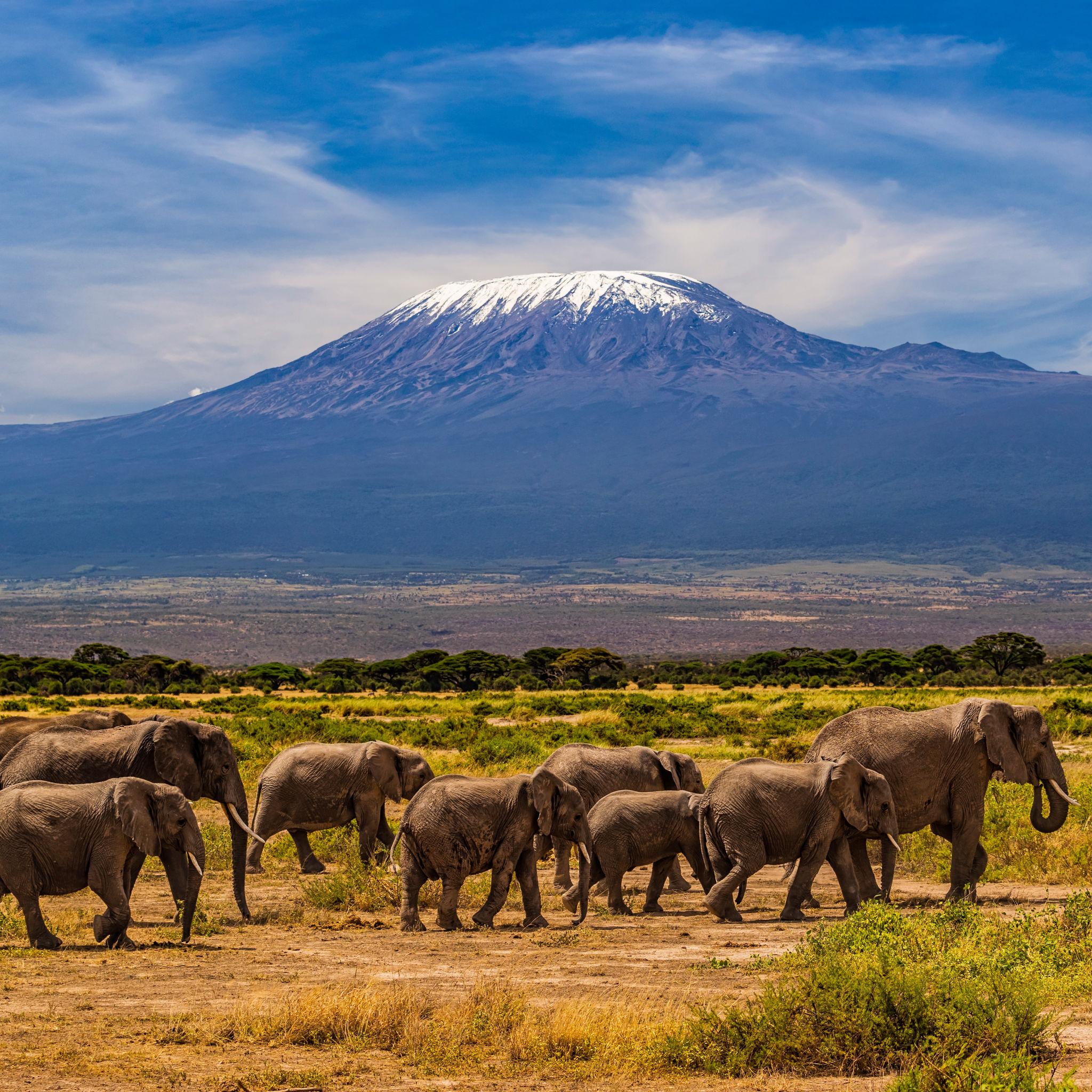
Mount Kilimanjaro is the highest mountain in Africa, one of the Seven Summits, and uniquely among major peaks at this altitude, a non-technical hike rather than a true climbing objective. The mountain consists of three volcanic cones — Kibo (the summit cone), Mawenzi, and Shira — with the summit known as Uhuru Peak at the rim of the Kibo crater. Kilimanjaro is unique for being the highest free-standing mountain in the world (not part of a mountain range) and for its location just 3 degrees south of the equator.
Approximately 35,000 to 50,000 climbers attempt Kilimanjaro each year via seven established routes (Marangu, Machame, Lemosho, Rongai, Northern Circuit, Umbwe, and Shira). The climb is technically straightforward — no ropes, no glacier travel — but the altitude is significant. Summit success rates vary from 60-90% depending on route choice and duration. The full Kilimanjaro framework is in our Kilimanjaro climbing guide, with detailed coverage of routes in our Kilimanjaro routes comparison, training plan at our 8-week training plan, and gear in our Kilimanjaro gear list. The 2026 cost framework is in our Kilimanjaro cost 2026 guide.
Iconic African peaks the recognizable mountains
Mount Kenya
Mount Kenya is the second-highest mountain in Africa and one of the most underrated mountaineering destinations in the world. Unlike Kilimanjaro which is a non-technical hike, Mount Kenya is genuinely technical — the highest summit, Batian Peak (5,199m), requires rock climbing skills up to 5.7+ on its standard North Face route. The second summit, Nelion (5,188m), is also technical climbing. Most trekkers visit the third summit, Lenana Peak (4,985m), which is a non-technical scramble accessible to fit hikers.
The mountain has three main trekking routes (Sirimon, Naro Moru, Chogoria) plus technical climbing routes on the upper peaks. Mount Kenya is dramatically less crowded than Kilimanjaro – approximately 16,000 climbers per year versus Kilimanjaro’s 35,000-50,000 – and offers a more adventurous African mountaineering experience. The mountain has unique afro-alpine vegetation including giant lobelias and senecio plants that create an otherworldly landscape. The full Mount Kenya framework is in our Mount Kenya routes guide, with weather detail in our Mount Kenya weather guide and difficulty in our Mount Kenya difficulty and safety guide.
Mount Stanley (Margherita Peak)
Mount Stanley is the highest peak in the legendary Ruwenzori range, also known as the “Mountains of the Moon.” The highest summit, Margherita Peak, sits exactly on the Uganda-Democratic Republic of the Congo border. The Ruwenzori are arguably the most unique mountain range in Africa — dramatic glaciated peaks rising from equatorial rainforest, with constant cloud cover, perpetual rain on the approach, and otherworldly bog vegetation.
Climbing Mount Stanley requires technical glacier travel (one of only three places in Africa with active glaciers), crampons and ice axe, and willingness to deal with extreme weather. The standard Central Circuit route takes 6-8 days through the dramatic Bujuku Valley. The Ruwenzori receive far fewer climbers than Kilimanjaro or Mount Kenya, partly because of complex logistics from Uganda and partly because the conditions are dramatically more challenging. The full Mount Stanley framework is in our Mount Stanley climbing guide.
Mount Speke
Mount Speke is the second-highest peak in the Ruwenzori range and the fourth-highest in Africa. Like all Ruwenzori peaks, it sits in the Uganda-DRC border region and requires technical mountaineering skills. The mountain has multiple summits, with Vittorio Emanuele (4,890m) being the highest. Mount Speke is often climbed as part of an extended Ruwenzori traverse rather than as a standalone objective, with parties combining it with Mount Stanley and Mount Baker for a multi-summit Ruwenzori expedition.
The Ruwenzori glaciers on Mount Speke have retreated dramatically since 1900 — some glaciers have disappeared entirely and others are projected to be gone within 10-20 years. Climbers seeking the historic equatorial glacier experience on African mountains face a closing window.
The Ruwenzori cluster peaks 5-8 in the rankings
Peaks 5 through 8 in the African rankings all sit in the Ruwenzori range on the Uganda-DRC border. These are typically climbed only by climbers attempting the full Ruwenzori traverse rather than as individual objectives:
Mount Baker
Mount Baker is the third-highest peak in the Ruwenzori range and often included in multi-summit Ruwenzori expeditions. The mountain has several named summits with Edward Peak being the highest. Less visited than Stanley but commonly combined with it on extended expeditions.
Mount Emin
Mount Emin is the fourth-highest peak in the Ruwenzori range, named after the 19th-century explorer Emin Pasha. The mountain straddles the Uganda-DRC border and is rarely climbed due to its remote position and limited access from the DRC side. Most climbers see Mount Emin only from adjacent peaks on the Central Circuit traverse.
Mount Gessi
Mount Gessi is the fifth-highest peak in the Ruwenzori and the seventh-highest in Africa. The peak sits in the northern part of the Ruwenzori range and is climbed primarily as part of extended Ruwenzori traverses by climbers seeking less-visited summits.
Mount Luigi di Savoia
Mount Luigi di Savoia (named for the Italian Duke of the Abruzzi who led the 1906 Ruwenzori expedition) is the sixth-highest peak in the Ruwenzori and the eighth-highest in Africa. The mountain rounds out the Ruwenzori summits typically included in extended Central Circuit expeditions.
Other East African giants peaks 9-10
Mount Meru
Mount Meru is the fifth-highest mountain in Africa (depending on how Ruwenzori subsidiary peaks are counted, it ranks 9th-10th overall) and Tanzania’s second-highest peak. Located in Arusha National Park approximately 70 kilometers west of Kilimanjaro, Mount Meru is increasingly climbed as acclimatization preparation for Kilimanjaro. The 3-4 day climb provides altitude exposure to nearly 4,600 meters before climbers attempt the higher Kilimanjaro.
The standard Momela route climbs through wildlife-rich savanna and montane forest. Climbers typically see buffalo, giraffes, and occasionally elephants on the lower approaches. The summit requires a non-technical scramble with some exposed sections on the final ridge. Mount Meru is dramatically less crowded than Kilimanjaro and offers a more wild African mountain experience. The full Mount Meru framework is in our Mount Meru climbing guide.
Ras Dashen (Ras Dejen)
Ras Dashen (also spelled Ras Dejen) is the highest peak in Ethiopia and the tenth-highest in Africa. The mountain sits in the Simien Mountains National Park in northern Ethiopia and represents an entirely different African mountain experience — high plateau highlands rather than volcanic peaks or equatorial glaciers. The Simien Mountains feature dramatic escarpments, gelada baboons (endemic to Ethiopia), and the unique walia ibex.
The standard Ras Dashen trek takes 3-5 days from the village of Debark via the Simien Lodge. The climb itself is non-technical hiking, but the Ethiopian context — combining mountaineering with the country’s deep Christian heritage, Lalibela’s rock-hewn churches, and the cultural complexity of the Ethiopian Highlands — makes Ras Dashen a unique African mountain objective. Most climbers combine the trek with broader Ethiopian travel.
All 10 peaks at a glance
| Rank | Peak | Country | Elevation | Character |
|---|---|---|---|---|
| 1 | Kilimanjaro | Tanzania | 5,895 m | Non-technical, Seven Summits, most accessible |
| 2 | Mount Kenya (Batian) | Kenya | 5,199 m | Technical climbing summit, Lenana trekking peak |
| 3 | Mount Stanley (Margherita) | Uganda/DRC | 5,109 m | Ruwenzori glacier climb, remote |
| 4 | Mount Speke | Uganda | 4,890 m | Ruwenzori second-highest |
| 5 | Mount Baker | Uganda | 4,844 m | Ruwenzori extension |
| 6 | Mount Emin | Uganda/DRC | 4,798 m | Ruwenzori remote peak |
| 7 | Mount Gessi | Uganda | 4,715 m | Ruwenzori northern peak |
| 8 | Mount Luigi di Savoia | Uganda | 4,627 m | Ruwenzori southern peak |
| 9 | Mount Meru | Tanzania | 4,562 m | Kilimanjaro acclimatization peak |
| 10 | Ras Dashen | Ethiopia | 4,550 m | Ethiopian Highlands, Simien Mountains |
Six of the top ten African peaks are in the Ruwenzori range, but the Ruwenzori receive a tiny fraction of the climbing traffic that Kilimanjaro does. This is a function of access (Uganda is more complex to reach than Tanzania), conditions (perpetual rainforest rain vs Kilimanjaro’s relatively dry savanna approach), and brand recognition (Kilimanjaro is one of the world’s most famous mountains; the Ruwenzori are largely unknown outside serious mountaineering circles).
African mountains by region beyond the top 10
North Africa: Mount Toubkal (Morocco)
Mount Toubkal at 4,167 meters in the Moroccan High Atlas range is the highest peak in North Africa. Toubkal is dramatically easier than the East African giants — a non-technical 2-3 day climb from the village of Imlil south of Marrakech. The mountain provides accessible high-altitude trekking combined with the unique Moroccan cultural context. Toubkal is increasingly popular as a “soft introduction” to African mountaineering for climbers without expedition experience.
West Africa: Mount Cameroon
Mount Cameroon at 4,040 meters is the highest peak in West Africa, located in southwestern Cameroon near the Atlantic coast. The mountain is an active stratovolcano with several recent eruptions including significant events in 1999, 2000, and 2012. The standard Buea route requires 3-4 days and is technically straightforward but physically demanding due to the steep relief from sea level. Mount Cameroon is climbed primarily by locals and African residents rather than international visitors.
Southern Africa: Mafadi and Thabana Ntlenyana
Southern Africa’s highest peaks are in the Drakensberg range straddling South Africa and Lesotho. Thabana Ntlenyana at 3,482 meters in Lesotho is the highest peak in Southern Africa. Mafadi at 3,450 meters is the highest peak entirely within South Africa. Both are non-technical hikes through dramatic Drakensberg escarpment terrain, though winter conditions can add complexity.
The Atlas Mountains beyond Toubkal
The Moroccan High Atlas contains multiple 4,000+ meter peaks including Toubkal (4,167m), Ouanoukrim (4,089m), Akioud (4,071m), and others. Climbers seeking multi-peak Moroccan trips often combine Toubkal with adjacent summits over a week-long traverse.
African mountains compared to other ranges
| Range | Highest peak | vs Africa |
|---|---|---|
| Himalaya | Everest 8,849 m | 3,000m higher, but Kilimanjaro more accessible |
| Andes | Aconcagua 6,961 m | 1,000m higher, similar technical character on standard routes |
| North America | Denali 6,190 m | Slightly higher, dramatically more technical |
| Africa | Kilimanjaro 5,895 m | Most accessible 5,000+ peak in the world |
| Caucasus | Mt Elbrus 5,642 m | Similar elevation, more technical on standard route |
| European Alps | Mont Blanc 4,810 m | 1,000m lower, technical mountaineering required |
| Sierra Nevada (USA) | Mount Whitney 4,421 m | 1,500m lower than Kilimanjaro |
Africa’s distinctive characteristic in global mountaineering is the unique accessibility of Kilimanjaro. No other 5,000+ meter peak in the world is as approachable for non-technical climbers. The full Seven Summits framework is in our Seven Summits collection.
A natural African mountains progression how climbers approach the continent
- Mount Toubkal (Morocco): 4,167m non-technical introduction. Combine with Marrakech cultural travel. 4-5 day trip.
- Mount Meru (Tanzania): 4,562m. Excellent acclimatization for Kilimanjaro. 3-4 days.
- Kilimanjaro (Tanzania): 5,895m, the centerpiece. Choose 7-9 day route for highest success rate. The standard “African mountain experience.”
- Mount Kenya (Lenana trekking peak): 4,985m non-technical alternative or addition. 4-6 days.
- Mount Kenya (Batian technical summit): 5,199m rock climbing. Serious technical objective.
- Mount Stanley (Ruwenzori): 5,109m glacier climb. The most adventurous mainstream African mountaineering objective.
- Ras Dashen (Ethiopia): 4,550m. Different cultural context from East African volcanoes.
- Full Ruwenzori traverse: multiple peaks across 7-10 days. Advanced African mountaineering project.
Most international climbers visiting Africa do Kilimanjaro alone as a one-time experience. Climbers building a serious African mountains portfolio combine 3-5 of the above over multiple trips spanning 5-10 years.
Cost framework for African mountains honest budgeting
| Trip type | Typical cost (USD) | Notes |
|---|---|---|
| Mount Toubkal (Morocco) | $500-$1,200 | 3-4 day guided trek |
| Mount Meru (Tanzania) | $800-$1,500 | 3-4 days, similar to Kilimanjaro pricing per day |
| Kilimanjaro standard 6-day route | $1,800-$3,500 | Marangu route, budget operators |
| Kilimanjaro premium 8-day route | $3,500-$6,500 | Lemosho or Northern Circuit, quality operators |
| Mount Kenya (Lenana trek) | $1,500-$2,500 | 4-6 day trek via Sirimon or Chogoria |
| Mount Kenya (Batian/Nelion technical) | $3,000-$5,000 | Multi-day with technical guide |
| Mount Stanley / Ruwenzori | $2,500-$4,500 | 6-8 day Central Circuit |
| Ras Dashen + Ethiopia tour | $2,000-$5,000 | Combined trekking and cultural |
| International flights to East Africa | $1,500-$3,500 | From US/Europe gateway cities |
Kilimanjaro represents excellent value among major peaks worldwide — a 5,895-meter summit attempt at $2,000-$6,000 versus the $45,000+ that an Everest expedition costs. The full Kilimanjaro 2026 cost framework is in our Kilimanjaro cost guide. Cost comparisons with other major peaks are in our Aconcagua cost breakdown and Seven Summits cost guide.
When to climb African mountains seasonal patterns
| Region | Best season | Avoid |
|---|---|---|
| Tanzania (Kilimanjaro, Meru) | Jan-Feb, Jun-Oct | Mar-May (long rains), Nov (short rains) |
| Kenya (Mount Kenya) | Jan-Feb, Jun-Oct | Mar-May, Nov (rainy seasons) |
| Uganda/DRC (Ruwenzori) | Dec-Feb, Jun-Aug | Mar-May, Sep-Nov (heavier rain) |
| Ethiopia (Ras Dashen) | Oct-Mar (dry season) | Jun-Sep (rains) |
| Morocco (Toubkal) | Apr-May, Sep-Oct | Jun-Aug (very hot) |
| Cameroon (Mount Cameroon) | Nov-Feb (dry season) | Mar-Oct (rains) |
Equatorial African mountains have two rainy seasons (long rains in March-May and short rains in October-November) which both make climbing more difficult. The two dry windows — January-February and June-October — are the standard climbing seasons. The Ruwenzori receive perpetual rainfall regardless of season but are slightly drier in the December-February and June-August windows.
The complete African peaks framework
Detailed peak profiles, route guides, costs, and the broader African climbing context.
Master collection →The bottom line on the highest mountains in Africa
Africa contains approximately 15-20 named mountains above 4,000 meters, concentrated heavily in East Africa with the Ruwenzori range alone containing 6 of the top 10 highest peaks. Mount Kilimanjaro in Tanzania at 5,895 meters is the highest mountain in Africa, one of the Seven Summits, and uniquely among major peaks at this altitude, a non-technical trek rather than a true climbing objective. The second-highest is Mount Kenya at 5,199m (technical Batian summit, non-technical Lenana). The third-highest is Mount Stanley at 5,109m in the Ruwenzori range — the most adventurous mainstream African mountaineering objective with technical glacier climbing on the equator. Outside East Africa, Mount Toubkal in Morocco (4,167m) is the highest North African peak and Mount Cameroon (4,040m) is the highest in West Africa. Africa’s distinctive characteristic is the equatorial glacier phenomenon — Mount Kenya, Kilimanjaro, and the Ruwenzori all have or had permanent ice despite sitting within 3 degrees of the equator, though climate change has dramatically reduced these glaciers since the 1990s. For climbers wanting major high-altitude experience without technical climbing, Kilimanjaro is the most accessible 5,000+ meter peak in the world. For more adventurous climbers, the Ruwenzori or Mount Kenya’s technical summits offer dramatically different experiences. The full African peaks framework is in our Africa’s highest peaks master collection, with detailed coverage of Kilimanjaro, Mount Kenya, Mount Stanley, and Mount Meru in our peak-by-peak guides.
Frequently asked questions
What is the highest mountain in Africa?
Mount Kilimanjaro in Tanzania is the highest mountain in Africa at 5,895 meters (19,341 feet). Kilimanjaro is also one of the Seven Summits — the highest peak on each continent. The mountain is a dormant stratovolcano composed of three volcanic cones (Kibo, Mawenzi, and Shira) with the summit, Uhuru Peak, on the Kibo cone. Kilimanjaro is unique among major peaks for being a non-technical hike rather than a climbing objective requiring ropes or specialized equipment, which makes it the most accessible 5,000+ meter mountain in the world for fit hikers.
What are the top 10 highest mountains in Africa?
The 10 highest mountains in Africa are: 1. Mount Kilimanjaro (5,895m, Tanzania), 2. Mount Kenya (5,199m, Kenya), 3. Mount Stanley/Margherita Peak (5,109m, Uganda/DRC border), 4. Mount Speke (4,890m, Uganda), 5. Mount Baker (4,844m, Uganda), 6. Mount Emin (4,798m, Uganda/DRC), 7. Mount Gessi (4,715m, Uganda), 8. Mount Luigi di Savoia (4,627m, Uganda), 9. Ras Dashen (4,550m, Ethiopia), and 10. Mount Meru (4,562m, Tanzania). All ten peaks are in eastern Africa, with the Ruwenzori range alone containing six of the top ten.
What is the 2nd highest peak in Africa?
Mount Kenya at 5,199 meters (17,057 feet) is the second-highest mountain in Africa after Kilimanjaro. Mount Kenya is located in central Kenya near the equator and is more technically demanding than Kilimanjaro – the highest summit (Batian Peak) requires technical rock climbing while the second summit (Nelion) is also technical. The third summit (Lenana Peak at 4,985m) is the standard trekking objective and is accessible to non-technical climbers via the Sirimon, Naro Moru, and Chogoria routes. Mount Kenya is significantly less crowded than Kilimanjaro and offers a more adventurous African mountaineering experience.
Where are the highest peaks in Africa located?
The highest peaks in Africa are concentrated in East Africa, primarily in Tanzania, Kenya, Uganda, and the Democratic Republic of the Congo border region. Mount Kilimanjaro is in Tanzania near the Kenyan border. Mount Kenya is in central Kenya. The Ruwenzori range, containing six of the top ten peaks including Mount Stanley, sits on the Uganda-DRC border. Ras Dashen at 4,550m is in northern Ethiopia. Other notable African peaks include Toubkal in Morocco (4,167m, the highest peak in North Africa) and Mount Cameroon (4,040m, the highest in West Africa).
What is the highest peak in West Africa?
Mount Cameroon at 4,040 meters (13,255 feet) is the highest peak in West Africa, located in southwest Cameroon near the Atlantic coast. The mountain is an active stratovolcano with multiple recorded eruptions including significant events in 1999, 2000, and 2012. Mount Cameroon is climbed primarily during the dry season (November to February) via the Buea route. The mountain is technically less challenging than the East African giants but offers a unique West African mountaineering experience combined with proximity to Atlantic coastal regions.
What is the highest peak in North Africa?
Mount Toubkal at 4,167 meters (13,671 feet) is the highest peak in North Africa, located in the High Atlas range of Morocco approximately 60 kilometers south of Marrakech. Toubkal is a non-technical climb accessible to fit hikers in 2-3 days from the village of Imlil. The mountain is climbed year-round though winter conditions add technical complexity. Toubkal is significantly easier than the East African major peaks and serves as an accessible introduction to high-altitude trekking for climbers without prior expedition experience. The mountain sits in Toubkal National Park, Morocco’s oldest national park.
How many mountains in Africa are over 4000 meters?
Africa has approximately 15 to 20 named mountains above 4,000 meters depending on how subsidiary summits are counted. The concentration is heavily in East Africa with the Ruwenzori range alone containing 6 peaks above 4,500 meters and the Ethiopian Simien Mountains containing several 4,000+ meter summits. The main 4,000-meter peaks span Tanzania, Kenya, Uganda, DRC, Ethiopia, Morocco, and Cameroon. Compared to the Himalaya (with over 100 peaks above 7,000 meters) or the Alps (with 82 peaks above 4,000 meters), Africa has fewer high mountains, but the East African peaks are uniquely positioned in equatorial latitudes where glaciers exist directly on the equator.