
Last updated May 17, 2026
Mount Stanley Margherita Peak Gear List 2026: Complete Equipment for Africa’s Wettest Mountain
Mount Stanley demands a unique gear loadout combining technical glacier climbing equipment with relentless wet-weather protection. The Rwenzori Mountains are equatorial and perpetually wet — standard cold-dry alpine kit performs poorly here. This complete 2026 gear list covers crampons, ropes, harness, and waterproof systems for the 5,109 m summit climb plus the multi-day bog-crossing approach.
Climbing Mount Stanley requires a gear approach that fundamentally differs from standard alpine climbing kit. The Rwenzori Mountains are equatorial and perpetually wet — even peak dry season includes daily heavy rain at higher elevations. Down insulation loses loft when wet, becoming useless. Single-boot mountaineering boots work better than doubles in the moderate cold. Deep bogs on the approach trails demand heavy-duty gaiters and acceptance of wet feet for most of the trek.
The technical climbing demands above Elena Hut at 4,541 m require full glacier travel equipment — crampons, harness, ascender, rope, helmet — plus the gear competence to use it efficiently on the Stanley Glacier crossing and the steeper Margherita Glacier above. The Uganda Wildlife Authority maintains fixed ropes and ladders on exposed sections, so personal fixed-rope kit and rappel devices are essential but not exotic.
Gear Loadout Overview
Mount Stanley gear divides into five distinct categories: technical climbing hardware for the summit, layered clothing system for the broad temperature range, footwear for both bogs and ice, sleeping/camping gear (much provided by operators), and personal supplies. The complete personal load typically weighs 10-20 kg depending on operator-provided inclusions.
| Category | Items | Operator typically provides | You bring |
|---|---|---|---|
| Technical climbing | Crampons, ice axe, harness, ascender, helmet, ropes | Ropes, helmet (varies) | Crampons, ice axe, harness, ascender |
| Clothing layers | Base, mid, shell, insulation, summit puffy | Nothing | Everything personal |
| Footwear | Mountaineering boots, trekking boots, gaiters | Nothing | Everything personal |
| Sleeping/camping | Sleeping bag, pad, hut bedding | Hut mattresses | Sleeping bag, pad, liner |
| Personal supplies | First aid, headlamp, water bottles, food, navigation | Group meals, water purification | Personal items, snacks, medications |
Operator-provided gear varies significantly between Rwenzori Mountaineering Services (Central Circuit) and Rwenzori Trekking Services (Kilembe Trail) — and within each operator’s pricing tiers. Some packages include full technical hardware; others include only ropes and group equipment. Get a written gear inclusions list during booking to avoid duplicating purchases or arriving without essential kit. Quality of operator-supplied harnesses and helmets is generally acceptable but not premium — climbers who own quality personal gear should bring their own.
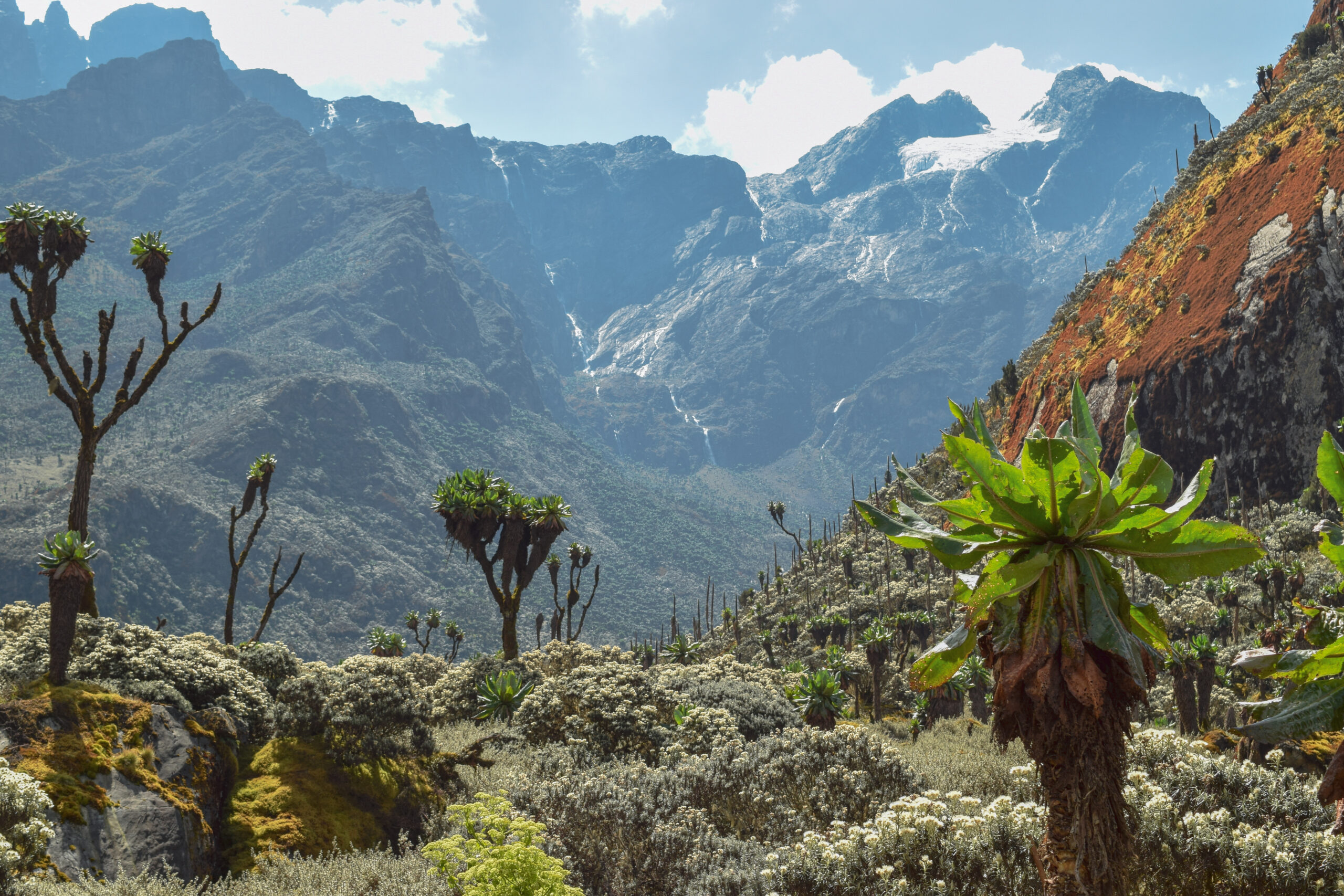
Technical Climbing Hardware
Mount Stanley’s summit climb crosses two distinct glaciers separated by a short rocky scramble, with fixed ropes and ladders on the most exposed sections of the Margherita Glacier and final summit rock wall. The technical hardware required is moderate by global alpine standards but cannot be compromised — failure on these systems at 5,000+ m has severe consequences.
Crampons and Ice Axe
- 12-point automatic crampons — Petzl Vasak Lever Lock, Black Diamond Sabretooth Pro, or equivalent. Must be compatible with your specific boot model. Test fit before the trip.
- Walking ice axe — 55-65 cm length depending on height. General-purpose mountaineering tool, not technical climbing axe. Petzl Glacier Literide, Grivel G1, or similar.
- Crampon storage — Heavy-duty crampon bag to protect pack and clothing from sharp points during transport.
- Spare crampon parts — Anti-balling plates, replacement straps. Repair kit for emergency tightening.
Harness and Personal Climbing Gear
- Climbing harness with adjustable leg loops — Black Diamond Momentum, Petzl Adjama, or similar. Adjustable legs accommodate puffy pants for summit day.
- Ascender (jumar) — Petzl Ascension or Black Diamond Index. Right-handed for most users. Essential for the Margherita Glacier fixed-rope sections.
- Two locking carabiners — One pear-shaped (HMS) for belay/rappel, one D-shaped for clipping in. Black Diamond RockLock or Petzl William.
- Two non-locking carabiners — For ascender attachment and general rigging. Wire-gate preferred.
- Belay/rappel device — ATC-style tube device or Petzl Reverso. Used for descending fixed ropes.
- 120 cm sling — Dyneema or nylon for backup tether and ascender daisy.
- Prusik cord — 1.5 m of 6 mm cord for emergency self-rescue and ascender backup.
Ropes and Group Hardware
- Glacier rope — 40-60 m dynamic rope, 8.5-9 mm. Provided by guide for roped glacier travel teams.
- Helmet — Mountaineering helmet for falling rock and ice protection. Petzl Meteor or Black Diamond Vapor type. Some operators include, some require personal.
- Ice screws — Group hardware carried by guides for emergency anchor placement.
- Pickets and pulleys — Crevasse rescue hardware. Group equipment.
- UWA fixed ropes and ladders — Installed and maintained by Uganda Wildlife Authority on the most exposed Margherita Glacier sections and the summit rock wall.
Mount Stanley summit day is not the place to learn crampon technique. Practice walking with crampons, basic ice axe self-arrest, ascender use on fixed ropes, and rappel descent before arriving in Uganda. Most operators include a brief technique session at Bujuku or Elena Hut, but climbers who arrive with established skills navigate the summit day significantly more safely. Local Ugandan guides have summited 200+ times but cannot teach fundamental technique mid-climb.
Clothing Layer System
The Rwenzori climate is fundamentally different from typical alpine ranges. Equatorial position means relatively warm temperatures even at altitude — summit day rarely drops below -10°C and approach trekking can reach 25°C. However, persistent moisture from rain and bogs means clothing must handle being wet and drying repeatedly across multiple days. Synthetic insulation outperforms down in these conditions because down loses loft when wet and takes days to dry inside humid hut conditions.
Base Layers
- 2-3 sets merino or synthetic base layer tops — Long sleeve, lightweight, multiple sets for rotation. Merino wool resists odor better during 7-10 day trips.
- 2 sets merino or synthetic base layer bottoms — Long underwear, lightweight to midweight.
- Sports bra (women) — Two sets, synthetic or merino.
- Liner socks — Synthetic, multiple pairs. Help reduce blisters during long approach trekking days.
Midlayers
- Lightweight fleece — Patagonia R1 or similar. Active layer for cool weather.
- Synthetic puffy jacket — Patagonia Nano Puff or similar. Critical: synthetic, not down, due to wet conditions.
- Softshell pants — Active trekking pants for approach. Water-resistant but breathable.
- Trekking shirt — Lightweight long sleeve for sun protection.
Waterproof Shell System
- Genuinely waterproof shell jacket — Gore-Tex Pro 3-layer or equivalent. Standard hiking rain jackets are insufficient for Rwenzori conditions. Patagonia Triolet, Arc’teryx Beta AR or similar.
- Genuinely waterproof shell pants — Full-zip preferred for easy on/off over boots. Must handle continuous rain and bog crossings without wetting through.
- Pack rain cover — Plus internal dry bags as backup. Standard pack rain covers fail in continuous heavy rain.
- Waterproof gloves — Outdoor Research Stormtracker or similar. Synthetic insulation for wet conditions.
Summit Day Insulation
- Heavier synthetic puffy — Patagonia DAS Parka or Arc’teryx Atom AR Hoody. Worn over shell on summit day for warm pre-dawn glacier start.
- Heavy gloves — Insulated mountaineering gloves for summit climbing. Black Diamond Guide or Outdoor Research Alti.
- Buff or neck gaiter — Face protection from wind and sun reflection off ice.
- Beanie / warm hat — Fleece or wool, fits under helmet.
- Sun hat — Wide brim for approach days at altitude. Heavy UV exposure near equator.
Footwear and Foot Protection
Footwear for Mount Stanley balances three competing demands: comfort for 4-6 days of approach trekking, ability to cross deep bogs without disintegrating, and rigidity for crampon use on summit day. Most climbers use a single boot that handles all three, though some bring two pairs and switch at Bujuku Hut.
Mountaineering Boots
- B2-rated mountaineering boots — Compatible with 12-point automatic crampons. Single-boot construction is adequate given moderate temperatures.
- La Sportiva Trango Tower Extreme, Scarpa Mont Blanc Pro, La Sportiva Nepal Cube — Established options for this altitude and use case.
- Waterproof and well broken-in — Boots that aren’t broken in will destroy your feet during the 5-7 day approach.
- Goretex membrane for waterproofing, though no membrane fully resists continuous Rwenzori moisture.
Gaiters — Heavy Duty
- Full-length heavy-duty gaiters — Outdoor Research Crocodile or similar. These get more use on Mount Stanley than nearly any other climb due to deep bogs.
- Velcro or zip closure with reinforced lower section to handle continuous mud and bog crossings.
- Backup pair — Cheap secondary pair worth bringing as primary gaiters often fail mid-trip.
Approach Trekking Boots (Optional)
- Waterproof hiking boots — For lower-elevation forest approach days where heavy mountaineering boots are overkill.
- Switch to mountaineering boots at Bujuku Hut or John Matte Hut.
- Adds 1-2 kg to porter load — Consider whether the comfort gain justifies the extra weight given porters carry your gear.
Socks
- 3-4 pairs medium-weight wool/synthetic blend — Smartwool, Darn Tough, or similar. Multiple pairs essential for rotation during wet conditions.
- 2 pairs heavy mountaineering socks — For summit day with crampons.
- 4-6 pairs liner socks — Synthetic, reduce blistering during multi-day approach.
- Camp socks — Dry pair reserved for hut/tent use only.
The Bigo Bog and other approach trail sections cannot be crossed dry. Even with heavy-duty gaiters and waterproof boots, expect wet feet most days. Most experienced Rwenzori climbers accept this reality, focus on keeping summit-day footwear dry inside huts, and rotate through multiple sock pairs. Bring a small bottle of foot powder and check for blisters daily.
Sleeping and Camping Gear
Mount Stanley climbers stay in established huts on both the Central Circuit and Kilembe Trail. Huts include mattresses and basic shelter, but climbers bring their own sleeping bags and supplementary pads. Operator-provided gear in this category varies — confirm specific inclusions during booking.
Sleeping Bag
- Sleeping bag rated to -10°C — Synthetic insulation strongly preferred over down for wet conditions. Mountain Equipment Aurora or similar synthetic bag.
- Compression sack with dry bag — Double protect against moisture during transport.
- Silk or synthetic liner — Adds 5-10°C warmth and improves hygiene during multi-night use.
Sleeping Pad
- Inflatable pad for hut bunks — Therm-a-Rest NeoAir XLite or similar. Hut mattresses are basic; personal pad improves sleep significantly.
- Closed-cell foam backup — Optional. Doubles as sit pad and emergency insulation.
Hut Infrastructure
- Mattresses and basic shelter at each overnight stop along established trails.
- Cooking facilities with meals prepared by porter team.
- Water from glacier streams and rainwater collection (filtered or boiled by cook team).
Personal Supplies and Safety
Personal supplies for Mount Stanley combine standard mountaineering essentials with specific Rwenzori additions for tropical disease risk and the wet climate.
Headlamp and Lighting
- Primary headlamp with 300+ lumen output — Petzl Actik Core, Black Diamond Spot 400. Essential for 2 AM summit start.
- Backup headlamp — Smaller secondary unit. Critical for summit day given pre-dawn departure.
- Extra batteries — Lithium batteries perform better in cold than alkaline.
Hydration and Nutrition
- Two 1-liter water bottles — Nalgene or similar. Hydration bladder hoses freeze on summit morning.
- Thermos for hot drinks on summit day — Stanley or similar 500 ml.
- Personal trail snacks — Energy bars, gels, dried fruit. Operator meals are filling but heavy on starches; personal snacks fill gaps.
- Electrolyte tablets — Nuun, SaltStick, or similar.
First Aid and Medications
- Personal first aid kit — Blister treatment (moleskin, KT tape), pain relievers, antiseptic, bandages.
- Diamox for altitude prophylaxis — 250 mg twice daily starting 24 hours before reaching altitude.
- Antimalarial medication — Required for Uganda entry. Consult travel doctor for specific protocol.
- Personal prescription medications for full trip duration plus buffer.
- Anti-diarrheal medications — Loperamide for travel illness.
- Sunscreen SPF 50+ — UV exposure intense at equator. Lip balm with SPF.
Navigation and Electronics
- Smartphone with offline maps — Gaia GPS, Maps.me with Rwenzori area downloaded.
- Portable power bank — 10,000 mAh minimum, no electricity at higher huts.
- Camera and extra batteries — Cold drains batteries faster.
- Garmin InReach Mini — Optional but valuable for satellite messaging in remote glaciated terrain.
Pack and Carry Systems
- 40-50 liter day pack — Personal items you carry yourself.
- 80-90 liter duffel bag — Porter-carried gear. Heavy-duty waterproof North Face Base Camp or Patagonia Black Hole.
- Multiple dry bags — Separate sleeping bag, electronics, clean clothes inside duffel.
- Trekking poles — Black Diamond Distance Carbon Z or similar. Significantly reduce knee strain on descent days.
Climate-Specific Gear Tips
The Rwenzori’s equatorial-wet climate creates specific gear challenges absent from most high-altitude environments. Standard alpine packing lists need modifications.
Synthetic over down everywhere possible
Down insulation loses 80% of its loft when wet and takes 24-48 hours to dry inside humid hut conditions. Synthetic insulation maintains 60-70% of its loft when wet and dries overnight. Bring synthetic puffy jackets, synthetic sleeping bag, synthetic mid-layers. The single area where down still works is summit-day light puffy worn under a shell — but synthetic equivalent is safer.
Dry bags everywhere
Every item in your duffel and day pack should be inside a dry bag. Pack rain covers fail during continuous Rwenzori rain. Use 2-4 small dry bags inside the duffel rather than one large bag — failures isolate damage. Heavy-duty plastic trash bags as backup work fine.
Drying time matters
Bring 2-3 sets of base layers and rotate them. Wet base layers don’t fully dry inside humid huts overnight. Wearing damp base layers next day causes hypothermia risk at altitude. Sock rotation is even more critical — bring 4+ pairs and rotate daily.
Footwear handling
Remove mountaineering boots immediately on arriving at huts. Pull insoles to allow drying. Stuff boots with newspaper or dry cloth if available. Plan for boots to be wet on the inside for most of the trip — this is normal in Rwenzori conditions.
Mount Stanley demands more careful gear thinking than many higher peaks because the wet equatorial climate creates conditions standard mountaineering kit isn’t designed for. Climbers with significant Aconcagua, Mont Blanc, or Denali experience often arrive overprepared for cold and underprepared for wet. The Rwenzori reward climbers who research local conditions specifically rather than applying generic alpine packing lists.
Mount Stanley Gear Frequently Asked Questions
What gear do I need for Mount Stanley?
Mount Stanley requires technical mountaineering equipment including 12-point automatic crampons, climbing harness with adjustable leg loops, ascender, two locking carabiners, and a helmet. Essential clothing includes waterproof shell jacket and pants, insulating midlayers, gloves, and mountaineering boots compatible with crampons. The equatorial Rwenzori climate adds specific requirements: heavy-duty gaiters for deep bogs, multiple full changes of waterproof outer layers, and gear that handles continuous moisture better than typical alpine kit.
What boots do I need for Margherita Peak?
Mount Stanley climbers need mountaineering boots compatible with 12-point automatic crampons — single-boot construction is acceptable given the moderate altitude. La Sportiva Trango Tower Extreme, Scarpa Mont Blanc Pro, or equivalent B2-rated boots work well. Boots must handle three days of bog crossings and approach trekking before the summit-day glacier climb. Some climbers bring lighter trekking boots for the lower approach and switch to mountaineering boots from Bujuku Hut upward.
Do I need to bring my own ropes and crampons?
Most operators include glacier ropes, harnesses, helmets, and basic technical hardware in their expedition packages. Climbers typically need to bring their own crampons, ice axe, gaiters, gloves, and all personal clothing. Operator-provided gear varies in quality — confirm specific inclusions during booking. The Uganda Wildlife Authority maintains fixed ropes and ladders on Margherita Glacier exposed sections.
How does the Rwenzori climate affect gear choices?
The Rwenzori Mountains are among the wettest mountains in Africa, receiving heavy rainfall year-round even during dry seasons. Standard alpine gear designed for cold-dry conditions performs poorly. Climbers need genuinely waterproof shell layers, synthetic insulation rather than down (which loses loft when wet), heavy-duty gaiters for the deep bogs on the approach, and multiple full changes of clothing. Dry bags for sleeping bags and electronics are essential.
What clothing should I bring for Mount Stanley?
Layer system covering 25 to minus 10 Celsius range. Base layers (2-3 sets merino or synthetic), midlayers (fleece plus synthetic puffy), shell layer (genuinely waterproof jacket and pants), summit-day insulation (heavier puffy worn over shell on summit day), gloves (3 pairs: liner, midweight, heavy), warm hat plus sun hat, multiple pairs of socks, gaiters, and base camp clothing. Synthetic insulation is strongly preferred over down due to the wet conditions on the approach.
Need the full Mount Stanley climbing guide?
This gear list is part of our complete Mount Stanley climbing resource covering routes, history, permits, costs, best season, hazards, and the full expedition planning framework for Africa’s third-highest summit.
Continue your Mount Stanley research
Six companion guides cover every aspect of climbing Margherita Peak. Currently viewing the Gear List.
Was this helpful?
🏔Related peaks nearby
🧭Explore & compare
Global Summit Guide is an independent mountaineering resource founded in 2026. The team combines first-hand trekking and climbing experience with in-depth research and professional health and nutrition review to help climbers choose objectives, prepare properly, and stay safe.
Health, altitude, and nutrition content is reviewed by Taylor Ludlow (Registered Nurse) and Brigg Hoopes (Nutritionist).
What We Don't Know Yet
Mountain information changes quickly. This box explains the limits of what this page can responsibly promise.
- Weather, snowpack, avalanche risk, road access, and route conditions can change quickly and may be different on your climbing dates.
- Route conditions, trailhead access, crevasse exposure, stream crossings, and rescue access may vary from published planning guidance.
- Gear requirements can change by season, route variation, weather window, personal cold tolerance, and guide-service requirements.
- Visa, passport, vaccination, border, insurance, and local transportation rules may change before your trip.
Verify current conditions with official land managers, guide services, local forecasts, and current route reports before booking or climbing.
Mountaineering, rock and ice climbing, glacier travel, and high-altitude activity are inherently dangerous and can result in serious injury or death. The information on Global Summit Guide is provided for general informational and educational purposes only and is not a substitute for professional instruction, qualified guiding, proper equipment, or your own judgment and experience.
Route conditions, weather, snowpack, permits, regulations, and hazards change constantly and may differ from what is described here. Details may be incomplete, out of date, or contain errors. Always verify current information with local authorities, certified guides, and official sources before making any decision in the mountains.
Nothing on this site is medical, legal, or financial advice. Our fitness, acclimatization, altitude, and nutrition content is general in nature; consult a qualified physician before beginning any strenuous exercise program or exposing yourself to high altitude.
You are solely responsible for your own safety and decisions. To the fullest extent permitted by law, Global Summit Guide and its team accept no liability for any loss, injury, damage, or expense arising from use of, or reliance on, this information. By using this site you acknowledge these risks and accept these terms.
Some links on this site may be affiliate links. If you buy through them we may earn a small commission at no extra cost to you; this never affects our recommendations.
Global Summit Guide recommendation path
Next Best Mountain to Research
Use these recommendations to continue the right planning path instead of stopping on one page.
Use current permit, weather, route, and operator information before booking or climbing.