
Last updated October 15, 2026
Camino de Santiago: Find the Route That Fits Your Journey.
The Camino is not one trail. Five major historic routes reach Santiago de Compostela by very different roads. Compare the Francés, Portugués, del Norte, Primitivo and Inglés by distance, time, terrain and atmosphere—then plan the walk that is right for you.

Choose the experience first. Choose the distance second.
The Camino Francés is the best default for a social first pilgrimage. Portugués is ideal for a roughly two-week journey from Porto. Del Norte rewards walkers who love Atlantic scenery and quieter company. Primitivo suits stronger hikers who want hills and history. Inglés from Ferrol offers a complete named Camino in about a week.
For a short, highly serviced walk, the final Francés from Sarria is another strong one-week choice. It is a section of the larger French Way rather than a separate route.
Choose Your Camino de Santiago Route
Each route has its own pace and personality. Use the filters to shortlist your options, or read all five before choosing. These are route-selection ranges, not precise GPS totals.
 The classic choice
Camino Francés
The most established pilgrim network: historic towns, the Pyrenees, the Meseta, abundant albergues, and the strongest chance of finding Camino community.
Choose it for: your first full Camino, social walking, flexible start points.
Explore the Camino Francés →Photo: Simon Burchell / Wikimedia Commons · CC BY-SA 4.0 Two-week international route
Camino Portugués
A strong first international Camino. Walk the historic inland Central Way or take Atlantic scenery on the Coastal route before the branches converge in Galicia.
Choose it for: a shorter Camino, Portugal, heritage or ocean views.
Compare Central and Coastal →Porto Cathedral image: Wikimedia Commons · source/license Atlantic scenery
Camino del Norte
Green headlands, coastal cities and repeated hills. Quieter than the Francés, though weather and less-dense accommodation make the planning more demanding.
Choose it for: Atlantic landscapes, cooler summer walking, less crowding.
Explore the Northern Way →Photo: José Antonio Gil Martínez / Wikimedia Commons · CC BY 2.0 Historic mountain route
Camino Primitivo
The steeper, older Camino, with Asturian ridges, rural stages and weather-exposed choices. Shorter than the Francés, but often harder day to day.
Choose it for: fitter walkers, history, mountain effort and quiet.
Explore the Original Way →Photo: Simon Burchell / Wikimedia Commons · CC BY-SA 4.0 One-week pilgrimage
Camino Inglés
A complete named pilgrimage from Ferrol, tracing the historic path of pilgrims who arrived in Galicia by sea. Compact but genuinely rewarding.
Choose it for: one-week travel, first-time pilgrims and a full start-to-finish route.
Explore the English Way →Pontedeume image: Wikimedia Commons · source/licenseCamino Routes Compared
Distances vary according to start, variant, detours and measuring method. Use these figures to choose the route, then finalize stages in the dedicated guide.
| Route | Common start | Approx. length | Typical walking time | Physical feel | Best fit |
|---|---|---|---|---|---|
| Francés | Saint-Jean-Pied-de-Port | ~780 km | 32–38 days | Moderate; hard Pyrenean opening, high cumulative mileage | First long Camino; social route |
| Portugués | Porto | ~250 km Central / ~280 km Coastal | 10–14 days | Easy–moderate; pavement, rolling terrain, coastal exposure | Two-week international pilgrimage |
| del Norte | Irún | ~800 km | 35–40 days | Moderate–hard; frequent climbs, wetter weather | Atlantic landscapes and quieter walking |
| Primitivo | Oviedo | ~300–320 km | 12–15 days | Harder; mountains, long ups/downs, weather exposure | Stronger hikers and history |
| Inglés | Ferrol | 112.4 km | 5–6 days | Moderate; short but rolling | Complete Camino in one week |
The usual 100 km walking rule for the Compostela requires a continuous, recognized route into Santiago and proper documentation; a distance figure alone does not establish qualification.

More Than a Long-Distance Walk.
The routes toward Santiago grew around pilgrimage to the shrine and tomb traditionally associated with Saint James. Centuries of hospitality, churches, bridges, towns and shared symbols make the Camino a cultural and religious road as well as a walking journey.
The yellow arrow tells you which way to go. The scallop shell evokes the pilgrim tradition. The albergue can become a community of familiar faces. And Santiago gives thousands of different journeys one destination.
Anyone may walk the Camino, including people whose reasons are cultural, personal or reflective. The Cathedral’s traditional Compostela, however, retains specific religious or spiritual criteria. Respect for the pilgrimage’s origins and openness to different walkers can coexist.
One Week, Two Weeks, or Five Weeks?
Don’t force a famous route into an unsuitable calendar. Decide how much time you have, then give the walk enough room for fatigue and arrival in Santiago.
The compact Camino
Camino Inglés from Ferrol, or the final Francés from Sarria. Both fit a shorter holiday; the former is a full named route and the latter a popular section.
See the Inglés →The two-week journey
Portugués from Porto for Central or Atlantic character, or the more strenuous Primitivo from Oviedo if hills are part of the appeal.
See the Portugués →The long pilgrimage
Walk the full Francés for social Camino tradition or the Norte for coast, rain, hills and more space between other pilgrims.
See the Francés →Eight Decisions That Make the Walk Work
The detailed logistics live in How to Walk the Camino. This is the quick framework to use before buying flights or booking beds.
Choose your Camino
Decide whether your priorities are community, coast, history, hills or a compact itinerary.
Pick a realistic start
Calculate walking days and travel access before committing to a famous trailhead.
Set a daily range
Many first-timers plan roughly 18–25 km a day, then adjust for terrain and recovery.
Choose lodging style
Public albergues, private hostels and hotels change budget, privacy and spontaneity.
Get the passport
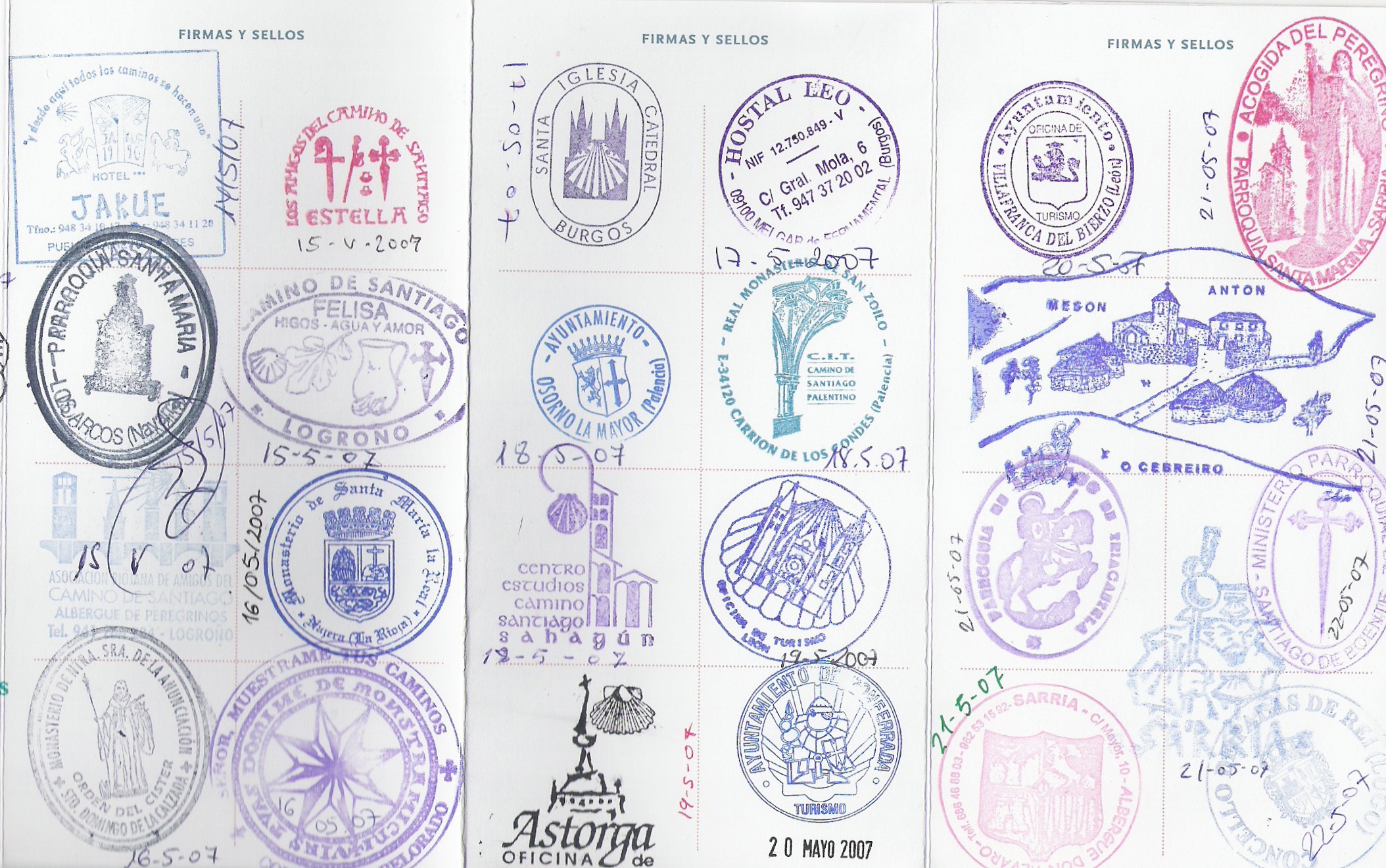
Carry an accepted pilgrim credential and collect the required stamps.
Protect your feet
Use proven footwear, repeatable clothing and appropriate rain protection.
Reserve constraints
Secure your first night, crowded bottlenecks and Santiago arrival as needed.
Leave a Santiago buffer
Make room for the Cathedral, certificate process and a recovery day.
How the Compostela Works
The Cathedral’s Pilgrim’s Reception Office sets the current requirements. For a traditional Compostela, the normal distance threshold is at least 100 continuous kilometres on foot or horseback, or 200 kilometres by bicycle, along a recognized route that finishes at Santiago.
Carry an authorized Credencial del Peregrino and obtain at least two dated stamps per day through the qualifying section. The Compostela has religious or spiritual conditions; another official Certificate of Distance is available for those seeking a record of their route.
The exact rules contain exceptions—including some recognized routes begun outside Spain—and can change. Check the official office before relying on an edge case.
Weather, Beds and Cost Change the Camino.
May–June & September–October
Often milder than high summer on inland routes. The Norte and Primitivo can remain wetter and cooler, and mountain sections need season-specific checks.
Compare months →Albergue, Pension or Hotel?
Galicia’s public pilgrim-hostel network was listing €10 per night at the September 2026 review. Prices, closures and booking rules differ by region and operator; verify current listings.
Understand albergues →Build a Budget by Style
Budget depends primarily on lodging, restaurant meals, transit, baggage transfer, and rest days—not on one universal Camino entry fee.
See the Camino cost guide →Camino de Santiago Orientation Map
The Camino routes approach Santiago from different parts of Spain and Portugal. This map orients you to northwestern Iberia and the shared destination; it does not draw the official walking tracks or replace route GPX and current waymarking.
One Route Decision Should Lead to the Next Useful Guide.
This Camino hub helps you choose. These dedicated articles handle the depth you need next, without making every route page repeat the same advice.
Camino de Santiago FAQ
Which Camino is best for a first-time pilgrim?
The Camino Francés is usually the easiest full Camino to understand logistically because its albergues, signs, cafés and pilgrim community are extensive. If you have about two weeks, the Camino Portugués from Porto is another excellent first choice.
How long does it take to walk the Camino de Santiago?
From 5–6 walking days on the Camino Inglés from Ferrol, to about two weeks from Porto, to roughly five weeks for the full Camino Francés. Exact time depends on your start, rest days, fitness and route variants.
How far do you need to walk for the Compostela?
The general rule is at least 100 continuous kilometres on foot or horseback on a recognized route into Santiago; cyclists generally need 200 km. An accepted credential and stamp requirements also apply. Check the Pilgrim Office for exceptions and current rules.
Can a nonreligious person walk the Camino?
Yes. The routes welcome religious, spiritual, cultural and personal journeys. The Cathedral’s traditional Compostela has its own motivation requirements, and the Pilgrim’s Office provides a Certificate of Distance for documentation of the walk.
When is the best month to walk?
Late spring and early autumn are strong general choices. Inland Francés sections can be hot in July and August; the Norte is often wetter and the Primitivo has more weather-exposed mountain terrain. Choose a season for your specific route.
Can I walk the Camino alone?
Yes. Solo pilgrims are common. Popular routes make it easy to meet others; quieter routes need more attention to lodging availability, water, weather, pace and transportation.
Do I need to book accommodation?
Not always. Booking the first night, busy holiday stretches and Santiago can reduce stress. Public albergue access differs from privately reservable pensions and hotels; use a hybrid approach where flexibility matters.
Verify the Rules That Affect Your Journey.
Route distances, credential procedures, public-hostel fees and office access can change. The underlying Global Summit Guide research was checked September 9, 2026. Confirm time-sensitive details with the institutions that administer them before departure.
Photography is credited under each image to its existing Wikimedia Commons source; those file pages provide the applicable licenses. The guide presents planning ranges and editorial comparisons, not a substitute for current official maps, closures or access rules.
Your Best Camino Is the One You Can Walk Well.
Choose the route for its fit—not because it is the longest, most famous or most difficult. Then give yourself time to notice the people, towns and traditions along the road to Santiago.
Was this helpful?
Global Summit Guide is an independent mountaineering resource founded in 2026. The team combines first-hand trekking and climbing experience with in-depth research and professional health and nutrition review to help climbers choose objectives, prepare properly, and stay safe.
Health, altitude, and nutrition content is reviewed by Taylor Ludlow (Registered Nurse) and Brigg Hoopes (Nutritionist).
What We Don't Know Yet
Mountain information changes quickly. This box explains the limits of what this page can responsibly promise.
- Route conditions, trailhead access, crevasse exposure, stream crossings, and rescue access may vary from published planning guidance.
- Visa, passport, vaccination, border, insurance, and local transportation rules may change before your trip.
- Route conditions, snowpack, closures, and weather can change quickly after this page is updated.
- Permit rules, fees, quotas, and reservation windows may change between review cycles.
- Operator availability, pricing, guide ratios, and cancellation terms can change by season.
Verify current conditions with official land managers, guide services, local forecasts, and current route reports before booking or climbing.
Mountaineering, rock and ice climbing, glacier travel, and high-altitude activity are inherently dangerous and can result in serious injury or death. The information on Global Summit Guide is provided for general informational and educational purposes only and is not a substitute for professional instruction, qualified guiding, proper equipment, or your own judgment and experience.
Route conditions, weather, snowpack, permits, regulations, and hazards change constantly and may differ from what is described here. Details may be incomplete, out of date, or contain errors. Always verify current information with local authorities, certified guides, and official sources before making any decision in the mountains.
Nothing on this site is medical, legal, or financial advice. Our fitness, acclimatization, altitude, and nutrition content is general in nature; consult a qualified physician before beginning any strenuous exercise program or exposing yourself to high altitude.
You are solely responsible for your own safety and decisions. To the fullest extent permitted by law, Global Summit Guide and its team accept no liability for any loss, injury, damage, or expense arising from use of, or reliance on, this information. By using this site you acknowledge these risks and accept these terms.
Some links on this site may be affiliate links. If you buy through them we may earn a small commission at no extra cost to you; this never affects our recommendations.
Global Summit Guide recommendation path
Next Best Mountain to Research
Use these recommendations to continue the right planning path instead of stopping on one page.
Use current permit, weather, route, and operator information before booking or climbing.
Search Flights, Hotels & Rental Cars
Have the mountain or destination picked? Use Expedia to compare the flights, lodging and rental cars that fit your actual trip dates. For mountain travel, consider arriving early enough for delays and adding a buffer night after the climb before a fixed flight home.
Compare current flight, hotel and car options.
Affiliate disclosure: Global Summit Guide may earn a commission if you book through this link, at no additional cost to you.