
Complete Guide to Essential Mountaineering Skills
The 10 core skill categories every mountaineer must master, from foot skills and ice axe self-arrest through rope work, anchors, glacier travel, and self-rescue. Comprehensive 2026 pillar reference covering progression from beginner to advanced level, learning timelines, common mistakes, and cross-references to deep-dive guides for each skill category.
This pillar guide synthesizes technical content from American Mountain Guides Association (AMGA), American Alpine Institute (AAI), International Federation of Mountain Guides Associations (IFMGA), and American Alpine Club published curriculum, cross-referenced with personal field experience. No affiliate partnerships influence recommendations. Specific brand mentions are illustrative, not endorsements. See full methodology and editorial standards below.
📑 On This Page
- What Are Mountaineering Skills?
- Tier 1: Foundation Skills
- 1. Foot Skills + Crampons
- 2. Ice Axe Mastery
- 3. Rope Work + Knots
- Tier 2: Intermediate Skills
- 4. Belay Techniques
- 5. Anchor Building
- 6. Glacier Travel
- 7. Rappelling
- Tier 3: Advanced Skills
- 8. Navigation + Route Finding
- 9. Mountain Weather + Decisions
- 10. Self/Partner Rescue
- Progression Path
- How to Learn These Skills
- Common Mistakes
- The Skills Cluster
- FAQ
- Methodology + Sources
⚡ Quick Answer: The 10 Essential Mountaineering Skills
Foundation Skills (months 1-6): (1) Foot skills + crampon technique · (2) Ice axe mastery + self-arrest · (3) Rope work + knots
Intermediate Skills (months 6-12): (4) Belay techniques · (5) Anchor building · (6) Glacier travel + crevasse rescue · (7) Rappelling
Advanced Skills (months 12-24+): (8) Navigation + route finding · (9) Mountain weather + decision making · (10) Self rescue + partner rescue
How This Guide Was Built — Field Experience Foundation
This pillar guide draws on personal mountaineering experience across Mount Kilimanjaro (Tanzania, 5,895m), multiple Mexican volcanoes including Pico de Orizaba (5,636m) and Iztaccíhuatl (5,230m), Rainier-class peaks in the Pacific Northwest, and extensive expedition trekking experience. Specifically, the skill descriptions and progression guidance reflect what was actually required and used during these climbs, not just theoretical knowledge.
Notably, this is a pillar post — designed to anchor the broader Skills cluster on Global Summit Guide. Each of the 10 skill categories will receive dedicated deep-dive coverage in supporting posts (see the cluster structure below). Where supporting posts exist, this pillar links to them; where they’re still in development, the pillar provides the foundational treatment that the deep-dive will expand upon. The pillar will be updated quarterly as new supporting posts publish.
🏔 The Mountaineering Skills Framework
Mountaineering competency is built in three tiers: Foundation, Intermediate, and Advanced. First, the Foundation tier establishes the non-negotiable safety skills — foot skills, ice axe self-arrest, and the essential knots that all roped work depends on. Second, the Intermediate tier adds the rope-based skills that enable climbing with partners: belay technique, anchor construction, glacier travel, and rappelling.
Third, the Advanced tier develops the judgment and rescue skills that separate confident mountaineers from competent ones: navigation in poor visibility, weather decision-making, and self-rescue capabilities. Fourth, all three tiers require extensive field practice — typically 50-100 climbing days per year — for skills to become reliable under real conditions. Fifth, formal instruction is essential for the intermediate and advanced skills; the foundation skills can be self-taught but professional courses dramatically accelerate progression.
Mountaineering skills are the combined technical, decision-making, and rescue competencies required to travel safely in mountainous terrain that includes snow, ice, glaciers, rock, exposure to fall hazards, and the consequences of remoteness from professional medical or rescue support. Generally, these skills distinguish mountaineering from hiking (which requires only basic outdoor skills) and from rock climbing (which is one component of mountaineering rather than the complete discipline). Specifically, mountaineering skills are organized in standard curricula by organizations including the American Mountain Guides Association (AMGA), American Alpine Institute (AAI), British Mountaineering Council (BMC), and International Federation of Mountain Guides Associations (IFMGA). Notably, while specific techniques vary by region, the 10 core skill categories described here are universal — every mountaineer eventually develops all of them.
Key Takeaways
- 10 core skill categories organized in three tiers: Foundation, Intermediate, Advanced.
- Foot skills come first — confident footing prevents falls in the first place.
- Ice axe self-arrest is the most critical single skill — practice 50-100 times before relying on it.
- Knots are foundational — memorize 8 essential knots until they’re muscle memory.
- Formal courses are essential for intermediate/advanced skills — 5-7 day courses cost $500-$1,500.
- Crevasse rescue is the hardest single skill — practice repeatedly until systematic.
- Decision-making cannot be taught from a book — requires extensive field time.
- Skill progression takes 12-24 months with 50-100 climbing days per year.
- Cost: $500-$3,000 for initial course + essential gear.
- Practice each skill regularly — skills decay without use.
📊 Mountaineering Skills Quick Facts
- Skill Categories
- 10 (3 tiers)
- Foundation Skills
- 3 (months 1-6)
- Intermediate Skills
- 4 (months 6-12)
- Advanced Skills
- 3 (months 12-24+)
- Most Important Skill
- Ice axe self-arrest
- Hardest Skill
- Crevasse rescue
- Practice Required
- 50-100 days/year
- Formal Course Cost
- $500-$1,500
- Course Duration
- 5-7 days typical
- Initial Gear Cost
- $1,500-$3,000
- Total Skill Timeline
- 12-24 months
- Boots Required
- B1-B3 (varies)
- Crampons Required
- 12-point
- Ice Axe Length
- 45-55 cm
- Rope Diameter
- 8.5-9.8mm dynamic
- Essential Knots
- 8 to memorize
- Belay Methods
- 4 standard
- Anchor Types
- 3 major categories
- Standard Cert Bodies
- AMGA, AAI, IFMGA
- Annual Skills Audit
- Recommended
✓ Editorial Trust Signals
- First-hand: Kilimanjaro + Mexico volcanoes climbs
- Independent: No affiliate sponsorship
- Cross-referenced: AMGA, AAI, IFMGA curricula
- Last verified: June 9, 2026
- Review cycle: Quarterly
- Safety review: Dawson Ludlow (WFA)
- Gear review: Walker Ludlow
- 200+ source pages: Cross-linked
What Are Mountaineering Skills?
Mountaineering skills are the combined technical, decision-making, and rescue competencies required to travel safely in mountainous terrain. Generally, they distinguish mountaineering from hiking (which requires only basic outdoor skills) and from rock climbing (which is one component of mountaineering rather than the complete discipline). Specifically, mountaineering involves traveling off-trail through snow, ice, glaciers, rock, and exposed terrain — often at altitude, often in remote locations, and often under conditions where weather, route finding, and rescue concerns become survival-critical.
The 10 skill categories described in this pillar guide are organized by three tiers of progression: Foundation, Intermediate, and Advanced. Generally, these tiers correspond to typical learning timelines: Foundation skills in months 1-6, Intermediate in months 6-12, Advanced in months 12-24+. Specifically, each tier builds on the previous one — you cannot safely learn intermediate skills without solid foundation skills, and advanced judgment cannot develop without extensive field application of intermediate techniques.
Tier 1: Foundation Skills (Months 1-6)
The Foundation tier comprises three skills that every mountaineer must develop before attempting any technical climbing. Generally, these are the non-negotiable safety skills — foot skills that prevent falls, ice axe self-arrest that recovers from falls, and the knots that all roped work depends on. Specifically, the foundation skills can largely be self-taught with diligent practice and good resources, though a basic course substantially accelerates progression.
1. Foot Skills and Crampon Technique
Walking on snow, ice, and mixed terrain — the foundation of everything else.
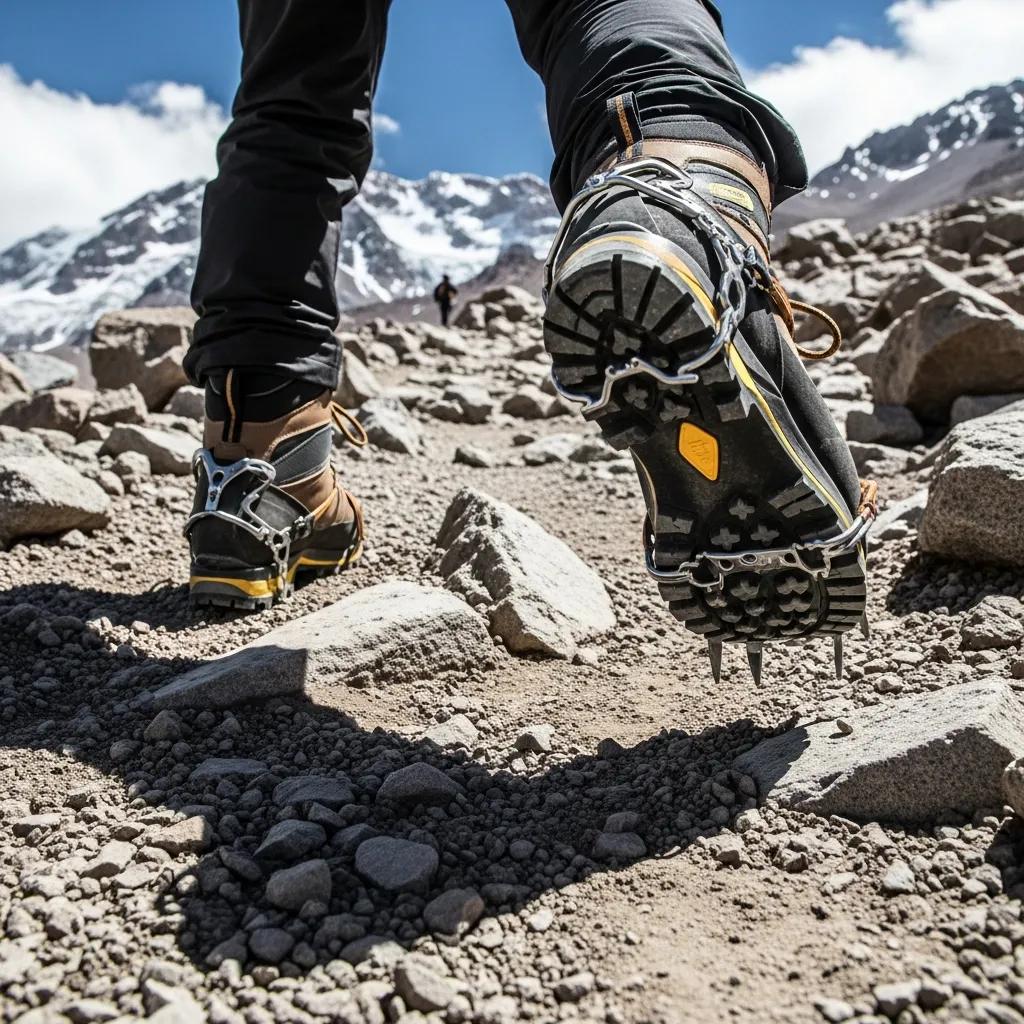
Foot skills are the foundation of all mountaineering. Generally, confident footing prevents falls in the first place, making this skill more important than rescue skills (which assume something has already gone wrong). Specifically, three primary crampon techniques cover all standard terrain:
- French technique (pied à plat): All 10 bottom points of the crampon flat on the snow. Used for low-angle slopes up to approximately 35-40 degrees. Most energy-efficient on moderate terrain. Requires ankle flexibility.
- German technique (frontpoint): Front 2 points kicked perpendicular into steep snow or ice. Used for slopes above 50-55 degrees and on water ice. Requires calf strength and confident commitment.
- American technique (combination diagonal): One foot flat (French), one foot frontpointing (German). The standard technique for moderate slopes 40-55 degrees and for transitions between angles.
Boot and crampon pairing is critical to safe technique. Generally, the B0-B3 rating system pairs boots with crampons: B0 hiking boots accept C1 (strap-on) crampons only; B1 light mountaineering boots accept C1-C2; B2 mountaineering boots accept C2 (semi-automatic); B3 technical boots accept C3 (fully automatic step-in). Notably, mismatched boot-crampon pairings are dangerous — a soft B0 boot in a stiff C2 crampon can flex unpredictably and detach mid-stride.
Dedicated deep-dive coming: “How to Use Crampons: Complete Step-by-Step Guide.”
2. Ice Axe Mastery and Self-Arrest
The single most important mountaineering skill — recovers from falls on snow and ice.
Ice axe mastery is the single most critical mountaineering skill because it is the difference between a survivable slip and a fatal fall on any snow or ice slope. Generally, the ice axe serves multiple functions throughout a climb:
- Cane position: Held in uphill hand on moderate terrain — the most common position during snow approach. The spike enters the snow as the climber’s third point of contact.
- Adze position: Used for chopping steps in firm snow or ice when crampons alone don’t provide security. Also the standard position for arrest.
- Dagger position: The pick driven into steep snow for security on steep ground (50-70 degrees).
- Self-arrest position: The arrested position with axe head buried in snow, body weight on the shaft, feet held off snow to prevent ankle injury.
Self-arrest must be practiced from all four falling positions: head-first feet-down, head-first feet-up, prone (face-down), and supine (back-down). Generally, each requires different recovery mechanics.
Self-arrest must be practiced 50-100 times across multiple sessions before it becomes reliable muscle memory. Specifically, in a real fall a climber has 2-5 seconds before reaching dangerous speed — self-arrest must be reflexive, not deliberate. Generally, practice on a safe snow slope with clear runout. Notably, even experienced climbers practice self-arrest at the start of every climbing season to refresh the reflex.
Dedicated deep-dive coming: “Ice Axe Self-Arrest: The Most Critical Mountaineering Skill.”
3. Rope Work and Essential Knots
Memorize 8 essential knots — the foundation of all roped climbing.
The 8 essential mountaineering knots must be memorized until they can be tied in under 30 seconds, with cold hands, in poor lighting, with eyes closed. Generally, knots are the prerequisite to all roped climbing — without confident knot skills, all other rope-based techniques become unsafe.
The 8 essential knots:
- Figure-eight follow-through: The standard knot for tying into a harness. Easy to inspect visually for correctness.
- Bowline: Alternative tie-in knot, easier to untie under load. Requires a backup stopper knot.
- Clove hitch: Adjustable mid-rope knot, primary belay anchor knot. Adjusts length easily without untying.
- Prusik: Friction knot used for ascending rope, crevasse rescue, and as autoblock backup on rappel.
- Munter hitch: Belay backup knot when a belay device is lost or unavailable.
- Double fisherman’s: Joins two ropes for rappel descent or extended slings.
- Water knot (ring bend): Joins flat webbing for sling construction.
- Overhand on a bight: Quick mid-rope clip-in or anchor point.
Keep a 2-meter piece of cord on your desk or by your TV. Generally, the best climbers can tie all 8 essential knots without looking — the knots are reflexes, not procedures. Specifically, professional guides report tying figure-eight follow-throughs 1,000+ times per season. Notably, the path from “can tie this knot” to “can tie this knot reflexively” takes approximately 100-200 repetitions of each knot.
Dedicated deep-dive coming: “Essential Mountaineering Knots Every Climber Should Know.”
Tier 2: Intermediate Skills (Months 6-12)
The Intermediate tier comprises four skills that require formal instruction and substantial supervised practice. Generally, these are the rope-based skills that enable climbing with partners on technical terrain: belay technique, anchor construction, glacier travel with crevasse rescue, and rappelling. Specifically, attempting to self-teach these skills is risky — an incorrectly built anchor or improperly executed belay can be fatal. Notably, a 5-7 day mountaineering course with AMGA, AAI, or IFMGA instruction is the standard pathway to acquiring intermediate skills safely.
4. Belay Techniques
The partner safety skill — every climbing pair needs reliable belays.
Belay technique is the partner safety skill — the technique by which one climber protects another from falling. Generally, four standard belay methods cover all common climbing scenarios:
- Top rope belay: The simplest belay scenario — rope runs from climber up through an anchor at the top of the route, back down to the belayer. Most beginners learn this first.
- Lead belay: The climber places protection (or clips bolts) while ascending. The belayer feeds out slack and arrests falls. Substantially more complex.
- ATC (Air Traffic Controller) belay: Standard tube device used for most belay scenarios. Requires belayer’s brake-hand attention.
- GriGri (assisted-braking) belay: Camming mechanism that locks under load. Adds safety margin but requires specific technique to feed slack smoothly.
Multi-pitch belay transitions add complexity. Generally, multi-pitch climbing involves multiple rope-lengths stacked vertically with anchor stations between each pitch. Specifically, the belayer at the top of a pitch must transition seamlessly from belaying the climber up to belaying them on the next pitch. Notably, smooth multi-pitch transitions take 50-100 multi-pitch days to master.
Dedicated deep-dive coming: “How to Belay: Top Rope, Lead, and Multipitch Techniques.”
5. Anchor Building
The technical foundation of multi-pitch climbing and mountaineering.
Anchor building is the technical foundation of multi-pitch climbing and mountaineering. Generally, anchors must follow the SERENE-A principles:
- Solid — Each individual placement must be solid
- Equalized — Load distributed evenly across all components
- Redundant — Multiple components so failure of one doesn’t fail the system
- Efficient — Quick to build and dismantle
- No Extension — If one component fails, no shock loading on others
- Angle — The angle between anchor components stays below 60°
Three major anchor categories: (1) Snow anchors include the picket (buried perpendicular to slope), deadman (T-slot anchor with axe or stuff sack buried), and bollard (snow cone or T-slot cut into snow). (2) Ice anchors include ice screws (12-22cm length depending on ice quality) and the V-thread/Abalakov anchor. (3) Rock anchors include cam placements, nut placements, and slings around natural features.
Dedicated deep-dive coming: “Anchor Building for Mountaineering and Climbing.”
6. Glacier Travel and Crevasse Rescue
The hardest single mountaineering skill — must be practiced repeatedly until systematic.
Glacier travel and crevasse rescue is widely considered the hardest single mountaineering skill. Generally, the skill requires multiple interrelated capabilities under time pressure: building a snow anchor while a partner hangs in a crevasse, escaping their hauling weight from your harness, ascending a rope with prusiks, constructing a mechanical advantage system, and performing the actual rescue.
Rope team configuration: Standard rope team configuration for glacier travel is 10-15 meters between climbers on a 60m dynamic rope. Generally, three-person teams are most common (more redundant rescue capability). Specifically, climbers tie into the rope using a figure-eight follow-through with prusiks pre-attached for quick crevasse rescue if needed.
Z-pulley (3:1 mechanical advantage) is the standard crevasse rescue technique. Generally, a Z-pulley uses two prusiks and a redirect carabiner to multiply the rescuer’s pull by approximately 3x. Specifically, the system: (1) builds a T-slot anchor with the axe, (2) transfers load from the rescuer’s harness to the anchor, (3) pre-rigs the Z-pulley, (4) hauls the fallen climber. Notably, in heavy snow conditions or with a heavy victim, a 6:1 mechanical advantage system may be required.
Dedicated deep-dives coming: “Glacier Travel Basics” + “Crevasse Rescue Step-by-Step Guide.”
7. Rappelling
Controlled descent — used for retreat, downclimbing, and route descent.
Rappelling is the controlled descent technique used for retreat from technical climbs, downclimbing complex terrain, and descending climbing routes. Generally, two primary rappel modes:
- Single rope rappel: Used for short descents or when sufficient single-rope length covers the descent. Simplest setup.
- Double rope rappel: Two ropes joined together for longer descents. Allows the rappeller to descend twice the single-rope length, then pull the rope down by one strand to retrieve.
The autoblock backup (third hand) is essential for safety. Generally, a friction hitch (typically a prusik or auto-block knot) below the rappel device locks the rope if the rappeller loses control. Specifically, this is the single most important safety addition to a rappel system. Notably, professional guides require autoblock backups on virtually all rappels.
Dedicated deep-dive coming: “Rappelling Guide: Setup, Technique, and Safety.”
Tier 3: Advanced Skills (Months 12-24+)
The Advanced tier comprises three skills that cannot be taught from a book — they require extensive field time, real-world experience, and emotional self-awareness to develop. Generally, these are the judgment and rescue skills that separate confident mountaineers from competent ones. Specifically, they include navigation in poor visibility, weather decision-making, and self-rescue capabilities. Notably, the time to develop advanced skills extends throughout a mountaineering career — these skills continue to deepen over decades.

8. Navigation and Route Finding
Travel safely when visibility drops to meters — the mark of an advanced mountaineer.
Navigation skills enable travel in low-visibility conditions when GPS signals fail and terrain features disappear in cloud or storm. Generally, advanced navigation combines five interlocking capabilities:
- Topographic map reading: Interpreting contour lines, slope angle, terrain features, and the relationship between map and ground.
- Compass use with declination correction: Most maps are oriented to true north; compasses point to magnetic north. The declination correction must be applied for accurate bearing.
- GPS as backup: GPS provides position confirmation but should not replace map and compass — batteries fail, satellites can be obscured by terrain or weather.
- Altimeter navigation: A wristwatch altimeter provides elevation tracking that helps confirm position on a known route.
- Pace counting and bearing taking: Measuring distances by step count combined with compass bearings to navigate to known waypoints in low visibility.
Notably, GPS technology has not replaced traditional navigation — it has added redundancy. Generally, advanced mountaineers carry a paper map and compass on every climb, regardless of GPS availability.
Dedicated deep-dive coming: “Navigation Skills: Map, Compass, GPS, and Altimeter.”
9. Mountain Weather and Decision Making
The judgment to know when to turn around — the hardest meta-skill in mountaineering.
Mountain weather skills combine observation, interpretation, and decision-making. Generally, mountain weather changes faster and more dramatically than at sea level — afternoon thunderstorms, sudden wind shifts, and rapid temperature drops are routine occurrences that can become life-threatening if missed. Specifically, advanced mountaineers develop the ability to:
- Read clouds: Cap clouds (lenticular formations) over peaks indicate strong winds aloft. Mammatus clouds suggest severe convective activity. Cumulus building before noon predicts afternoon thunderstorms.
- Track barometric pressure: Falling pressure precedes storms; rising pressure suggests clearing. A wristwatch altimeter doubles as barometer.
- Recognize wind pattern shifts: Wind direction reversals or sudden gusts often precede frontal passages.
- Read terrain effects: Lee waves, downslope wind acceleration, and ridge-line venturi effects all create local weather patterns invisible on forecasts.
Summit window assessment is the practical application. Generally, summit windows are 4-12 hour periods of favorable weather suitable for the final push to a summit. Specifically, advanced mountaineers combine multiple data sources — forecasts, local observations, cloud reading, pressure trends — to identify and trust summit windows. Notably, the hardest decision in mountaineering is often the turn-around decision when weather signals are ambiguous.
How to Read a Summit Window →Dedicated deep-dive coming: “How to Read Mountain Weather.”
10. Self Rescue and Partner Rescue
The skills you hope never to use — but absolutely must know.
Self-rescue and partner-rescue skills enable response to emergencies far from professional rescue resources. Generally, mountaineering objectives often place climbers hours or days from organized rescue. Specifically, the core rescue skills include:
- Improvised harness: When equipment is damaged or unavailable, harnesses can be constructed from webbing or rope (Swiss seat, hasty harness).
- Improvised litter: Trekking poles, rope, and clothing can construct an emergency litter for evacuating an injured climber.
- Assisted hoist: Used to raise an injured climber to a ledge or anchor when they cannot climb themselves.
- Counterbalance lower: Used to descend an injured climber when only one rope is available.
- Escaping a stuck rappel: Techniques for recovering when rope is stuck during descent.
- Evacuation prioritization: When to evacuate, when to shelter in place, when to call for outside rescue.
Wilderness First Aid is essential complement to rescue skills. Generally, a Wilderness First Aid (WFA) certification — typically a 16-hour course costing $200-300 — teaches medical response in remote settings. Specifically, key skills include patient assessment, bleeding control, splinting, hypothermia/heatstroke management, and medical evacuation criteria. Notably, professional guides often hold Wilderness First Responder (WFR) certification — an 80-hour intensive course that adds substantially more medical capability.
Dedicated deep-dive coming: “Wilderness First Aid: Essential Skills for Mountaineers.”
The Progression Path: From Beginner to Advanced
The 10 mountaineering skills are typically learned in a progressive sequence over 12-24 months of focused training. Generally, the progression follows the three-tier structure described above, though individual learners may move through stages at different paces.
| Phase | Months | Skills Focus | Typical Climbing Objectives |
|---|---|---|---|
| Foundation | 1-2 | Foot skills, basic ice axe use, beginning knots | Snow scrambling, easy snowshoe ascents |
| Foundation | 2-4 | Self-arrest mastery, all 8 knots, crampon technique | Mount Adams, Mount Hood normal routes |
| Intermediate (Course) | 4-6 | Formal 5-7 day mountaineering course | Course objectives (Mount Baker, North Cascades) |
| Intermediate | 6-9 | Belay, rappel, basic anchors, glacier travel | Mount Rainier, Mount Shasta |
| Intermediate | 9-12 | Crevasse rescue practice, multi-pitch skills | Mount Whitney winter, Denali progression |
| Advanced | 12-18 | Decision-making, navigation in poor visibility | Aconcagua, Denali, Kilimanjaro |
| Advanced | 18-24+ | Self/partner rescue, expert weather assessment | Technical peaks, 6000m peaks, expedition climbing |
How to Learn These Skills
Three primary learning pathways combine to develop mountaineering competency: self-study, formal courses, and mentored climbing. Generally, all three are necessary — none alone is sufficient.
1. Self-Study (Foundation Skills)
Foundation skills (foot work, basic ice axe, knots) can largely be self-taught with diligent practice and good resources. Specifically, recommended self-study resources include the “Mountaineering: The Freedom of the Hills” textbook (the genre-standard reference), instructional YouTube channels from AMGA-certified guides, and supervised practice with experienced climbing partners. Notably, self-study alone is insufficient for the intermediate skills — attempting to self-teach anchors, belay, or crevasse rescue is risky.
2. Formal Courses (Intermediate Skills)
The standard pathway for intermediate skills is a 5-7 day mountaineering course. Generally, leading providers include:
- American Alpine Institute (AAI) — Bellingham, WA. Comprehensive curriculum including 6-day Mountaineering 1 course.
- RMI Expeditions — Rainier-focused training including 6-day Mountaineering Seminar.
- Mountain Madness — Seattle-based with comprehensive instructional offerings.
- NOLS — Extended wilderness courses including 14-30 day mountaineering expeditions.
Notably, courses outside the United States include the British Mountaineering Council (BMC) and various European and South American instructional providers.
3. Mentored Climbing (Advanced Skills)
Advanced skills — judgment, decision-making, complex rescue — develop primarily through mentored climbing with experienced partners. Generally, this involves climbing with mentors who can explain decision-making in real time, providing direct feedback on choices, and progressively giving the apprentice more decision authority on climbs. Specifically, this pathway typically takes 2-5 years of regular climbing with mentor relationships. Notably, joining a local American Alpine Club (AAC) chapter is the standard way to find mentors.
Common Mistakes in Mountaineering Skill Development
(1) Rushing past foundation skills — Climbers eager to start technical climbing skip the foot skills and ice axe work that prevent the falls all the other skills are trying to recover from. (2) Reading about skills instead of practicing them — Knots and self-arrest are reflexes, not procedures. (3) Skipping formal instruction — Self-teaching intermediate skills is dangerous and 10x slower than course-based learning. (4) Climbing above current skill level — The most dangerous gap between actual and assumed competence. (5) Not maintaining skills — Mountaineering skills decay without regular practice. (6) Underestimating decision-making time — Advanced judgment requires extensive field time, not just course attendance. (7) Climbing only with people at your own level — Skill development accelerates dramatically with mentor relationships.
The Mountaineering Skills Cluster
This pillar post is the anchor of the Mountaineering Skills cluster on Global Summit Guide. Generally, each of the 10 skill categories will receive dedicated deep-dive coverage in supporting posts. Specifically, the cluster includes:
| Cluster Role | Post Title | Status |
|---|---|---|
| PILLAR | Complete Guide to Essential Mountaineering Skills (this post) | Published |
| Support 1 | How to Use Crampons: Complete Step-by-Step Guide | Coming soon |
| Support 2 | Ice Axe Self-Arrest: The Most Critical Mountaineering Skill | Coming soon |
| Support 3 | Essential Mountaineering Knots Every Climber Should Know | Coming soon |
| Support 4 | How to Belay: Top Rope, Lead, and Multipitch Techniques | Coming soon |
| Support 5 | Anchor Building for Mountaineering and Climbing | Coming soon |
| Support 6 | Glacier Travel Basics: Rope Teams and Crevasse Awareness | Coming soon |
| Support 7 | Crevasse Rescue Step-by-Step Guide | Coming soon |
| Support 8 | Rappelling Guide: Setup, Technique, and Safety | Coming soon |
| Support 9 | Navigation Skills: Map, Compass, GPS, and Altimeter | Coming soon |
| Support 10 | How to Read Mountain Weather | Coming soon |
| Support 11 | Wilderness First Aid: Essential Skills for Mountaineers | Coming soon |
Frequently Asked Questions About Mountaineering Skills
What are the essential mountaineering skills?
The 10 essential mountaineering skill categories are: (1) Foot skills and crampon technique, (2) Ice axe mastery including self-arrest, (3) Rope work and knots, (4) Belay techniques, (5) Anchor building, (6) Glacier travel and crevasse rescue, (7) Rappelling, (8) Navigation and route finding, (9) Mountain weather and decision making, and (10) Self rescue and partner rescue. These skills build sequentially with foot skills as the foundation, then ice axe mastery, then progressively more complex roped skills. Most climbers develop competence in the first 6-7 skills within 12-18 months of focused training.
How long does it take to learn mountaineering skills?
Achieving competent mountaineer status typically takes 12-24 months with consistent training. The foundation skills (foot skills, ice axe self-arrest, basic knots) can be learned in 2-3 months of dedicated weekend practice. The intermediate skills (belay, basic anchors, rappelling, glacier travel) require a formal mountaineering course plus 6-9 months of supervised practice. The advanced skills (decision-making, route finding, complex rescues) require 12-24 months of extensive field time. Professional guides recommend 50-100 climbing days per year to maintain and develop skills — meaning most weekend mountaineers reach competency over 2-3 years.
What is the most important mountaineering skill?
Ice axe self-arrest is widely considered the single most critical mountaineering skill because it is the difference between a survivable slip and a fatal fall on any snow or ice slope. Self-arrest works from all four falling positions (head-first feet-down, head-first feet-up, prone, supine) and must be practiced until it becomes pure muscle memory — typically 50-100 practice arrests across multiple sessions. Beyond self-arrest, foot skills (proper crampon technique) come second in importance because confident footing prevents falls in the first place.
Can you learn mountaineering skills without a course?
Some mountaineering skills can be self-taught with diligent practice and good instructional resources, but several core skills require formal instruction. Foot skills, self-arrest, and basic knots can be learned through self-study with videos, books, and supervised practice with experienced friends. However, rope work, belay techniques, anchor building, and crevasse rescue are best learned in a formal course with AMGA, AAI, IFMGA-certified guides or equivalent instruction. The cost of a formal 5-7 day course is $500-1,500 USD versus the risk of incorrect technique that could be fatal.
What is the difference between hiking and mountaineering skills?
Hiking skills involve walking on established trails with comfortable conditions, while mountaineering skills involve traveling off-trail in mountainous terrain that may include snow, ice, glaciers, rock, and exposure to fall hazards. Hiking requires good fitness, navigation basics, weather awareness, and packing knowledge. Mountaineering adds technical skills: crampons, ice axe, rope work, anchors, belay technique, glacier travel, and self-rescue. The transition typically involves: graduating to off-trail snow travel with poles, learning crampons and ice axe basics, taking a formal mountaineering course, joining experienced climbers on supervised peaks, and progressively independent climbing.
What skills do you need for your first mountain?
For a first non-technical peak (e.g., Mount Hood normal route, Mount Adams, Mount Baker easy route, Mount Whitney summer route), the essential skills are: confident foot skills on snow and scree, basic ice axe technique including self-arrest, snow travel skills with proper layering, basic navigation with map and compass, and understanding of altitude effects. No roped skills are required for these peaks under normal conditions. However, a basic mountaineering course before your first peak is strongly recommended even for non-technical objectives — the course teaches situational awareness, emergency response, and safe travel principles that videos cannot convey.
How do you practice mountaineering skills without mountains?
Several skills can be practiced in non-mountain settings. Knots can be practiced anywhere — keep a piece of cord on your desk and tie knots while watching television. Belay technique can be practiced at any climbing gym with top-rope and lead climbing walls. Self-arrest can be practiced on suburban hills with snow (even very gentle slopes work for technique practice). Rope coiling, rope management, and prusik ascending can be practiced in a backyard. Dry tooling crags allow ice axe and crampon practice without ice. Fitness training for mountaineering can be done anywhere. However, glacier travel and crevasse rescue truly require glacial terrain to practice safely.
Are mountaineering courses worth it?
Yes, formal mountaineering courses are widely considered essential for safely developing mountaineering skills. A 5-7 day AMGA, AAI, or IFMGA-certified course costs $500-1,500 USD and teaches in one week what might take 12-18 months of self-study. The course provides certified instructor guidance on critical safety skills, structured curriculum from foundation to intermediate level, real-world practice in safe controlled conditions, and validation that skills are being performed correctly. The cost-benefit comparison is compelling: a single critical mistake on an anchor or knot could be fatal, while $1,000 spent on instruction is a small fraction of typical lifetime mountaineering costs.
What is the hardest mountaineering skill to learn?
Crevasse rescue is widely considered the hardest single mountaineering skill because it requires multiple interrelated skills under stressful conditions: building a snow anchor under load, escaping a partner’s hauling weight from your harness, ascending a rope using prusik knots, constructing a Z-pulley 3:1 or 6:1 mechanical advantage system — all while the fallen partner is in danger and time-critical. The skill must be practiced repeatedly until it becomes systematic — most climbers practice crevasse rescue 10-20 times before feeling competent. Beyond crevasse rescue, decision-making in marginal weather is considered the hardest “meta-skill” because it cannot be taught through procedure.
How do mountaineering skills differ for snow vs rock vs mixed terrain?
Each terrain type emphasizes different skill subsets. Snow mountaineering prioritizes foot skills, crampon technique, ice axe mastery, glacier travel, and self-arrest. Rock mountaineering prioritizes rock climbing technique, gear placements (cams, nuts), rock anchors, belay technique, and rappelling. Mixed terrain mountaineering (snow + rock + ice in the same climb) requires fluency in all three plus the judgment to transition between techniques smoothly. Most North American mountaineering is snow-focused (Pacific Northwest, Sierra Nevada, Rockies) while European Alpine mountaineering involves more mixed terrain.
Methodology & Editorial Standards
How This Pillar Was Built
1. Primary Source: Personal Field Experience
This pillar guide draws on Travis Ludlow’s personal mountaineering experience including Mount Kilimanjaro (Tanzania), multiple Mexican volcanoes (Pico de Orizaba, Iztaccíhuatl), and Rainier-class peaks in the Pacific Northwest. Skill descriptions reflect what was actually required and used during these climbs.
2. Curriculum Cross-Reference
The 10 skill categories and progression structure were validated against published curricula from the American Mountain Guides Association (AMGA), American Alpine Institute (AAI), the International Federation of Mountain Guides Associations (IFMGA), and the genre-standard textbook Mountaineering: The Freedom of the Hills (now in its 10th edition). The structure represents industry consensus.
3. Internal Cross-Reference
This pillar is cross-referenced against Global Summit Guide’s existing 200+ skills, gear, and safety pages, ensuring consistency with our complete content corpus and creating internal link equity flow for SEO purposes.
4. Editorial Independence
No affiliate partnerships influence recommendations. Specific course providers, brands, and books are mentioned only where they exemplify a category, not as endorsements. The article generates revenue only through Google AdSense display ads (when applicable).
5. Update Cycle
This pillar is reviewed quarterly. Next scheduled review: September 2026. Supporting deep-dive posts will be added approximately monthly across the coming 12 months — each addition will update this pillar with internal links to the new supporting content.
Sources and References
Numbered Source References
This mountaineering skills pillar synthesizes data from authoritative mountaineering education organizations and original Global Summit Guide field research.
- American Mountain Guides Association (AMGA) · https://amga.com/ — North American professional standard for mountaineering instruction.
- American Alpine Institute (AAI) · https://www.alpineinstitute.com/ — Bellingham, WA. Comprehensive mountaineering curriculum and reference.
- International Federation of Mountain Guides Associations (IFMGA) · https://www.ifmga.info/ — International professional standard.
- American Alpine Club · https://americanalpineclub.org/ — Climbing accident and safety statistics. Annual Accidents in North American Climbing publication referenced.
- Mountaineering: The Freedom of the Hills (10th ed.) · https://mountaineersbooks.org/ — The Mountaineers Books. Genre-standard textbook.
- RMI Expeditions · https://www.rmiguides.com/ — Rainier-focused training provider.
- Mountain Madness · https://www.mountainmadness.com/ — Seattle-based instructional provider.
- NOLS (National Outdoor Leadership School) · https://www.nols.edu/ — Extended wilderness courses.
- British Mountaineering Council (BMC) · https://www.thebmc.co.uk/ — UK mountaineering authority.
- Global Summit Guide internal research — Cross-referenced from existing 200+ skills, gear, and safety pages plus personal field experience.
Methodology note. Quarterly review cycle — next review September 2026. Climbing techniques, equipment standards, and safety best practices evolve continuously; verify current information with the cited organizations within 12 months of attempting technical climbs.
About the Author
Explore the Cluster
Start Your Mountaineering Journey
The 10 essential mountaineering skills are learned progressively over 12-24 months with consistent practice and formal instruction. Generally, foot skills first, then ice axe and knots, then formal course, then progressive climbing experience. Specifically, the path is well-trodden — generations of mountaineers have followed it, and the resources to support you (courses, mentors, equipment) are well-developed.
Start with Kilimanjaro → Rainier Progression →Start With the Boot—Then Match the Crampon
The traditional B0–B3 / C1–C3 system is useful shorthand, but the important rule is compatibility rather than memorizing a chart. The British Mountaineering Council describes B0 boots as unsuitable for crampons; B1 is the minimum category generally recommended for C1 walking crampons. B2 boots are designed for four-season mountaineering and commonly pair with C1 or C2 systems, while B3 technical boots can accept technical C3 crampons as well as less aggressive systems.
Always follow the actual boot and crampon manufacturers’ compatibility instructions. Binding style, sole stiffness, welts, boot shape and fit all matter, and a nominal category match does not guarantee that every boot/crampon combination fits safely.
Self-Arrest Is an Emergency Skill—Fall Prevention Comes First
Self-arrest is a critical snow-travel skill, but it should be treated as a last-ditch response after prevention has failed. Good footwork, appropriate crampon use, balance, route choice and self-belay are the first lines of defense. Once a climber begins accelerating, arrest becomes progressively harder and may be impossible on very hard snow, ice, steep terrain or poor runout.
Practice until the movement becomes immediate and reliable from multiple body orientations, under qualified supervision on a safe training slope with a clear runout. There is no universal repetition count that proves competence. Conditions, technique quality and the climber’s ability to perform the skill consistently matter more than reaching a specific number.
Use Self-Study for Concepts; Use Hands-On Instruction for Life-Safety Skills
Books, videos and articles are excellent for learning terminology, preparing for a course and reviewing familiar techniques. They are not a substitute for qualified instruction when a mistake can produce a fall, failed anchor, rope-team accident or crevasse-rescue failure.
For crampon technique, ice axe use, self-arrest, belaying, anchors, glacier travel, rappelling and crevasse rescue, learn hands-on with a qualified guide, mountaineering organization or experienced instructor, then practice repeatedly in controlled terrain. Self-study remains valuable—but it should support field instruction rather than replace it.
Learn Skills in the Order the Consequences Increase
The existing 10-skill framework is strong. The useful refinement is to separate concepts you can study anywhere from technical systems that should be learned and assessed hands-on.
Study Before the Course
Weather terminology, route planning, knots on dry ground, equipment vocabulary, maps and decision frameworks can all be studied safely before field instruction.
Snow Movement
Learn boot work, crampon movement, ice axe positions and self-arrest on low-consequence training terrain where an instructor can correct technique immediately.
Instruction Before Independence
Belays, anchors, rappels, glacier rope teams and crevasse rescue create consequences for partners as well as yourself. These need hands-on instruction and repetition.
Mentored Mountain Days
Route finding, weather judgment and rescue decisions are not completed by a course certificate. Build them through increasingly complex climbs with experienced partners.
.jpg)


