
Mountain Comparisons · 2026 Guide
Mount Whitney vs Mount Rainier: Which Should You Climb First?
Mount Whitney is the tallest peak in the lower 48 at 14,505 feet. Mount Rainier sits 95 feet shorter at 14,410 feet. By that single metric they look interchangeable. They are not. Whitney is a strenuous hike on a non-technical trail. Rainier is a real glaciated mountaineering expedition that demands rope teams, crampons, ice axes, crevasse rescue training, and a multi-day climb. The honest comparison is not which mountain is taller — it’s which mountain you should attempt first, with what skills, and at what cost.
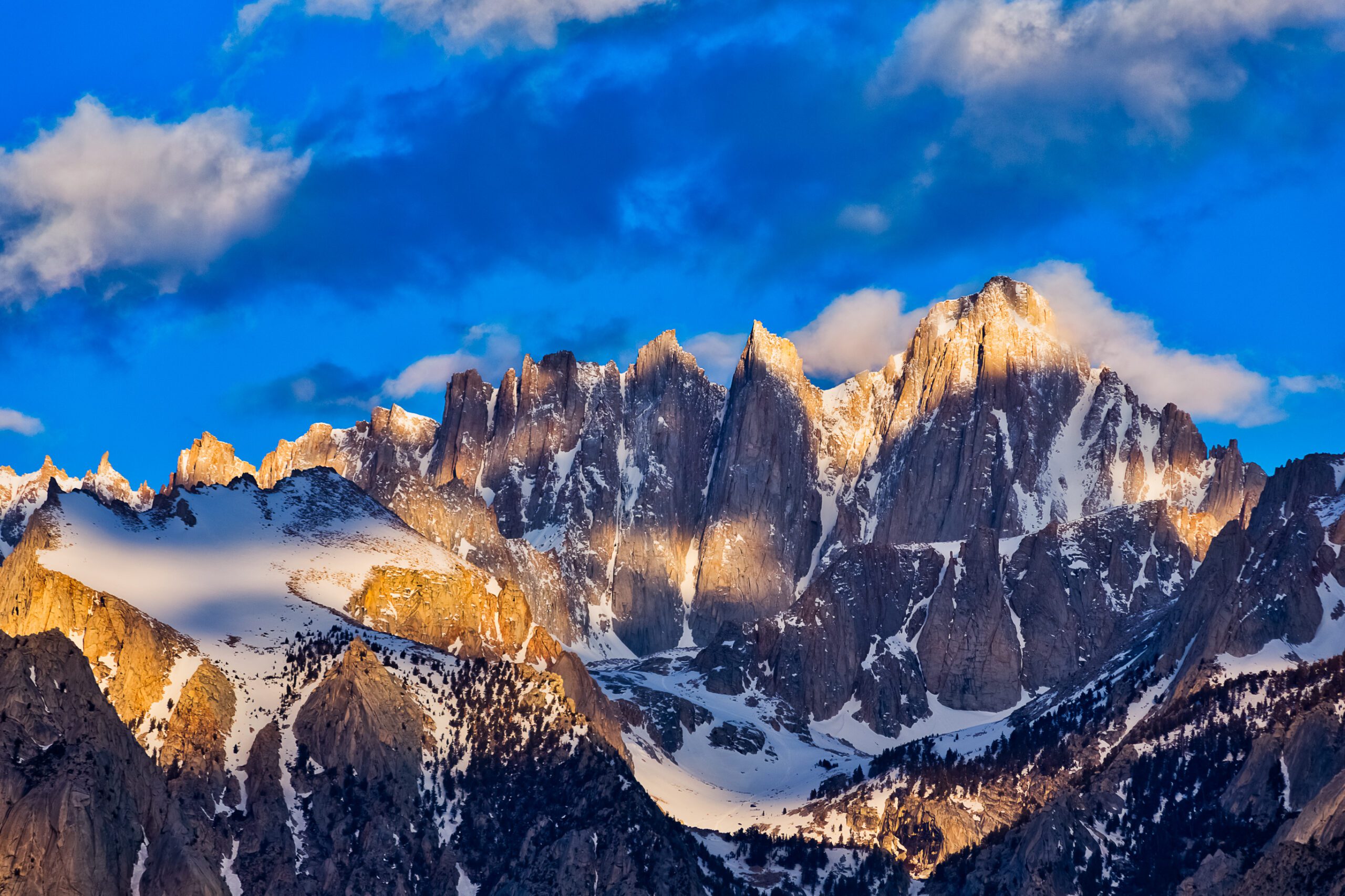
Mount Whitney
Tallest peak in the contiguous United States. Tests endurance, altitude, distance. Permit lottery required.
Mount Rainier
Most glaciated peak in the lower 48. Real expedition mountaineering — crampons, ropes, glacier travel.
The 95-foot height difference is the only thing similar about them
Both peaks sit at almost exactly 14,400 feet. Both are climbed by tens of thousands of people each year. Both sit in the western United States, accessible from major cities, with established commercial guide services and well-documented standard routes. Almost everything else differs.
Mount Whitney’s standard route — the Mount Whitney Trail from Whitney Portal — is a 22-mile round-trip hike with approximately 6,600 feet of elevation gain. When the trail is snow-free (typically July through late September), the U.S. Forest Service classifies the route as “non-technical, but strenuous.” Strong day-hikers complete it in 12 to 14 hours. No ropes. No crampons. No ice axes. Just trail running shoes or hiking boots, water, food, and a permit.
Mount Rainier’s standard route — the Disappointment Cleaver via Camp Muir — is a 14.5-mile round-trip glaciated mountaineering expedition with approximately 9,000 feet of elevation gain. It involves active crevasse fields, collapsing snow bridges, rockfall on the Cleaver, and variable ladder crossings. According to National Park Service data, in 2018, 10,762 climbers attempted the mountain with 5,135 successful summits — a 48% success rate. Guided parties typically summit at around 60%; independent climbers at around 44%. Recent years have shown more month-to-month variability due to climate-affected glacier conditions: per Alpine Ascents International, success rates ranged from 45% to 90% across different months in 2024-2025.
The Whitney Trail is non-technical only when it’s snow-free. From October through June (sometimes longer in heavy snow years), the route requires winter mountaineering skills, traction devices, ice axes, and self-arrest capability. Inyo County Search and Rescue specifies that “May to June tends to have the highest accident and fatality rates in the permit season” — because climbers attempt the route before the snow has cleared but without the technical gear required.
2025 saw five fatalities on Whitney — the deadliest year of the past decade. The 2026 season has already claimed one life near the summit on January 19. If you’re planning a Whitney attempt outside the July–September window, you’re not on a hike; you’re on a mountaineering route.
The data: success rates, climbers, fatalities
Permits: the lottery for Whitney, the queue for Rainier
The permit systems are completely different in mechanism, cost, and difficulty of acquisition.
The Mount Whitney lottery
Mount Whitney uses a strict lottery system administered through Recreation.gov. The 2026 lottery ran February 1 through March 1, with results posted March 15. Applicants pay a $6 application fee and rank up to 15 preferred dates. If awarded a permit, the holder pays an additional $15 per person to confirm by April 21.
During quota season (May 1 to November 1), Inyo National Forest issues 100 day-use permits and 60 overnight permits per day for the Mount Whitney Zone. Historical data from the U.S. Forest Service: in 2021, more than 25,000 applications were submitted requesting space for 108,500 people. 72% of applicants were unsuccessful. Peak dates in July and August — particularly the August 5–7 weekend in 2022 — saw success rates as low as 1% for that specific date.
Unclaimed lottery permits release back to the public on April 22 at 7:00am Pacific. Cancellations open up throughout the season — some climbers monitor Recreation.gov daily during the season for last-minute releases, which often disappear within minutes.
Outside the quota season (November 2 to April 30), no quota applies, but the Whitney Trail requires winter mountaineering skills and equipment due to snow and ice.
Mount Rainier permits
Mount Rainier uses a two-part permit system administered by the National Park Service. Every climber traveling above 10,000 feet or onto any glacier must pay the climbing cost recovery fee, which is currently $63 per climber for the calendar year (regardless of how many trips you make). The fee funds high-camp rangers, lower-mountain ranger stations, and human waste management on the upper mountain.
In addition to the climbing fee, climbers need a wilderness permit for overnight stays. Wilderness permits are managed through Recreation.gov. About two-thirds of permits are available for advance reservation between May 1 and the first federal holiday in October; the remaining one-third are walk-up only.
Disappointment Cleaver is the most-climbed route by a substantial margin. Per the National Park Service’s published climbing statistics, the Disappointment Cleaver route receives approximately 2,000+ attempts per year — roughly double the Emmons-Winthrop route (1,478 attempts in 2005 historical data) and an order of magnitude more than technical routes like Liberty Ridge.
The skills gap: what each mountain actually demands
The single most important difference between Whitney and Rainier is the gap between what an average fit hiker can handle and what each mountain requires.
Mount Whitney’s skill demands (standard trail, summer)
- Aerobic endurance: 22 miles of hiking with 6,600 feet of gain in a day, or split across 2-3 days with a heavy pack
- Altitude tolerance: 14,505 feet is high enough to cause altitude sickness in unacclimated climbers. AMS symptoms are the leading cause of Whitney rescues during the summer permit season
- Long-day pacing: 12-14 hour summit day means starting before sunrise and finishing after dark
- Navigation: The trail is well-marked, but late-season snow patches can obscure the route above Trail Camp
- Self-care: Hydration, calorie intake, layering for 40°F swings between trailhead and summit
Mount Rainier’s skill demands (Disappointment Cleaver)
- Everything Whitney requires, plus:
- Glacier travel: Roping up in 3-person teams, maintaining proper spacing, recognizing crevasse hazards
- Crevasse rescue: Z-pulley system, prusik ascending, partner extraction — all should be practiced before the climb, not learned on it
- Crampon technique: Flat-footing, French technique, front-pointing on steep névé and ice
- Ice axe technique: Self-arrest, anchoring, plunge-step descent
- Alpine pacing: Maintaining 1,000 ft/hour ascent rate on the upper mountain at 12,000+ feet altitude
- Heavy pack carrying: 45-55 lb packs to Camp Muir on Day 1; 10-15 lb summit packs on Day 2
- Weather decision-making: Turning around at 13,000 feet because the wind has picked up
- Equipment management: Crampons, ice axe, harness, helmet, rope, prusiks, locking carabiners — all must be set up correctly in cold, dark conditions at high altitude
This is why guide services exist. The major Rainier guide services (RMI Expeditions, International Mountain Guides, Alpine Ascents International, Northeast Mountaineering) all run instructional climbs that build these skills into the expedition itself — typically with a half-day or full-day skills clinic at the trailhead or low camp before pushing for the summit.
Mt. Rainier gives you a full on mountaineering experience. It is the perfect training ground for future mountaineering expeditions around the world.
Northeast Mountaineering — 2026 Mount Rainier programCost comparison: $50 vs. $3,000
The cost gap is enormous because the climbs are structurally different.
Mount Whitney costs (unguided, standard trail)
- Permit application fee: $6
- Permit confirmation: $15 per person
- Whitney Portal Hostel (optional pre-climb night): ~$80
- Lone Pine motel (optional): ~$120-180
- Food and gas: ~$50-100
- Total per person: $50-300 typical
Whitney is rarely climbed with commercial guides. Most climbers do it independently with personal hiking gear they already own.
Mount Rainier costs (guided 3-day Disappointment Cleaver)
- Guide service fee (2026): $2,250-$2,995 depending on operator and peak vs. non-peak dates
- NPS climbing cost recovery fee: $63
- Wilderness permit: included in guide package
- Park entrance fee: $30 (or America the Beautiful pass)
- Pre/post-climb lodging in Ashford or Seattle: ~$200-400
- Food/gas/transit: ~$100-200
- Tip for guides (industry standard): ~10% of program cost = $225-300
- Total per person: $2,800-$4,000
Independent unguided climbing reduces the cost substantially — typically $200-400 total in fees, lodging, and consumables — but requires either prior glacier mountaineering experience or significant pre-trip training. For first-time mountaineers, the guided pathway is structurally safer per the documented success-rate difference (60% guided vs. 44% independent).
Gear costs (first-time climber)
If you don’t already own mountaineering gear, the first-time Rainier kit can add substantially to total cost:
- Mountaineering boots: $300-500 (La Sportiva Trango, Scarpa Mont Blanc Pro)
- Crampons: $150-250 (Petzl Vasak, Black Diamond Sabretooth)
- Ice axe: $80-150 (Petzl Glacier, Black Diamond Raven)
- Harness: $80-150
- Helmet: $80-150
- Sleeping bag rated 0°F: $300-500
- Sleeping pad (R-value 4+): $150-250
- Backpack (60-70L): $250-350
- Hardshell jacket and pants: $400-700 combined
- Mid-layer fleece and insulating jacket: $200-400
- Base layers, socks, gloves, headlamp, glacier glasses: $200-350
- Total first-time gear investment: $2,200-$3,700
Rainier guide services rent most of the technical gear (crampons, ice axe, harness, helmet, sleeping bag) for around $150-250 per program. Many first-time Rainier climbers rent rather than buy — particularly if they’re not sure they’ll continue mountaineering after the trip. Per our guide-pack investigation, the difference between rented and owned gear is operationally negligible on a single climb; the difference matters more across multiple expeditions where ownership amortizes.
The honest verdict: when each is the right choice
Both peaks are excellent objectives. The question isn’t which is “better” — it’s which is right for your current skill level and goals.
Pick Mount Whitney first if
Pick Mount Rainier first if
The “do both” sequence (most common path)
For climbers building a multi-year mountaineering progression, the canonical sequence is:
- Year 1: Day hikes and weekend backpacking to build aerobic base. Climb Mount Whitney as the “altitude test.” If you summit comfortably, your altitude tolerance is good enough to continue.
- Year 2: Take a glacier skills course or guided Mount Baker climb to learn technical fundamentals. Climb Mount Rainier guided.
- Year 3+: Independent Rainier climbs, then progression to Aconcagua, Denali, or 6,000m peaks abroad (see our first big mountain comparison for the next-step progression).
The single most common mistake we see is climbers attempting Rainier as their first “real mountain” without prior technical training. Rainier’s 48% success rate is not random — it reflects the gap between what climbers think they’re prepared for and what the mountain actually demands. Independent climbers attempting Rainier without glacier experience contribute disproportionately to the failure rate and to the rescue statistics. The structural advice across all major guide services: build glacier skills somewhere first, then take Rainier as a skill-applying climb rather than a skill-learning climb.
Quick-reference comparison
| Factor | Mount Whitney | Mount Rainier |
|---|---|---|
| Elevation | 14,505 ft | 14,410 ft |
| Location | California, Sierra Nevada | Washington, Cascades |
| Climb type | Strenuous day hike | Glaciated mountaineering expedition |
| Days required | 1 day (or 2-3 backpack) | 2-3 days minimum |
| Technical skills | None (snow-free season) | Glacier travel, crevasse rescue, rope team |
| Required gear | Hiking boots, daypack, water | Mountaineering boots, crampons, ice axe, harness, helmet |
| Annual climbers | ~25,000–30,000 summits | ~10,000 attempts, ~5,000 summits |
| Success rate | ~70%+ (summer permits) | ~45–50% (decade avg) |
| Permit system | Lottery (Feb 1–Mar 1) | NPS cost recovery + wilderness |
| Cost (unguided) | $50–300 per person | $200–400 fees + gear |
| Cost (guided) | Rarely guided | $2,250–$2,995 (3-day) |
| Best season | July–September | Late June–early September |
| Recent fatalities | 5 in 2025 (decade high) | ~1-3 per year typical |
| Best for | First “real” mountain test | First glaciated mountaineering objective |
Frequently Asked Questions
Is Mount Whitney harder than Mount Rainier?
No. Mount Rainier is meaningfully harder for most climbers. Whitney is a strenuous hike on a non-technical trail when snow-free. Rainier is real glaciated mountaineering requiring rope teams, crampons, ice axes, crevasse rescue skills, and a multi-day climb.
Summit success rates reflect this gap: Rainier averages 45-50% historically; Whitney exceeds 70% for summer permit holders on the standard trail. The 95-foot elevation difference is the only thing that’s similar about them.
Which should I climb first, Whitney or Rainier?
Climb Whitney first if you’re a strong day-hiker without prior glacier or technical mountaineering experience. The Whitney Trail tests endurance and altitude tolerance without requiring technical skills.
Climb Rainier first only if you have prior glacier travel experience, basic crampon and ice axe skills, and physical preparation for 8,000-9,000 feet of elevation gain over 2-3 days. For most climbers, the natural sequence is Whitney → glacier skills course → Rainier guided → bigger objectives.
How much does it cost to climb Mount Rainier vs Mount Whitney?
Whitney unguided: $15 per person reservation fee plus $6 application fee in the permit lottery, plus gas and food. Total under $50-300 per person typically.
Rainier guided (3-day Disappointment Cleaver): $2,250-$2,995 with major operators (RMI, IMG, Alpine Ascents). Plus tips, lodging, gear rental or purchase.
Rainier unguided: $63 NPS climbing cost recovery fee plus wilderness permit fee plus your gear (boots, crampons, ice axe, harness, helmet typically $1,500-3,000 first-time investment).
How do I get a Mount Whitney permit?
Apply to the Mount Whitney Lottery on Recreation.gov between February 1 and March 1. Results posted March 15. Pay $15 per person fee by April 21 to confirm.
Unclaimed permits release April 22 at 7am Pacific. During quota season (May 1 – November 1), 100 day-use permits and 60 overnight permits are issued daily. Historical win rate: approximately 28-29% of applicants receive a permit for one of their chosen dates.
If you don’t win the lottery, monitor Recreation.gov daily for cancellations. They appear regularly throughout the season but disappear within minutes.
What is Mount Rainier’s success rate?
Mount Rainier’s overall summit success rate averages 45-50% based on National Park Service data spanning multiple decades. In 2018, 10,762 climbers attempted the mountain with 5,135 successful summits (48%).
Guided parties summit at approximately 60%; independent climbers at 44%. Recent years have shown more month-to-month variability due to climate-affected glacier conditions, with success rates ranging from 45% to 90% depending on weather windows.
Can a beginner climb Mount Whitney?
Yes — with serious physical preparation, in summer conditions, on the standard Mount Whitney Trail. A fit beginner who has done 10+ mile day hikes with 3,000+ feet of elevation gain can complete the Whitney day hike.
The mountain is non-technical when snow-free (typically July through September). A beginner should NOT attempt the Mountaineer’s Route (Class 3 technical climb with fatal exposure) or the Whitney Trail outside the summer snow-free window without technical mountaineering training.
Can a beginner climb Mount Rainier?
Yes — but only with a guide service, and only on the standard Disappointment Cleaver route. Major guide services (RMI, IMG, Alpine Ascents, Northeast Mountaineering) explicitly run programs for first-time mountaineers, including pre-climb instruction in glacier travel, crampon use, ice axe technique, and crevasse rescue.
The 3-day instructional programs ($2,250-$2,995) are the standard beginner pathway. Beginner solo attempts on Rainier are dangerous and not recommended.
How long does it take to climb each mountain?
Whitney: 12-14 hours for a fit day-hiker on the standard trail (snow-free conditions). Most hikers start between 2-4am to reach the summit by mid-morning and descend before afternoon thunderstorms. Some hikers split it into 2-3 days, camping at Outpost Camp (10,500 ft), Trail Camp (12,000 ft), or other designated sites.
Rainier: 2-3 days minimum on the Disappointment Cleaver standard. Day 1: Paradise to Camp Muir (4-6 hours). Day 2 (summit night): Midnight or 1am start from Camp Muir, summit by 7-9am, return to Camp Muir by 11am-1pm, then descent to Paradise. Some operators add a day for skills instruction or weather contingency, making it 3-4 days total.
What to read next
- Investigation 06: Your first big mountain — Aconcagua vs Denali vs Elbrus — for the next step after Whitney or Rainier
- Investigation 18: What’s in a mountain guide’s pack — the gear and medical kit your guide carries that you don’t
- Investigation 03: Operator power rankings 2026 — how to pick the right guide service
- The Mountaineering Truth Project — all 20 of our flagship investigations
Sources and Verification
This comparison was built from primary sources including:
- USDA Forest Service, Inyo National Forest — Mount Whitney permit and access data
- U.S. National Park Service, Mount Rainier — climbing statistics and permit framework
- Recreation.gov — 2026 permit fees and lottery mechanics for both peaks
- Inyo County Search and Rescue — fatality and accident statistics, season analysis
- Alpine Ascents International — 2026 Rainier program pricing and success rate analysis
- International Mountain Guides (IMG) — Rainier program pricing 2026
- Northeast Mountaineering — 2026 Rainier program guidance
- RMI Expeditions — Rainier climbing program information
- GearJunkie — Mount Whitney 2026 lottery and fatality reporting (February 2026)
- StephAbegg.com Rainier Statistics — historical NPS climber and accident data
- Sherpa Adventure Gear — 2018 Rainier attempt/summit data
Subscribe to the Mountain Planning Brief
Get notified when each new mountain comparison publishes. One email per release. No marketing.
Subscribe →