Mountain Comparisons · 2026 Guide
Mount Baker vs Mount Rainier: Which Glaciated Volcano Wins?
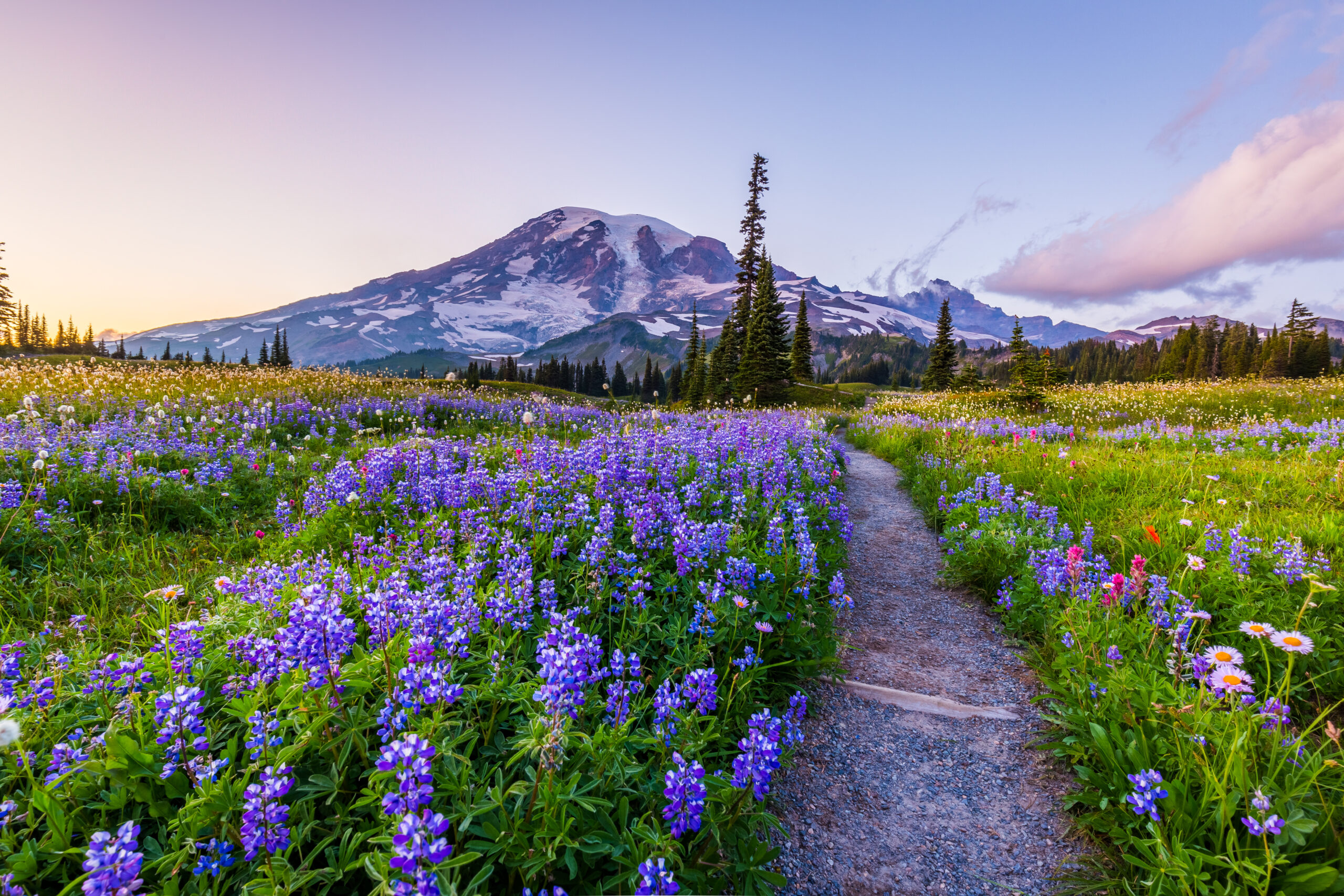
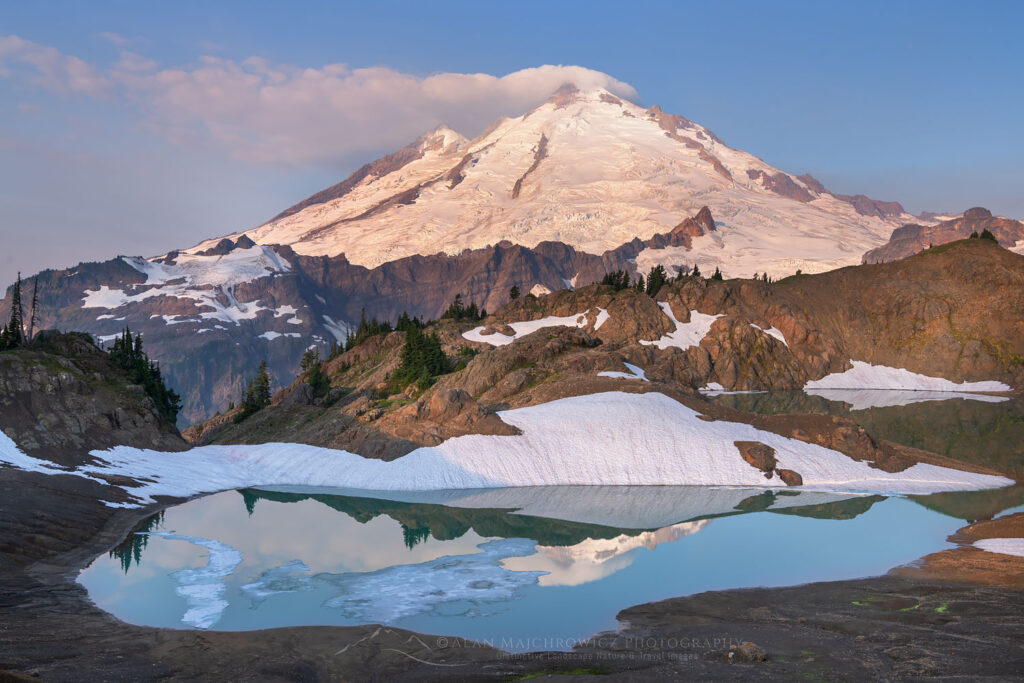
Mount Rainier rises to 14,410 feet in central Washington — the most heavily glaciated peak in the contiguous United States and the canonical Pacific Northwest expedition mountain. Mount Baker sits 200 miles north at 10,781 feet, just below the Canadian border in the North Cascades. Baker is 3,629 feet shorter. By every metric of “bigness,” Rainier wins. But Baker has earned a reputation as the training mountain for Rainier — the climb that every major guide service recommends as preparation before committing to the bigger objective. The right question isn’t “which is harder?” — it’s “in what order should you climb them?”
Mount Baker
Premier beginner glaciated peak in the lower 48. The canonical Rainier training mountain. Real glacier travel on forgiving terrain.
Mount Rainier
Most glaciated peak in the lower 48. The Pacific Northwest’s iconic expedition mountain. Real consequence on technical terrain.
Two glaciated volcanoes, two completely different skill tiers
On the map, Baker and Rainier look like siblings. Both are stratovolcanoes in Washington State’s Cascade Range. Both are heavily glaciated. Both have well-established standard routes climbed by thousands of mountaineers each summer. Both require crampons, ice axes, rope teams, and crevasse rescue skills.
In practice, the two mountains sit on opposite ends of the glaciated climbing difficulty spectrum.
Mount Baker’s standard route — the Coleman-Deming Glacier from the Heliotrope Ridge trailhead — is described by Blackbird Mountain Guides as “non-technical but require good fitness, basic mountaineering skills, and the ability to travel roped on glaciers.” The route climbs 7,400 feet across roughly 12.5 miles round trip, gaining the Coleman Glacier, crossing onto the Deming Glacier, and ascending the Roman Wall — a sustained 30-35 degree snow slope — to reach the summit plateau. Glacier travel is real: there are crevasses, seracs, and the need for rope team movement. But the angles are moderate, the route is well-established, and the consequence of a fall is recoverable on most sections.
Mount Rainier’s standard route — the Disappointment Cleaver via Camp Muir — is meaningfully harder on every measurable axis. The route covers 14.5 miles round trip and 9,000 feet of elevation gain, but the comparable metrics understate the difference. Rainier’s upper mountain involves crevasse fields that change daily, collapsing snow bridges, fixed ladder crossings in some seasons, rockfall on the Cleaver itself, and altitude that climbs above 14,000 feet. According to National Park Service data, in 2018 the mountain saw 10,762 attempts with 5,135 successful summits — a 48% success rate. Mount Baker guided programs typically report 70-85% success rates by comparison.
There’s an unusually strong consensus among Pacific Northwest guide services about the Baker-to-Rainier progression. Blackbird Mountain Guides puts it directly: “Is Mt. Baker good training for Rainier or Denali? Absolutely. With crevasses, alpine starts, and route finding challenges, it’s ideal preparation.”
This is not marketing copy. The technical skill set required for Rainier is identical to what Baker teaches — roped glacier travel, crevasse rescue, crampon technique, alpine pacing, altitude tolerance. Baker simply teaches these skills on shorter, less consequential terrain. The progression matters because Rainier’s 48% success rate is partially explained by climbers attempting it without sufficient glacier experience. Climbers who summit Baker first arrive at Rainier with the muscle memory and decision-making practice that turns a 50/50 climb into something closer to 70/30 in their favor.
The data: success rates, climbers, and what they reveal
The gap in success rates tells the story. Baker’s 75% success rate is roughly 50% better than Rainier’s 48% rate. That difference isn’t because Baker is “easy” — it’s because Baker’s lower altitude, shorter summit day, and more forgiving terrain make weather windows wider and turnaround pressure lower. Climbers who get pinned down by a storm on Rainier often fail to summit at all; climbers in the same conditions on Baker can often still complete the climb.
This is the structural insight that makes Baker the right first-glaciated-peak choice: you learn the skills you’d need on Rainier, but you summit more reliably while you learn them.
Mount Baker deep-dive: the Coleman-Deming route in detail
The route in stages
The Coleman-Deming route from Heliotrope Ridge to the summit moves through four distinct terrain bands:
- Heliotrope Ridge trailhead to Hogsback Camp (3,700–6,200 ft). A well-maintained trail climbs through old-growth Pacific Northwest forest, crosses Kulshan Creek at around 2 miles, breaks out of the trees at roughly 5,400 feet, and ascends a final moraine into Hogsback Camp at the edge of the Coleman Glacier. Most climbers reach Hogsback Camp in 3-4 hours with a 35-45 lb pack. Campsites are scattered between 6,000 and 6,200 feet along the glacier’s edge.
- Hogsback Camp onto the Coleman Glacier (6,200–8,500 ft). Above the moraine, the route ropes up and enters real glacier terrain. The Coleman Glacier has substantial crevasse fields, and rope team travel is mandatory from this point. The route winds northeast across the glacier, climbing moderately on 20-30 degree snow. Most climbers practice rope team movement, crevasse rescue setup, and pacing on the Coleman Glacier the afternoon before summit day.
- Colfax Col and the Black Buttes traverse (8,500–10,000 ft). The route climbs to Colfax Col — the saddle between the Black Buttes formation and Mount Baker’s main summit cone. Climbers skirt the Black Buttes (a complex of volcanic spires) at safe distance to avoid rockfall and avalanche risk from the Buttes themselves. From Colfax Col the route turns east-northeast and crosses onto the upper Deming Glacier.
- The Roman Wall and summit plateau (10,000–10,781 ft). The technical crux: a sustained 30-35 degree snow slope known as the Roman Wall climbs roughly 700-800 vertical feet to the summit plateau. Conditions vary year to year — some seasons offer firm consolidated snow ideal for crampon technique; other seasons present icy or rotten sections requiring more care. Above the Roman Wall, the broad summit plateau leads to the true summit at Grant Peak. The summit is actually the rim of an ice-filled volcanic crater roughly 1,300 feet deep.
Mount Baker permits and access (2026)
Baker’s permit system is among the simplest in the Cascades — there is no climbing-specific permit:
- Northwest Forest Pass: Required for parking at the Heliotrope Ridge trailhead. $5 per day or $30 annual. Available at the Glacier Public Service Center, REI, or online.
- Wilderness Permit: Free, self-issued at the trailhead. Required for all entries into the Mount Baker Wilderness.
- Pack-out human waste: Required. Most climbers use blue bags or WAG bags. No bags provided at the trailhead — bring your own.
- Group size limit: 12 climbers maximum in the wilderness.
Access to the Heliotrope Ridge trailhead is via State Highway 542 east from Bellingham. Forest Road 39 (Glacier Creek Road) is the access route from SR-542. The road is susceptible to washouts and may not fully clear of snow until mid-June in heavy snow years. Climbers attempting Baker in May or early June should check current road conditions via the Mount Baker Snoqualmie National Forest website.
“Beginner-friendly” doesn’t mean “safe to take lightly.” Mount Baker has substantial crevasse fields on both the Coleman and Easton Glaciers. The Mountaineers note that “there are many crevasses on this climb” and that the start of the Coleman Glacier can be tricky to discern — many parties have inadvertently roped up too late, only to encounter the first crevasse minutes later.
The Black Buttes section presents avalanche and rockfall hazard. Climbers must keep enough distance from the Buttes to avoid debris coming down from above. The Roman Wall itself is steep enough that a slide-arrest scenario is non-trivial. Baker is the easier of the two mountains compared in this article — but it is not, in any way, a casual hike. Real glacier travel skills are required.
Mount Baker guide services
Mount Baker is one of the most-guided peaks in the lower 48, with multiple established services offering programs from 2 to 6 days:
- American Alpine Institute (AAI) — Bellingham-based, runs both Coleman-Deming and Easton Glacier programs. The 3-day instructional climb is the canonical first glaciated mountaineering experience for many Pacific Northwest climbers.
- Northwest Alpine Guides — 2-day Coleman-Deming or Easton Glacier programs at $1,300. Adapts route choice based on conditions. Intermediate pace requires prior mountaineering experience (5,000+ ft single-day gain).
- Mountain Madness — Multi-day Baker programs including skills instruction and summit attempts.
- Northwest Mountain School — IFMGA-licensed guides, custom and scheduled programs.
- Blackbird Mountain Guides — North Cascades-based, runs Coleman-Deming and Easton programs.
- Skyline Mountain Guides — 3-day Coleman-Deming program with built-in skills instruction.
- Edgeworks Outdoor — 3-day programs on Coleman-Deming, Easton, and North Ridge variants.
Typical 3-day program cost: $700-$1,500 per person depending on group size and program structure. Most 3-day programs explicitly target first-time mountaineers and include instruction in crampons, ice axe self-arrest, rope team travel, and crevasse rescue setup. The 3-day programs report meaningfully higher success rates than 2-day programs because they build in skill instruction and acclimatization time.
The Coleman–Deming Route is a perfect first big mountain climb for climbers looking to elevate their mountaineering experience! The route involves glacier travel, rope team movement, and use of crampons and ice axe—all taught and reinforced by our Skyline Team.
Skyline Mountain Guides — 2026 Mount Baker Coleman-Deming programMount Rainier deep-dive: the Disappointment Cleaver route in detail
The route in stages
The Disappointment Cleaver route is structurally different from Baker — longer, higher, with technical sections that demand more of climbers:
- Paradise to Camp Muir (5,400–10,080 ft). The 4-6 hour ascent from Paradise to Camp Muir via the Muir Snowfield. The route gains 4,680 feet in 4.5 miles — a sustained but moderate slope. Camp Muir is a permanent high camp with stone shelters, guide-service tents, and ranger station. Most climbers arrive in early afternoon, prepare gear, eat, and try to sleep by 6 p.m. for a midnight summit start.
- Camp Muir to Ingraham Flats (10,080–11,000 ft). The summit attempt begins between midnight and 1 a.m. Climbers cross the Cowlitz Glacier to Cathedral Gap, traverse along the Ingraham Glacier, and reach Ingraham Flats at roughly 11,000 ft. This section involves the first real exposure to active crevasse terrain and serac fall potential from the Ingraham Icefall above.
- The Disappointment Cleaver proper (11,000–12,300 ft). The Cleaver is a rocky ridge that climbers ascend to bypass the most heavily crevassed section of the Ingraham Glacier. The Cleaver presents real rockfall hazard — climbers wear helmets and move efficiently. The Cleaver itself is exposed scrambling on rock, often with rope team protection. The name comes from early climbers who reached the top of the Cleaver and felt “disappointed” to realize how much climbing remained above.
- Upper mountain to summit (12,300–14,410 ft). Above the Cleaver, the route returns to the Ingraham Glacier and ascends 2,100 feet of moderate glacier on the upper mountain. Crevasses become more frequent and route-finding becomes critical. In some seasons fixed ladders are placed across larger crevasses by guide services. The summit crater rim is reached at Columbia Crest — Rainier’s true high point at 14,410 ft.
Mount Rainier permits and access (2026)
Rainier’s permit system is the most regulated of any peak in this comparison cluster:
- Climbing Cost Recovery Fee: $63 per climber per calendar year. Required for all travel above 10,000 ft or onto any glacier. Funds high-camp rangers and waste management.
- Wilderness Permit: Required for overnight stays. Managed through Recreation.gov with roughly two-thirds available for advance reservation (May 1 to the first federal holiday in October) and one-third walk-up only.
- Park Entrance Fee: $30 per vehicle (or America the Beautiful annual pass).
- Pack out human waste: Required above Camp Muir. Blue bags provided.
Most climbers access via the Paradise trailhead, accessible year-round from the Nisqually entrance on the south side of Mount Rainier National Park. See our Mount Whitney vs Mount Rainier comparison for full Rainier route and permit detail.
Mount Rainier guide services
Four major operators hold Mount Rainier concession permits:
- RMI Expeditions (Rainier Mountaineering, Inc.) — The largest Rainier operator. Multiple program lengths. 3-day Disappointment Cleaver: $2,250-$2,995.
- International Mountain Guides (IMG) — Park-concession holder with multi-day instructional programs.
- Alpine Ascents International (AAI Seattle) — Premier guided programs. Includes the Rainier Seminar (training-and-climb) for first-time mountaineers.
- Mount Rainier Alpine Guides — Smaller operator with personalized programs.
All four require either prior glacier mountaineering experience (often Baker is the cited example) or completion of a pre-climb seminar. This is the structural reason Baker fits so naturally as the prerequisite climb — it directly satisfies the experience requirement that Rainier operators look for.
Glacier recession and what it means for both peaks
Both Mount Baker and Mount Rainier are heavily affected by climate-driven glacier recession. See Investigation 12: Glacier recession and the future of mountaineering routes for the broader picture across Cascade volcanoes.
On Mount Baker, the Coleman Glacier has receded measurably over the past three decades, with new crevasse fields opening and the lower glacier toe retreating further uphill each season. The route’s standard line through the Coleman has shifted multiple times as new crevasses opened. The bergschrund at the base of the Roman Wall is now wider and more challenging in late season than it was historically.
On Mount Rainier, the impact is more severe. Multiple Rainier glaciers (Nisqually, Cowlitz, Emmons-Winthrop) have receded substantially, with documented changes in crevasse patterns season over season. The Ingraham Icefall has become increasingly active. Some routes that were once climbable are now considered too dangerous in most seasons. Recent years have seen success rates vary wildly month-to-month — Alpine Ascents International reports a range from 45% to 90% across different months in 2024-2025 based on conditions.
The practical effect for both peaks: route conditions matter more than they used to. Guide services adapt their route choice based on current conditions. Independent climbers must research recent trip reports and current conditions before committing. The “standard route” is increasingly a moving target rather than a fixed line up the mountain.
The skills gap: what each mountain actually demands
Mount Baker’s skill demands
- Multi-day camping commitment: Carrying a 35-45 lb pack to high camp at 6,000-7,000 ft. Setting up tents, melting snow for water, cooking meals at altitude
- Aerobic endurance: 7,400 feet of elevation gain across roughly 12.5 miles round trip. The summit day itself involves 4,500-5,000 ft of climbing with a light pack from high camp
- Basic to intermediate crampon technique: French technique, flat-footing, and front-pointing on the Roman Wall’s 30-35 degree snow
- Self-arrest reflexes: Important particularly on the Roman Wall where a slide could run out
- Rope team movement: 3-person rope teams are standard. Climbers must maintain proper spacing, manage the rope, and stop progress immediately when a teammate has issues
- Crevasse rescue setup: Z-pulley system, prusik ascending, partner extraction — taught in 3-day programs, expected from independent climbers
- Mild altitude tolerance: 10,781 ft is high enough that some climbers feel mild altitude effects (shortness of breath, fatigue), but rarely causes serious AMS
Mount Rainier’s skill demands
- Everything Baker requires, plus:
- Advanced glacier travel: Reading more complex crevasse patterns, navigating around or across crevasses that change daily, recognizing weakening snow bridges
- Confident crevasse rescue under pressure: Practiced repeatedly until reflexive — the consequences of a fall into a crevasse on Rainier are more severe than on Baker
- Faster alpine pacing: Maintaining 1,000 ft/hour on the upper mountain at 12,000+ feet — a meaningfully harder pace than Baker’s summit day
- Significant altitude tolerance: 14,410 ft causes real altitude effects in most climbers. AMS symptoms must be managed without compromising pace
- Heavier pack carrying: 45-55 lb packs to Camp Muir on Day 1; 10-15 lb summit packs on Day 2
- Rockfall awareness on the Cleaver: Helmet protocol, moving efficiently through exposed sections, recognizing daily/seasonal rockfall patterns
- Weather decision-making at higher consequence: Turning around at 13,000 feet is harder than turning around at 9,000 feet — both because of physical investment and because the weather window that opened the climb may not return
The fundamental insight: Baker teaches all the foundational skills. Rainier demands those same skills, applied faster, at higher altitude, with less margin for error. Climbing Baker first lets you build the skills in a lower-consequence environment, then bring them to Rainier already absorbed into muscle memory. This is why every major guide service explicitly recommends Baker before Rainier — it’s not a marketing structure, it’s a curriculum.
Cost comparison: Baker is meaningfully cheaper
Mount Baker costs
- Northwest Forest Pass: $5/day or $30/year
- Wilderness permit: free
- Pre-climb lodging in Bellingham or Glacier: $80-$200
- Camping gear (if not owned): variable; can rent locally
- Food, gas, transit: $80-$150
- Total unguided per person: $150-$400
- Guided 2-day climb: $1,300 (Northwest Alpine Guides)
- Guided 3-day climb: $700-$1,500 (AAI, Mountain Madness, Blackbird, Skyline)
Mount Rainier costs
- NPS climbing cost recovery fee: $63 per year
- Wilderness permit: included with guide programs
- Park entrance fee: $30
- Pre/post-climb lodging in Ashford or Seattle: $200-$400
- Food/gas/transit: $100-$200
- Tip for guides (~10% of program): $225-$300
- Total unguided per person: $300-$600 plus gear
- Guided 3-day climb: $2,250-$2,995 (RMI, IMG, Alpine Ascents)
- Guided 4+ day seminar climb: $3,200-$4,500 (Alpine Ascents Rainier Seminar)
The cost gap is substantial: Rainier guided is roughly 2x the cost of Baker guided. For climbers building a multi-year progression, this matters — climbing Baker first lets you invest a smaller amount to test your interest, build skills, and assess your fitness before committing to the higher-cost Rainier program. For full Rainier cost breakdown, see our Mount Whitney vs Mount Rainier comparison. See Investigation 18: What’s in a mountain guide’s pack for the gear list that covers both peaks.
The honest verdict: when each is the right choice
For 90% of climbers, the answer is clear: Baker first, Rainier second. But there are specific scenarios where the order varies.
Pick Mount Baker first if
Pick Mount Rainier first if
The recommended sequence (Year 1 to Year 3)
For climbers building a multi-year glaciated mountaineering progression, the canonical sequence is:
- Year 1, summer: Mount Baker via Coleman-Deming Glacier (3-day guided program). Build foundational glacier skills, rope team experience, crampon technique.
- Year 2, June-July: Mount Rainier via Disappointment Cleaver (3-4 day guided program). Apply Baker skills on bigger, more committing terrain.
- Year 2 or 3, winter: Glacier skills clinic, ice climbing course, or rescue practice to deepen the technical base.
- Year 3+: Independent Rainier climbs, then progression to international objectives — Aconcagua, Denali, 6,000m peaks (see Investigation 06: Your first big mountain for the next-step progression).
Each year, hundreds of climbers attempt Rainier without prior glacier experience, betting that the guide service will teach them what they need to know on the climb itself. This is the largest single contributor to Rainier’s 48% summit success rate. Climbers without prior glacier skills consistently underperform on Rainier compared to those who built skills on Baker first.
The independent-climber success rate on Rainier is ~44% — meaningfully lower than guided. The guided rate of ~60% reflects climbers who arrived with some prior experience plus the structured instruction of the guided program. If you want to maximize your odds of summiting Rainier, climb Baker first. This isn’t gatekeeping — it’s the structural advice from every major guide service in the region.
Best month to climb each: side-by-side
For the full framework, see Investigation 19: Best month to climb each mountain.
| Month | Mount Baker | Mount Rainier |
|---|---|---|
| January | Winter ski mountaineering only | Winter mountaineering only |
| February | Winter ski mountaineering only | Winter mountaineering only |
| March | Advanced ski mountaineering | Advanced winter conditions |
| April | Road still closed in many years | Spring conditions; advanced only |
| May | Good — depending on road opening; deep snow | Marginal — spring conditions |
| June | Excellent — peak season begins | Good — early season conditions |
| July | Excellent — peak conditions | Excellent — peak season |
| August | Good — exposed crevasses; route-finding harder | Excellent — stable conditions |
| September | Fair — variable conditions; weather windows shorter | Good — early month; deteriorating late |
| October | Marginal — fall storms beginning | Marginal — winter conditions returning |
| November | Winter conditions | Winter mountaineering only |
| December | Winter ski mountaineering only | Winter mountaineering only |
Quick-reference comparison
| Factor | Mount Baker | Mount Rainier |
|---|---|---|
| Elevation | 10,781 ft | 14,410 ft |
| Location | North Cascades, Washington | Central Cascades, Washington |
| Standard route | Coleman-Deming Glacier | Disappointment Cleaver |
| Route grade | Beginner-intermediate glaciated | Intermediate-advanced glaciated |
| Round trip distance | ~12.5 miles | ~14.5 miles |
| Elevation gain | ~7,400 ft | ~9,000 ft |
| Days required | 2-3 days | 2-4 days |
| Technical demands | Glacier travel, rope team, basic crampon/axe | Advanced glacier travel, complex crevasse rescue, fast pacing at altitude |
| Annual climbers | ~5,000-7,000 | ~10,000 attempts |
| Summit success rate | ~70-85% (guided) | ~48% overall |
| Permit cost | $5 parking (no climbing fee) | $63 climbing fee + wilderness |
| Cost (unguided) | $150-$400 per person | $300-$600 per person plus gear |
| Cost (guided) | $700-$1,500 (3-day) | $2,250-$2,995 (3-day) |
| Best season | June-July | Late June-early September |
| Best for | First glaciated climb / Rainier prep | Intermediate-advanced glaciated objective |
Frequently Asked Questions
Is Mount Baker harder than Mount Rainier?
No. Mount Rainier is meaningfully harder than Mount Baker. Rainier is 3,629 feet taller, has more crevasses, more objective hazard, longer summit-day distance, and demands more advanced glacier travel skills.
Baker is widely considered the premier Rainier training peak precisely because it offers real glaciated mountaineering on more forgiving terrain. Most major guide services explicitly recommend climbing Baker before Rainier.
Should I climb Baker before Rainier?
Yes, in almost all cases. Baker is the canonical Rainier preparation climb. It teaches the same fundamental skills — rope team travel, crevasse rescue, crampon and ice axe technique, altitude exposure, glacier reading — on shorter, less consequential terrain.
The Mount Baker Coleman-Deming route is rated as a beginner-friendly glacier climb; Rainier’s Disappointment Cleaver is intermediate-to-advanced. Building Baker into your progression substantially increases Rainier success rates.
How much does it cost to climb Mount Baker vs Mount Rainier?
Baker unguided: $5 Northwest Forest Pass for parking, plus food, gas, and lodging. Total under $400 typically.
Baker guided: $700-$1,500 for a 2-3 day program with American Alpine Institute, Northwest Alpine Guides, Mountain Madness, or others.
Rainier unguided: $63 NPS climbing fee plus wilderness permit. Total under $600 plus gear.
Rainier guided: $2,250-$2,995 for a 3-day program with RMI, IMG, or Alpine Ascents.
Rainier guided is roughly 2x the cost of Baker guided.
How long does each climb take?
Mount Baker: 2-3 days for most climbers via the Coleman-Deming route, with high camp at 6,000-7,000 feet. The 2-day program is intermediate-pace and requires prior mountaineering experience. The 3-day program builds in skills instruction.
Mount Rainier: 2-3 days minimum on the Disappointment Cleaver route, with high camp at Camp Muir (10,080 ft). Many programs run 4 days to include skills instruction and weather contingency.
Is Mount Baker a beginner-friendly climb?
Yes, when guided. Mount Baker’s Coleman-Deming and Easton Glacier routes are widely considered the most beginner-friendly true glaciated climbs in the lower 48.
Major guide services run multi-day programs for first-time mountaineers with built-in instruction in glacier travel, crevasse rescue, and rope team movement. Mount Baker is genuinely accessible to fit beginners with no prior mountaineering experience, provided they go guided.
What is Mount Baker’s success rate?
Mount Baker guided programs typically report 70-85% summit success rates, varying by season and weather window. This is meaningfully higher than Mount Rainier’s 48% historical average.
The higher Baker success rate reflects both lower technical demands and shorter overall commitment — bad weather windows close out Rainier climbs more often than they shut down Baker attempts.
When is the best time to climb Mount Baker?
May through September, with peak conditions typically in June and July. Earlier in the season the routes are fully snow-covered with stable crevasse bridges. By late summer, crevasses become more exposed and route-finding gets more complex.
The road to the Heliotrope Ridge trailhead may not fully open until mid-June in heavy snow years. Most guided programs run June through August.
What gear do I need for both climbs?
The technical gear list is nearly identical: mountaineering boots, crampons, ice axe, climbing harness, helmet, rope (provided by guide services), prusiks and rescue gear, glacier glasses, multi-layer clothing system.
For both peaks: tent, 0-20°F sleeping bag, sleeping pad, stove and fuel, food for 2-3 days, and a 60-70L pack. Mount Rainier additionally requires more cold-weather layering due to higher altitude and longer summit day exposure.
Most guide services rent the technical gear (crampons, ice axe, harness, helmet) for both peaks at similar prices. See Investigation 18: What’s in a mountain guide’s pack for the detailed gear list both guides carry.
What to read next
- Mount Whitney vs Mount Rainier — California’s highest vs Washington’s most glaciated
- Investigation 12: Glacier recession and the future of mountaineering routes — how Cascade glaciers are changing
- Investigation 18: What’s in a mountain guide’s pack — gear list that covers both Baker and Rainier
- Investigation 06: Your first big mountain — the next-step progression after Rainier
- Mount Hood vs Mount Adams — Oregon and Washington volcano comparison
- Mount Shasta vs Mount Hood — California vs Oregon Cascade volcanoes
- The Mountaineering Truth Project — all 20 flagship investigations
Sources and Verification
This comparison was built from primary sources including:
- U.S. Forest Service, Mt. Baker-Snoqualmie National Forest — Baker access and wilderness regulations
- U.S. National Park Service, Mount Rainier — climbing statistics and permit framework
- Recreation.gov — 2026 permit pricing for both peaks
- American Alpine Institute (AAI) — Mount Baker route descriptions and guided program details
- Northwest Alpine Guides — 2026 Baker program pricing and guidance
- The Mountaineers — Mount Baker Coleman-Deming route trip reports and route grades
- SummitPost — Mount Baker route descriptions and historical climbing data
- Skyline Mountain Guides — 2026 Coleman-Deming program structure
- Blackbird Mountain Guides — How to Climb Mt. Baker analysis (August 2025)
- Edgeworks Outdoor — Mount Baker route difficulty grading
- RMI Expeditions — Mount Rainier climbing program information
- International Mountain Guides (IMG) — Rainier program pricing and structure
- Alpine Ascents International — 2026 Rainier program and success rate analysis
- AllTrails — Mount Baker Coleman-Deming and Mount Rainier route details
Subscribe to the Mountain Planning Brief
Get notified when each new mountain comparison publishes. One email per release. No marketing.
Subscribe →