

Do You Have to Be Religious to Walk a Pilgrimage?
No. You do not have to be religious to walk a pilgrimage route. You can walk because you are grieving, curious, between chapters of life, fascinated by history, seeking challenge, looking for silence or simply drawn to the road. But a sacred route is not made secular simply because your own motivation is. The Camino de Santiago remains a Christian pilgrimage to the traditional tomb of St. James. Kumano Kodo remains a sacred Shinto-Buddhist mountain landscape. Shikoku remains bound to Buddhist temple tradition. The most respectful secular pilgrim does not pretend to believe—and does not pretend the tradition is irrelevant.
You Can Walk Without Believing. You Cannot Walk Respectfully by Pretending the Belief Does Not Matter.
A pilgrimage is a journey toward a place or idea that a community has treated as meaningful. That meaning may be explicitly religious: Santiago de Compostela, Jerusalem, Mecca, Kumano, Shikoku, Char Dham, Rome. It may also become personal for someone who does not share the underlying theology.
That distinction creates room for the secular pilgrim. You can be atheist, agnostic, culturally religious, spiritually curious or unsure what you believe. You can walk because someone died. You can walk after retirement, divorce, illness, graduation or a career change. You can walk to test your body, learn a culture or spend ten days without the usual noise of your life.
What makes the journey respectful is not adopting a belief you do not hold. It is learning enough to understand why the route exists, behaving appropriately at sacred sites, observing local customs, and allowing other pilgrims to practice their faith without turning their rituals into entertainment.
Research on Camino motivations supports this mixed picture. A recent peer-reviewed study identified three broad dimensions—religious, spiritual and secular—and found that pilgrims often combine them rather than fitting into clean categories. Secular motivation was present in most of the groups studied. A person may begin walking for nature and challenge while also finding the road unexpectedly reflective.
Prayer, worship, vow, repentance, religious community or approaching a sacred destination as an act of belief.
Reflection, grief, transformation, gratitude or searching without necessarily belonging to a religion.
Walking for heritage, nature, endurance, community, curiosity or life transition.
People rarely stay inside one category for an entire pilgrimage.
Religious, Spiritual and Secular Are Better Seen as Overlapping Circles.
A route can remain religious in origin even when the traveler arrives with a different motivation.
Conceptual model. Peer-reviewed Camino research has identified religious, spiritual and secular dimensions and found substantial overlap among them.
“I Am Walking Toward Something I Believe Is Sacred.”
This can include prayer, a promise, repentance, thanksgiving, asking for help, mourning with faith, or participating in an inherited tradition.
“I Need Space to Listen.”
The traveler may not belong to a formal religion but may still seek meaning, inner quiet, reconciliation, gratitude or a sense of connection larger than ordinary routine.
“I Want the Journey, History or Challenge.”
Architecture, landscape, physical endurance, cultural immersion, friendship or the structure of walking day after day can be enough reason to begin.

A Symbol Does Not Lose Its History Because a Secular Walker Follows It.
The scallop shell is now a practical waymark and global Camino symbol, but it also belongs to the Christian pilgrimage tradition of St. James. You do not have to pray at every shell. You should know what road the shell is marking.
Anyone Can Walk the Road. The Compostela Is a Different Question.
The Cathedral’s rules apply to its official religious certificate, not to your physical right to walk public roads and trails through Spain.
No Belief Test
You can walk the Camino for history, fitness, community, nature or any other lawful reason. You do not need to become Catholic or claim faith in St. James.
Church Framing Matters
The Pilgrim’s Reception Office says the official credential is intended for people making the pilgrimage with Christian sentiment, even if only with an attitude of search.
Religious / Spiritual Qualification
The Cathedral limits the Compostela to qualifying pilgrims who come for religious and/or spiritual reasons and meet the distance and credential requirements.
The Certificate You Choose Can Match the Journey You Actually Made.
There is no need to force a secular pilgrimage into a religious certificate category.
| Question | Compostela | Certificate of Distance |
|---|---|---|
| Issued by | Chapter / Cathedral of Santiago | Pilgrim’s Reception Office / Cathedral |
| Main purpose | Accreditation of pilgrimage to the tomb of St. James under Cathedral requirements | Records number of kilometres traveled |
| Motivation | Religious and/or spiritual under current Cathedral wording | Official page focuses on distance completed rather than defining religious motive |
| Distance | At least the final 100 continuous km on foot/horse or 200 km by bicycle under current rules | Records the route and kilometres actually traveled |
| Cost | Free | €3 on current official page |
| Best fit | Religious/spiritual pilgrim who meets the rules | Traveler wanting an official record of distance, including a secular walker |

The Trail Is Open to You. The Sacred Landscape Is Not Yours to Redefine.
You do not need to become Shinto or Buddhist to walk the Nakahechi. But the route passes oji shrines, purification sites and sacred mountains whose meaning predates modern hiking tourism by centuries. The respectful visitor enters that history as a guest.
Openness Has Deep Roots in the Kumano Tradition.
The modern inclusive experience is not simply a tourism invention.
Tanabe City’s official history describes Kumano as a sacred landscape where Shinto nature worship and Buddhism developed together. It also preserves a longstanding theme of openness. The Izumi Shikibu tradition at Fushiogami-oji is used to explain that Kumano did not exclude people from worship on the basis of sect, class or gender in the same way some other sacred sites historically did.
That does not mean every belief becomes interchangeable. A shrine is still a shrine. An oji is not merely a photo stop. A purification ritual has a religious history. A secular traveler can respond with curiosity rather than imitation: observe, learn, bow when appropriate if you choose, avoid blocking worshippers, and do not stage behavior simply for social media.
Learn the Site Before Arriving
Know why Hongu, Hayatama and Nachi matter and why oji shrines line the old routes.
Observe Before Copying
If local worshippers are performing a ritual, give them room and follow posted etiquette rather than treating it as a performance.
Call It “Just a Hike”
The official tourism guidance explicitly asks visitors to recognize Kumano Kodo as a sacred route, not merely a hiking path.
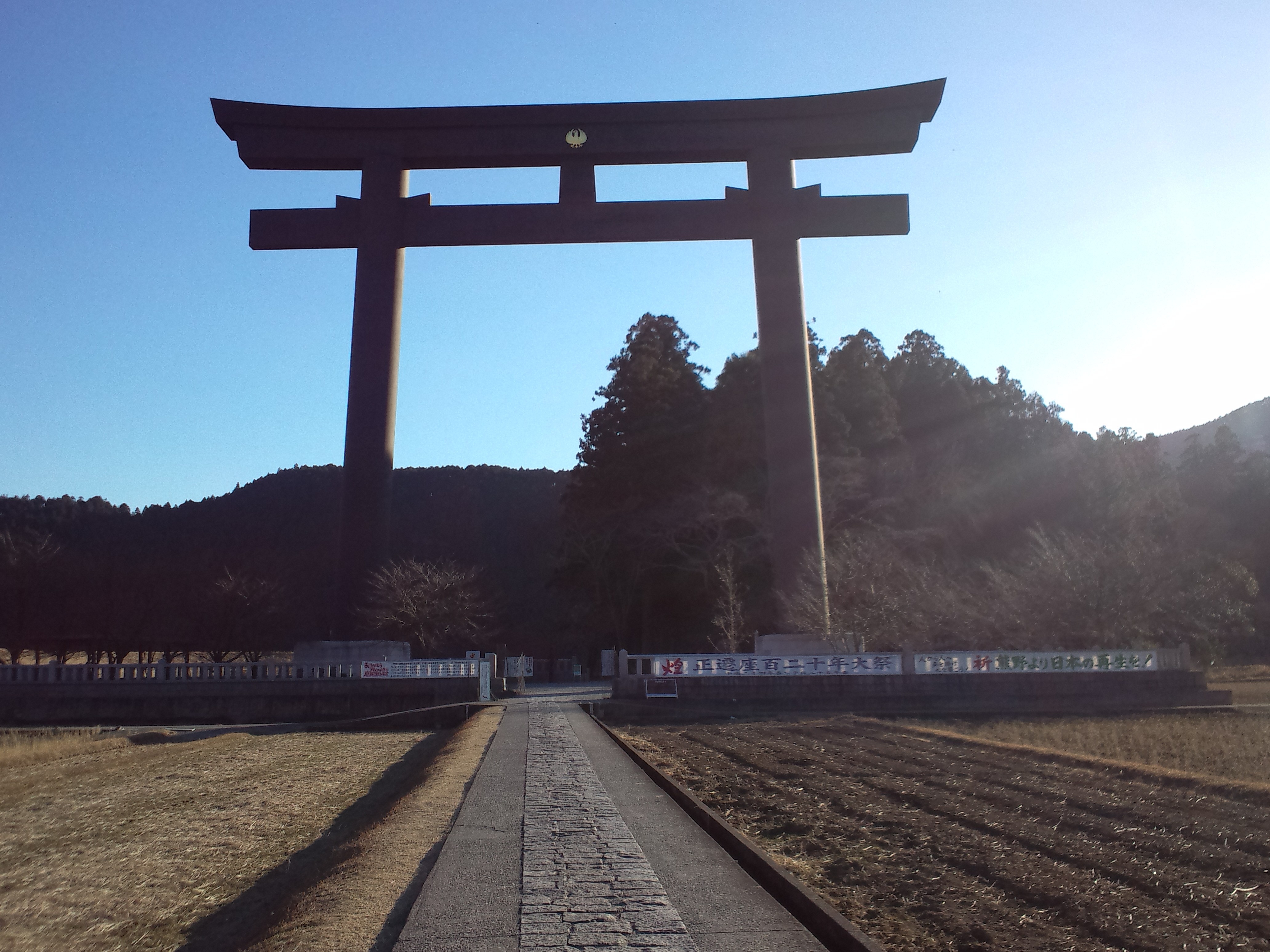
You Can Be Moved by a Sacred Place Without Claiming Its Theology.
That may be the clearest secular-pilgrim posture: allow the place to remain what it is. You can experience scale, silence, gratitude or beauty at Oyunohara without declaring yourself a believer—and without reducing the shrine to scenery.
Respect Is More Concrete Than “Being Spiritual.”
You do not need special language. Your behavior is what people experience.
Learn the Tradition
Know the destination, central stories, important symbols and basic etiquette before you arrive.
Do Not Fake Belief
Participation can be respectful without pretending conviction you do not have.
Give Worshippers Space
Do not block altars, shrine approaches, prayer areas or ceremonies for photographs.
Follow Site Rules
Dress, photography, silence, washing, shoes and access restrictions vary by tradition and location.
Keep Humor Away From Sacred Ritual
A pilgrimage can be joyful without making religious practice the joke.
Spend Locally
Guesthouses, cafés, donations and local guides help maintain routes whose heritage predates modern tourism.
Carry Out Your Waste
Respect for sacred landscape includes ordinary environmental discipline.
Let Others Name Their Experience
Do not tell a believer the route is merely tourism—or tell a secular walker that their journey is spiritually invalid.

An Albergue Can Teach Community Without Asking What You Believe.
The Camino’s communal lodging brings religious, spiritual and secular walkers into the same kitchens and dormitories. Your motivations may be different, but tomorrow morning everyone still packs a bag, treats a blister and follows the same yellow arrows.
You Do Not Need Prayer to Give the Walk Structure.
Ritual can be replaced by intentional practice without borrowing religious forms you do not understand.
Choose One Question
What deserves attention today? What are you avoiding? Who are you grateful for? What are you carrying that you no longer need?
Walk Some Miles Without Audio
Silence changes the trail from consumed content into an environment you actually notice.
Pause Before Photographing
Read the interpretation, watch how people use the space and give yourself one minute before reaching for the camera.
Ask Someone Why They Are Walking
The answer can expand your understanding of pilgrimage faster than another guidebook chapter.
Write Three Lines
What surprised you? What was hard? What do you want to remember tomorrow?
Do Not Rush to Explain the Meaning
Some journeys become clearer after you return home. A pilgrimage does not have to deliver one dramatic revelation.
You Are Allowed to Finish With a Different Reason Than the One You Started With.
That may be one of the most authentic features of pilgrimage.
A traveler may begin the Camino as a fitness project and discover that repeated conversations with strangers make the trip about community. A grieving pilgrim may begin with a spiritual purpose and find that ordinary laughter becomes as important as the solemn moments. Someone raised inside a religion may walk partly to reconnect with it—or to understand why they no longer believe.
The Camino motivation research is useful because it resists clean categories. Religious motives often coexist with secular and spiritual ones. That means there is no need to police every walker’s identity. The route can hold different intentions at the same time.

Mountains Can Be Beautiful to You and Sacred to Someone Else at the Same Time.
Nachi places shrine, Buddhist temple and waterfall in one landscape. A secular visitor does not need to resolve the theology to recognize that generations of worship shaped how the place was understood, protected and approached.
Choose the Tradition You Are Willing to Learn, Not the One That Asks the Least of You.
| Route | Religious tradition | Why it works for mixed motives | Respect point |
|---|---|---|---|
| Camino de Santiago | Christian / Catholic | Strong community, history, architecture, long-distance challenge, reflection | Understand Compostela and church-space etiquette |
| Kumano Kodo | Shinto-Buddhist syncretic tradition | Sacred mountain landscape, quiet forest walking, cultural immersion | Treat shrines and oji as living sacred sites |
| Shikoku 88 | Buddhist / Kobo Daishi tradition | Temple rhythm, endurance, hospitality, strong ritual framework | Learn temple behavior before collecting stamps mechanically |
| St. Olav’s Ways | Christian / Lutheran heritage | Nordic landscape, history, quieter route, contemplative travel | Recognize Nidaros as a religious destination |
| Via Francigena | Christian pilgrimage to Rome | European history, long-distance walking, villages, Alpine crossing | Approach Rome and church sites as more than monuments |

A Pilgrimage Does Not Need to Feel Solemn Every Hour.
Eating, bathing, laughing, being tired, getting lost and sharing a room are not distractions from the journey. They are the human texture that has always surrounded pilgrimage.
What If You Are Not Sure What You Believe?
Uncertainty can be a legitimate starting point rather than a problem to solve before leaving home.
Mountains and pilgrimage routes have always attracted people because they remove ordinary scale. Days become simple: move, eat, rest, continue. Sacred traditions add a second layer by asking travelers to see the landscape not only as terrain but as a place generations of people have treated as worthy of reverence.
You do not need to borrow another person’s certainty. You can simply remain open to the possibility that a journey may ask better questions than the ones you brought. For a deeper exploration of that relationship between altitude, sacred landscape and human reflection, continue to Faith & the Mountains.
You Do Not Need Answers Before You Start.
What Am I Leaving Behind?
Not permanently—just long enough to see it from a different distance.
What Do I Notice When I Stop Filling Every Silence?
Walking gives the mind enough work to quiet some forms of noise while leaving room for others.
Who Do I Need to Remember?
A secular pilgrimage can still be an act of remembrance.
What Do I Believe Deserves Reverence?
You may answer with God, family, nature, truth, human dignity or something still unnamed.
What Would I Do Differently After I Return?
Transformation matters more when it survives the flight home.
What Tradition Am I Entering as a Guest?
Understanding that answer is one of the simplest ways to become a better pilgrim.
The Practical Rules and the Broader Meaning Come From Different Kinds of Sources.
Pilgrim’s Reception Office
Current Compostela, credential, distance and motivation requirements from the Cathedral of Santiago.
Open Compostela rules →Tanabe City Kumano Tourism Bureau
Official explanation of Kumano’s history, oji shrines, mixed Shinto-Buddhist heritage and openness.
Open Kumano history →Pastoral Psychology
Peer-reviewed study identifying religious, spiritual and secular dimensions among Camino pilgrims.
Open research →Pilgrimage Without Religion FAQ
Do you have to be religious to walk the Camino de Santiago?
No. Anyone can physically walk the Camino. But the Camino is historically and institutionally a Christian pilgrimage, and the official Compostela issued by the Cathedral has religious or spiritual requirements.
Can an atheist walk a pilgrimage?
Yes. An atheist, agnostic or nonreligious traveler can walk a pilgrimage route for history, culture, challenge, reflection, grief, transition, community or curiosity. Respect for the tradition matters more than pretending to share a belief.
Can a nonreligious person get the Compostela?
The Cathedral of Santiago states that the Compostela is for pilgrims who come for religious and/or spiritual reasons and complete the required route conditions. A purely secular walker should not misrepresent motivation simply to obtain the document.
What can I get in Santiago if I walk for nonreligious reasons?
The Pilgrim’s Reception Office offers a Certificate of Distance recording the route, starting point, distance and arrival. It is separate from the Compostela and costs 3 euros according to the current official page.
Is Kumano Kodo only for Shinto or Buddhist believers?
No. Modern visitors of many backgrounds walk the Kumano Kodo, but it remains a sacred pilgrimage landscape rooted in Shinto nature worship, Buddhism and Shugendo traditions. Visitors should treat shrines, oji and ritual spaces accordingly.
What is the difference between religious, spiritual and secular pilgrimage?
Religious pilgrimage is explicitly tied to faith, worship, devotion or religious practice. Spiritual pilgrimage may involve meaning, grief, transformation or inner searching without formal affiliation. Secular pilgrimage may emphasize history, culture, endurance, nature or personal transition.
Is it disrespectful to walk a pilgrimage for fitness or travel?
Not automatically. The disrespect comes from treating sacred sites as props, mocking rituals, ignoring local rules or claiming traditions as your own without understanding them. A fitness or travel motive can coexist with curiosity and respect.
Can your reason for walking change during a pilgrimage?
Yes. Research on Camino motivation finds that pilgrims often have mixed religious, spiritual and secular motives. A journey begun for challenge or curiosity may become reflective, while a faith-based pilgrimage can also include friendship, scenery and physical accomplishment.
Choose the Route, Then Learn the Tradition You Are Entering.
Start with the global pilgrimage hub and the deeper reflection page, then move into the route or comparison that best matches your reason for walking.
You Do Not Need to Believe What Earlier Pilgrims Believed. You Do Need to Know That They Believed It.
A pilgrimage route can hold faith, doubt, grief, challenge, culture, history and curiosity at the same time. Walk honestly. Do not borrow a religious identity just to earn a certificate. Do not erase the tradition simply because it is not yours. Learn the stories, respect the rituals, make room for believers and allow the journey to remain unfinished in meaning. That is enough to begin.