
Getting the Compostela: The Pilgrim Passport, Stamps & Distance Rules
To qualify for the Compostela on foot, the current Pilgrim Office requires at least 100 continuous kilometres on the same recognized route into Santiago, including the final stage to the Cathedral. Cyclists need at least 200 km. Your authorized Credencial records the walk, and the Office requires at least two sellos per day through the qualifying distance. That sounds simple until you ask about Sarria, Tui, Ferrol, A Coruña, staged Caminos, cross-border routes or sailing—so this page answers those cases directly.
You Need the Right Distance, the Right Route Continuity, the Right Credencial—and a Pilgrimage to Santiago.
The famous “100 km rule” is only the first layer. The Pilgrim Office currently states that a walker or horseback pilgrim must complete at least 100 continuous kilometres on the same recognized route to Santiago. The last part of that journey must include the final stage into Santiago Cathedral. A cyclist needs at least 200 km under the same route-continuity principle.
The walk is documented through an authorized Credencial del Peregrino. The Pilgrim Office says only credentials issued by the Cathedral or organizations specifically authorized by it are accepted for the Compostela process. During the qualifying final distance, collect at least two sellos per day.
Finally, the Compostela is not merely a sporting mileage certificate. The Cathedral defines it as an accreditation of pilgrimage to the Tomb of St. James and states that it is granted for pilgrimage made with Christian sentiment. The Credencial page describes the broader pilgrim posture as including an attitude of search, but the Compostela itself retains its religious character.
Same recognized route, ending with the final stage into Santiago.
Same continuity conditions as the walking pilgrimage.
Cathedral-issued or from an organization specifically authorized by the Cathedral.
Through the qualifying final distance.
Do You Qualify for the Compostela?
Use this as a planning filter, then confirm unusual cases directly with the Pilgrim Office.
Planning diagram. The Cathedral’s Pilgrim Office is the authority for unusual or exceptional cases.
The Pilgrim Passport Is Not a Souvenir Until the Walking Is Over.
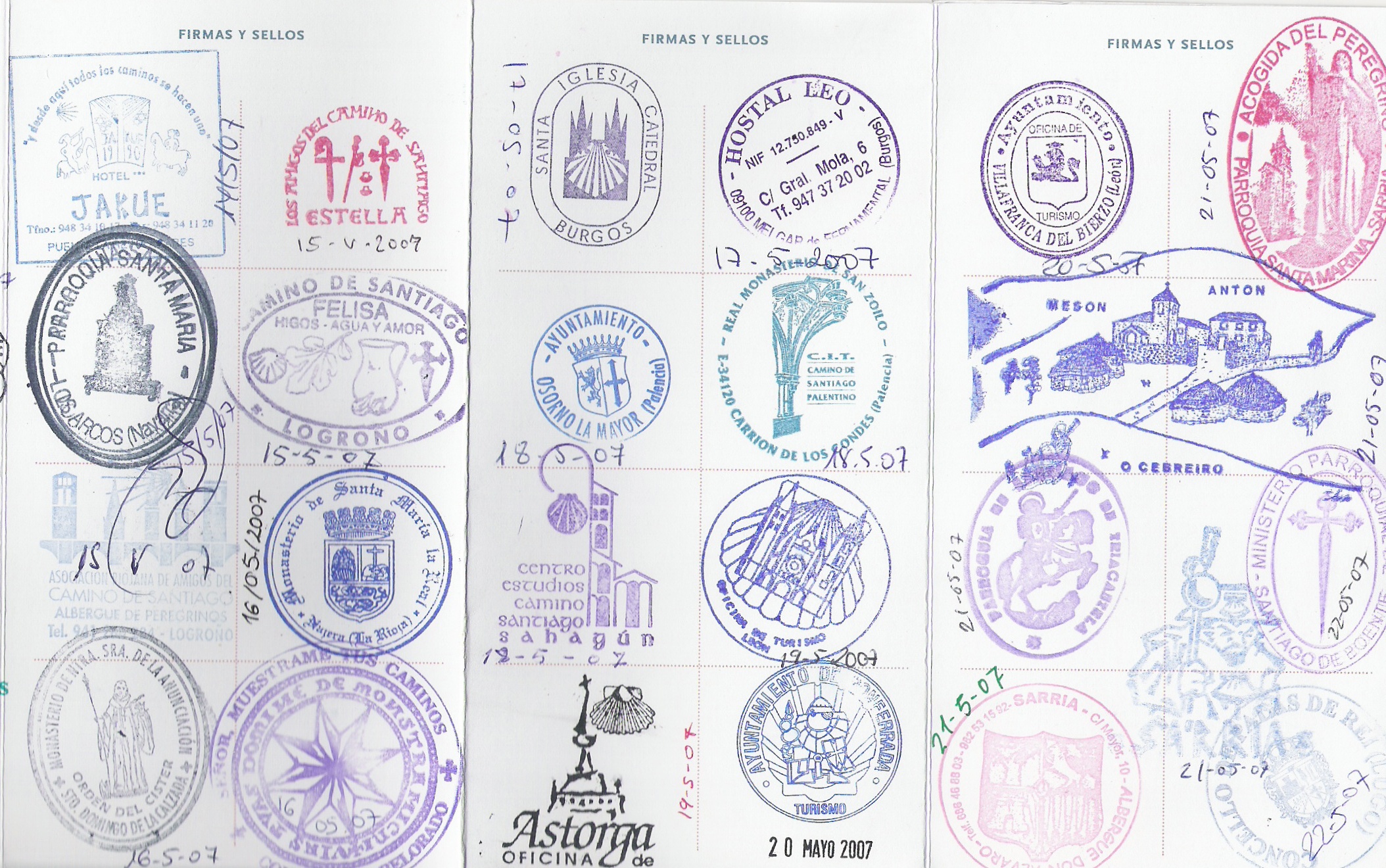
Each sello helps establish where you were and when. In the final qualifying distance, the pattern matters: two stamps per day, dates that make sense, and a route that progresses continuously toward Santiago.
Get the Right Pilgrim Passport Before You Need It.
The Cathedral treats the Credencial as the official record used both for pilgrim hospitality and for the Compostela application.
Cathedral or Authorized Organization
The Pilgrim Office lists authorized confraternities and associations in Spain and around the world. It also issues the Credencial at the Pilgrim Office itself.
A Random Stamp Book Is Not Enough
The Office specifically states that only the Cathedral Credencial or one issued by a specifically authorized organization is accepted for the Compostela process.
The Credencial Also Identifies You as a Pilgrim
The Office says it is required for pilgrim hostels along the routes that operate within the traditional pilgrim-hospitality system.
Two Stamps per Day: What Counts and Where Do You Get Them?
The stamps are easy to find. Remembering to collect them before you leave town is the harder part.
At Least Two Per Day in the Qualifying Distance
The Pilgrim Office explicitly requires two daily sellos through the final 100 km for walkers/horseback pilgrims and through the qualifying section for cyclists.
Churches, Albergues, Hotels, Town Halls and More
The Office lists these as normal sources. Cafés and other Camino businesses also frequently stamp credentials, but you do not need to hunt for one “official” type of stamp.
One Earlier, One Later
A morning or midday sello plus one at your destination creates a clean daily record and is harder to forget than trying to collect two at check-in.
Dates Matter When Continuity Is the Question
This becomes especially important when walking in stages. The Pilgrim Office specifically tells minimum-distance staged pilgrims to stamp at both the start and end of each stage with the corresponding date.
Where Can You Start and Clear the 100-km Rule?
These are practical examples, not the only qualifying starts. You can begin much farther away.
Distances are official Galicia route figures. Qualification still requires the other Cathedral rules; distance alone is not enough.
| Start | Route | Official distance | Distance-alone status | Planning note |
|---|---|---|---|---|
| Sarria | Camino Francés | 114.9 km in official Galicia route material | Above 100 km | The best-known short Francés start. |
| Tui | Camino Portugués | 118.8 km | Above 100 km | Clean short Portuguese Way start inside Spain. |
| Ferrol | Camino Inglés | 112.4 km | Above 100 km | Best straightforward one-week English Way start. |
| A Coruña | Camino Inglés | 72.8 km | Below 100 km | Needs a valid additional basis; do not assume ordinary walking qualification. |

Sarria Is Famous Because It Sits Safely Beyond the 100-km Threshold—not Because the Camino Begins There.
Galicia’s official French Way material places Sarria at 114.9 km from Santiago. That makes it practical for certificate-seeking short walkers, but the Francés itself extends hundreds of kilometres farther east.
Can You Complete the Camino in Stages?
Yes—but your paperwork needs to show that one trip ends where the next one begins.
Chronological + Geographical Order
The Pilgrim Office explicitly allows the Way to be completed in stages as long as the sequence follows the route forward toward Santiago.
Stamp the Start and End of Each Stage
If you are doing only the minimum qualifying 100 or 200 km over multiple trips, the Office says to obtain a stamp at the start and end of each stage with the date, even when the start duplicates the previous stage’s final town.
Sarria → Portomarín This Year, Continue Later
End the first trip with a dated Portomarín sello. When you return, get another dated Portomarín sello before resuming. That creates documentary continuity rather than a gap.
Disconnected Weekend Sections
Walking 25 km near Sarria, 30 km near León and 45 km near Santiago does not create a continuous final 100-km pilgrimage simply because the arithmetic totals 100.
If You Start Outside Spain, the Rule Changes—but Only in a Specific Way.
This matters most to routes such as the Portuguese Way and long French approaches.
A Cross-Border Pilgrimage Can Carry Into Spain
The qualifying journey did not begin at the Spanish border. The Office recognizes the continuous route that started abroad, while still requiring a meaningful continuous section inside Spain.
You Cannot Simply Start 70 km From Santiago
The 70-km figure is not a new general walking minimum. It applies when the pilgrim already started outside Spain on a recognized route and continues that route into Spain.

Ferrol Is Simple. A Coruña Is Not.
The official English Way is 112.4 km from Ferrol and only 72.8 km from A Coruña. If your goal is a straightforward walking Compostela, Ferrol is the clean answer. A Coruña should only be used with a clearly valid additional qualifying basis.
Does A Coruña Qualify?
Not by the ordinary walking-distance rule.
72.8 km Is Below 100 km
Galicia’s official English Way page is unambiguous about the route distance. An ordinary walk beginning in A Coruña therefore does not clear the general 100-km walking rule by distance alone.
The Cathedral Can Consider Exceptions
The Pilgrim Office states that the Cathedral Chapter reserves the right to grant the Compostela in special and exceptional circumstances and tells pilgrims to contact the International Pilgrim Welcome Center in advance.
A Coruña Can Make Sense as a Landing Port
The current sailing rule recognizes 100 nautical miles at sea followed by the remaining Camino on foot from the port of disembarkation, with the appropriate walking-stage sellos.
Can You Earn the Compostela by Sailing?
Yes, under a specific sea-pilgrimage framework.
100 Nautical Miles
The current Pilgrim Office Compostela rules recognize a sailing pilgrimage after at least 100 nautical miles at sea.
Then Continue on Foot From the Port
The pilgrim must finish the remaining Camino on foot from the port where they disembark and document those walking stages with sellos in the Credencial.

The Camino Does Not Become More Authentic at Kilometer 101.
The Cathedral needs a threshold because certificates require rules. Pilgrimage itself is not an arithmetic contest. A full Norte, a Porto Portugués and a Ferrol Inglés can all be serious journeys with very different lengths.
The Compostela Is a Religious Document.
This point is often softened or skipped in planning articles, but the Cathedral’s own wording is clear.
Christian Sentiment, Even as an Attitude of Search
The Pilgrim Office’s Credencial page says the document is for those making the pilgrimage with Christian sentiment, even if that takes the form of an attitude of search.
The Certificate Retains Its Christian Meaning
The Office says the Compostela is granted to those making the pilgrimage to the Tomb of the Apostle with Christian sentiment. Its Latin text reflects devotion, vow or piety rather than simply athletic completion.
Do Not Misrepresent Your Motivation Just for Paper
You can walk the Camino for history, culture, challenge, reflection or many other reasons. If your motivation does not fit the Compostela’s stated religious purpose, treat that distinction respectfully and ask the Office what documentation is appropriate for your circumstances.
The Certificate of Distance Is a Separate Document
The Pilgrim Office also offers an official Certificate of Distance showing route, starting point, arrival date and kilometres. It is useful when the mileage itself is what you want formally recorded.

The Credencial Works Best When You Stop Treating It Like a Scavenger Hunt.
Collect the stamps you need, then go back to walking. The point of the sellos is to document the pilgrimage, not turn every café and church into another box to fill.
How to Collect the Compostela at the Pilgrim Office
The last bureaucracy of the Camino is relatively simple if your Credencial is ready.
Pilgrim’s Reception Office
The current office is at Rúa Carretas 33 in Santiago de Compostela, a short walk from the Cathedral.
Complete the Pilgrim Registration
The Office uses an online registration process to collect your personal details, route and pilgrimage information before the Compostela is issued.
Take the QR-Coded Ticket
The queue ticket includes a QR code that lets you monitor your place in real time rather than standing physically in one line for the entire wait.
Bring the Credencial
The staff reviews the record and places the final Cathedral stamp on the credential as part of the reception process.
The Compostela Is Free
The Pilgrim Office states that both pilgrim reception and issuance of the Compostela are completely free.
Do Not Schedule the Airport Too Tightly
The office currently lists daily hours of 9:00–19:00, closed December 25 and January 1, and warns that same-day Compostela collection cannot always be guaranteed during heavy influx.

The Camino Ends at the Tomb of St. James—not at the Pilgrim Office Printer.
The Cathedral describes Santiago’s Tomb of the Apostle as the destination of the pilgrimage. The paperwork matters, but the certificate is the record of arrival rather than the reason the destination matters.
Compostela vs Certificate of Distance
One certifies the traditional religious pilgrimage. The other records where you started and how far you traveled.
| Document | Purpose | What it records | Current price |
|---|---|---|---|
| Compostela | Traditional Cathedral accreditation of the qualifying pilgrimage to St. James | Name and religious pilgrimage completion under Cathedral rules | Free |
| Certificate of Distance | Official record of distance completed | Starting point, route, kilometres, start/arrival details | €3 |
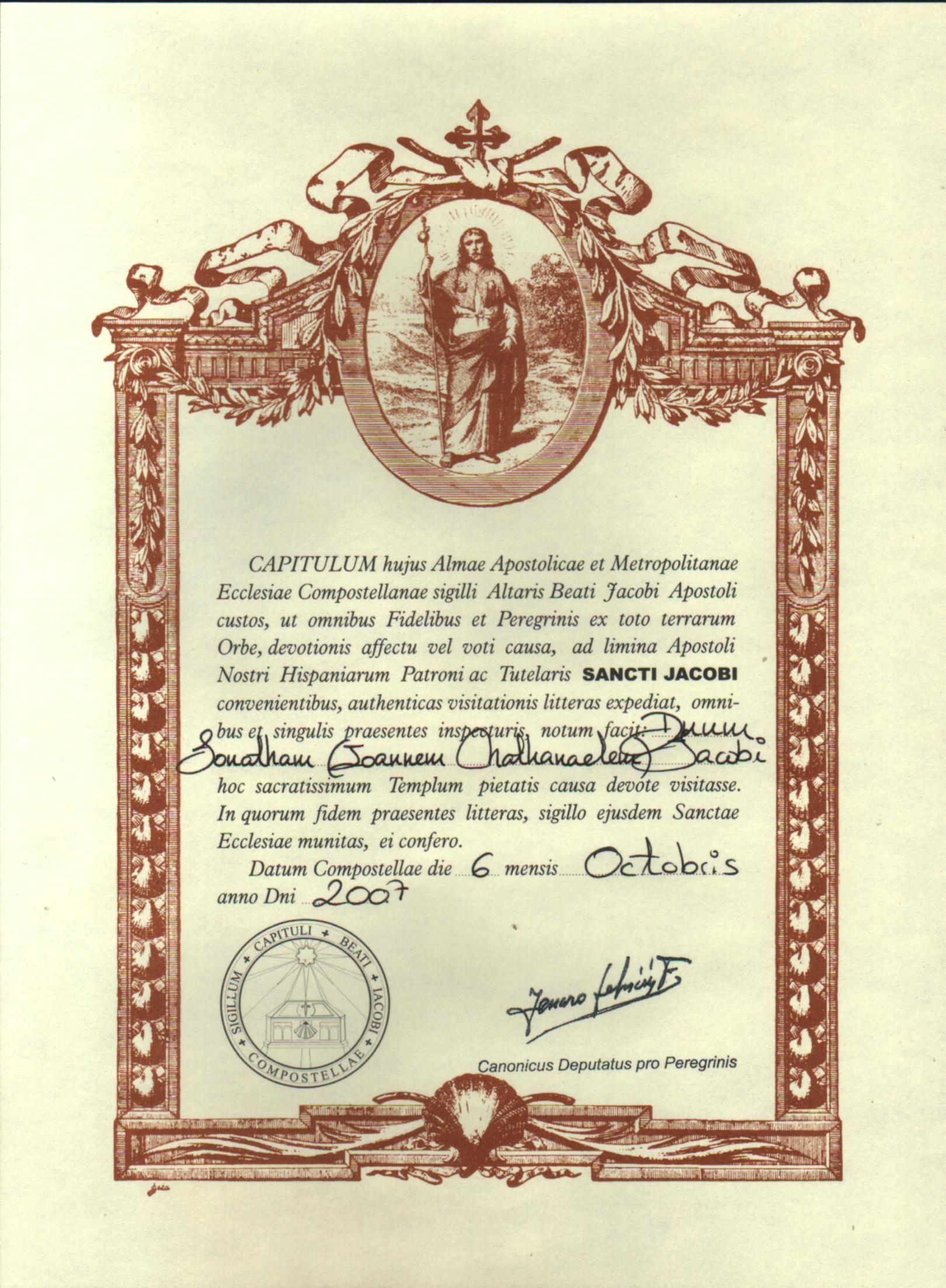
The Compostela Is Written as an Ecclesiastical Accreditation.
Its form, language and issuing authority are part of its identity. That is why the distinction between a religious pilgrimage certificate and a simple distance record matters.
Historic certificate image: Wikimedia Commons · source.
Seven Mistakes That Can Complicate the Compostela
Most documentation problems are created before Santiago.
Starting Below 100 km
Do not assume a famous Camino town qualifies. Check official route distance before booking.
Using an Unauthorized Credential
A beautiful personal stamp book is not a substitute for the accepted Credencial.
Only One Daily Sello
The final qualifying distance requires at least two stamps per day.
Skipping Around the Route
Disconnected sections do not create a continuous qualifying final Camino.
Weak Staged-Camino Dates
Stamp both arrival and restart when splitting the minimum qualifying section across trips.
Assuming A Coruña Automatically Counts
Its official walking distance is 72.8 km. Ordinary distance qualification therefore does not apply.
Booking a Tight Departure From Santiago
Heavy arrival days can prevent guaranteed same-day collection.
Can Children Receive the Compostela?
The Pilgrim Office has a specific rule for younger pilgrims rather than applying the adult certificate process mechanically.
Yes, When They Understand the Pilgrimage
The Office states that children walking with parents or groups can receive the Compostela if they have received Communion or are capable of understanding the spiritual or religious meaning of the Camino, assuming the route and documentation requirements are also met.
A Special Certificate or Parent’s Compostela May Apply
If a child is too young to understand that meaning, the Office says a special certificate can be issued in the child’s name. Infants or very young children may instead have their names included on the Compostela of the parent or accompanying adult.
Use the Cathedral for Certificate Rules and Galicia for Route Distances.
Do not let an old forum comment outrank the current authority issuing the certificate.
The Compostela
Current distance, continuity, staged-Camino, cross-border, sailing and exceptional-case rules.
Open current rules →The Credencial
Official credential purpose, issuing organizations and religious context.
Open Credencial rules →Where to Get the Credencial
Authorized associations plus the current two-sello reminder.
Find authorized issuers →French Way Distances
Official Galicia route material places Sarria 114.9 km from Santiago.
Open French Way →Portuguese Way
Official route length of 118.8 km from the Galicia entry framework at Tui.
Open Portuguese Way →English Way
Official 112.4 km from Ferrol and 72.8 km from A Coruña.
Open English Way →Compostela & Pilgrim Passport FAQ
How many kilometres do I need to walk?
At least 100 continuous kilometres on the same recognized route into Santiago, including the final stage leading into Santiago Cathedral.
How many kilometres do I need to cycle?
At least 200 km on the same recognized route under the same continuity principles.
How many stamps do I need?
At least two sellos per day during the qualifying final distance. Churches, albergues, hotels and town halls are among the normal places to get them.
Can I walk the Camino in stages?
Yes. Keep the stages chronological and geographical. If completing only the minimum distance, stamp both the start and end of each resumed stage with dates.
Does Ferrol qualify?
Yes by distance, assuming all other rules are satisfied. The official English Way from Ferrol is 112.4 km.
Does A Coruña qualify?
Not by ordinary walking distance alone because the official route is 72.8 km. Valid special circumstances may exist, so confirm them directly with the Pilgrim Office before travel.
Is the Compostela free?
Yes. The Compostela and reception service are free. The optional Certificate of Distance currently costs €3.
Where do I collect it?
At the Pilgrim’s Reception Office, Rúa Carretas 33, Santiago. Current hours are 9:00–19:00 daily except December 25 and January 1, with QR-based queue management.
Know the Rule, Then Build the Journey Around the Camino You Actually Want.
The Compostela should confirm a pilgrimage plan, not dictate every decision before you know which route fits.
Walk a Continuous Qualifying Route, Carry the Correct Credencial and Collect Two Sellos per Day.
Start in Sarria, Tui, Ferrol or farther away if you want the simple walking case. Keep the final 100 km continuous, document it properly, and do not gamble a trip on an exception you never confirmed. Then arrive in Santiago with the paperwork ready—and remember that the Compostela is meant to record a pilgrimage to the Cathedral, not replace it.