
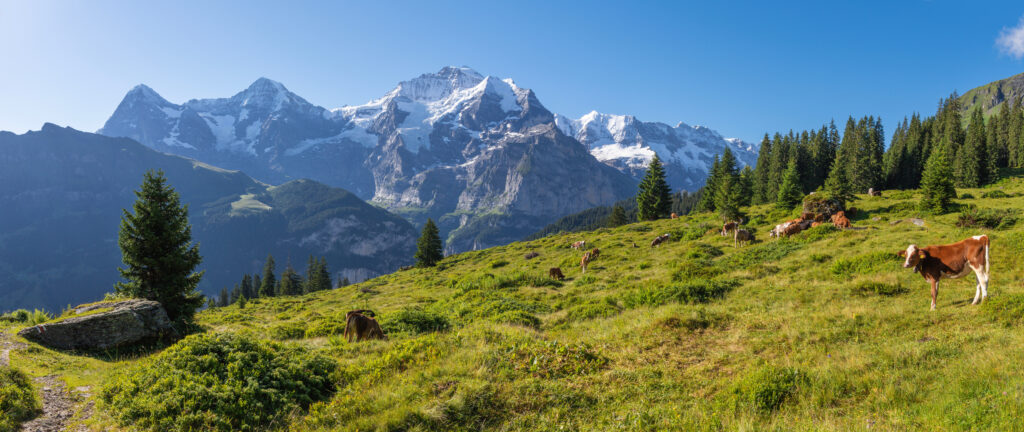
Best Eiger Operators: 4 Commercial Operators Compared for 2026
The Eiger (3,970m / 13,025 ft) is one of the most iconic mountains in the European Alps — the dramatic Bernese Oberland peak whose North Face (Nordwand) defines high-end alpinism alongside the Grandes Jorasses and Matterhorn. The standard commercial route is the Mittellegi Ridge — Alpine Grade D (Difficile), the long and exposed east ridge climbed first in 1921. The route delivers some of Europe’s finest moderately technical terrain on a knife-edge ridge with thousands of feet of exposure on both sides. Despite falling just below the magical 4,000m threshold, the Eiger is a serious technical alpine objective requiring confident rock climbing in alpine boots, comfort with sustained UIAA III+/IV- climbing, and the long Eigerjoch traverse descent. The commercial operator field requires 1:1 client-to-guide ratio for summit day across all reputable operators: Adventure Consultants (NZ IFMGA with comprehensive Mittellegi + Mönch acclimatization framework), Jagged Globe (UK Saas Grund acclimatization split ratio framework), Mountain Madness (American boutique technical alpine), and Grindelwald Sports (local Bernese Oberland guide office managing Mittellegi Hut bookings).
13,025 ft / Bernese Alps
price range
Mittellegi Ridge
Mid-Sep
season
The Eiger occupies a structurally specific position in European commercial alpine climbing: iconic Bernese Oberland peak whose Mittellegi Ridge delivers Europe’s finest moderately technical alpine ridge climbing experience — long, exposed, technically demanding, with the dramatic backdrop of the famous North Face below. The mountain’s 3,970m elevation falls just below the magical 4,000m threshold — much better for that, per IFMGA Mountain Guide Tim Blakemore writing for the British Mountaineering Council — meaning the Eiger doesn’t attract the high-volume commercial traffic of the Matterhorn or Mont Blanc. The Mittellegi Ridge is a serious commercial objective for experienced alpinists with confident rock climbing in alpine boots to UIAA IV / US 5.7 / UK HS, comfort with sustained technical movement when tired, and capability for the long Eigerjoch traverse descent. The 1:1 client-to-guide ratio for summit day is non-negotiable across all reputable IFMGA operators reflecting the route’s technical and exposure demands. This comparison evaluates 4 commercial Eiger operators against the eight criteria framework.
The Mittellegi Ridge is the standard commercial route on the Eiger and one of Europe’s classic moderately technical alpine ridges. Route grade Alpine D (Difficile), AD+ 4a, with sections of UIAA III+/IV- technical climbing. The route runs along the east ridge from the Mittellegi Hut (3,355m) to the Eiger summit (3,970m), then descends via the South Ridge across the Eigerjoch traverse to the Mönch and ultimately Jungfraujoch. The route delivers: knife-edge ridge climbing with thousands of feet of exposure on both sides; sections equipped with fixed ropes including a long fixed rope section in the upper half; rock climbing on shattered limestone with often-poor belay points in the upper third; abseiling required including 20m rappel from Grosse Turm gendarme; snowy ridge crests near the summit requiring crampons; and the long Eigerjoch traverse descent with multiple 25m abseils. Quick teams complete the full traverse in 7-9 hours; typical commercial expeditions run 10-14 hours summit day.
The Eiger’s structural accessibility — train access via the Jungfraubahn from Grindelwald to the Eismeer station, well-developed Bernese Oberland tourism infrastructure, established commercial operator framework — can mask the mountain’s genuine technical alpine demands. Climbers must be confident rock climbing in alpine boots to grade US 5.7 / UK HS / UIAA IV, capable of moving at steady pace for extended periods in technical terrain on snow and rock when tired, and have RECENT experience of Alpine routes graded AD and above. The Mittellegi Hut approach from Eismeer station is a technical day in its own right with a IV- UIAA crux pitch on small holds and ledges. The long Eigerjoch traverse descent is AD mountaineering that should not be rushed. Climbers without prior comparable Alpine technical experience should establish capability through Matterhorn (Wave 2), Mont Blanc Cosmiques traverse, or comparable Alpine technical objectives before attempting the Eiger Mittellegi Ridge.
4 operators evaluated against the eight criteria framework. Pricing is 2026-estimated and should be verified directly with operators. The structural diversity between operators reflects different commercial models — international IFMGA operators (Adventure Consultants, Jagged Globe, Mountain Madness) deliver comprehensive 6-7 day commercial frameworks with structured acclimatization weeks while local Bernese Oberland operators (Grindelwald Sports) deliver 2-3 day Mittellegi Ridge ascent-only frameworks at meaningfully lower pricing. The 1:1 client-to-guide ratio for summit day is non-negotiable across all reputable operators reflecting route technical demands. Twice-yearly review cycle. Next scheduled review: September 2026.
Why the Eiger? Europe’s Iconic Moderately Technical Alpine Peak
The Eiger occupies a structurally distinctive position in European commercial alpine climbing:
Iconic Bernese Oberland peak with North Face heritage. The Eiger’s North Face (Nordwand) is among the three finest north faces in the Alps alongside the Grandes Jorasses and Matterhorn — almost twice the size of many at 1,800 vertical metres of climbing. The dramatic 1930s attempts on the Nordwand defined modern high-end alpinism, with multiple prospective ascensionists perishing before the first ascent in 1938 by Heckmair, Vörg, Harrer, and Kasparek. The North Face is beyond standard commercial framework — climbing the Mittellegi Ridge gives commercial climbers structurally distinctive proximity to this iconic mountaineering history with birdseye view of the immense face from the ridge above.
3,970m falls just below the 4,000m threshold. The Eiger’s elevation falls just short of the magical 4,000m height so collected in the Alps. This structural quirk matters commercially — the Eiger is much better for falling below the 4,000er ticking culture (per IFMGA Mountain Guide Tim Blakemore writing for the British Mountaineering Council). The mountain doesn’t attract the high-volume commercial traffic of the Matterhorn or Mont Blanc, producing a more authentic alpinist atmosphere on the route. Climbers on the Mittellegi Ridge feel like alpinists among peers rather than commercial summit traffic.
Mittellegi Ridge — Europe’s classic moderately technical ridge. The Mittellegi Ridge is the standard commercial route — first climbed in 1921, named after the small Mittellegi Hut (3,355m) perched spectacularly on the ridge. The route delivers exposed knife-edge ridge climbing with thousands of feet of exposure on both sides, sections equipped with fixed ropes, rock climbing on shattered limestone, abseiling on both ascent approach and South Ridge descent, and snowy ridge crests near the summit. The combination produces structurally distinctive moderately technical alpine commercial framework.
Technical commercial framework matters structurally. The Eiger Mittellegi Ridge requires structurally distinctive commercial framework:
- 1:1 client-to-guide ratio for summit day — non-negotiable across all reputable IFMGA operators reflecting route technical and exposure demands
- 3-5 day acclimatization framework — Mönch via SE Ridge, Saas Grund peaks, or Chamonix region peaks before Mittellegi Ridge attempt
- 2-3 day weather buffer built into 6-7 day commercial programs to access best summit weather window
- Mittellegi Hut booking essential — limited capacity with limited Bernese Oberland guide office reservation channels
- Technical training prerequisite — climbers must be confident rock climbing in alpine boots to UIAA IV / US 5.7 / UK HS
Bernese Oberland infrastructure framework. Grindelwald is the standard valley base — Bernese Oberland village with established commercial climbing infrastructure including the Jungfraubahn train access through the Eiger to Eismeer station, Mittellegi Hut booking through local guide offices, mountain hostel accommodation framework, and integrated logistics for international climbers. The Jungfraubahn train access is structurally distinctive — climbers ride through tunnels carved into the Eiger itself before exiting at Eismeer station for the Mittellegi Hut approach, producing one of the most dramatic mountain access frameworks in European commercial alpine climbing.
Mid-July to Mid-September primary climbing season. The Eiger Mittellegi Ridge season runs mid-July through mid-September, with peak season late-July through August offering most stable conditions. The route requires the rocky sections to be dry and relatively free of snow for safe and efficient ascent — early-season climbs (June, early July) often encounter excessive snow on the rock sections making climbing significantly more difficult and dangerous. Late-season climbs (September) can deliver excellent conditions but with shorter daylight and approaching alpine winter weather. The Mittellegi Hut typically operates mid-June through end of September; outside hut operating dates, climbers can use the unguarded winter room.
2026 Eiger Operator Awards
Four operators selected to represent the structural diversity of the Eiger commercial operator field — international IFMGA premium operator with comprehensive acclimatization framework, UK comprehensive operator with split ratio framework, American boutique technical alpine operator, and local Bernese Oberland guide office. Each delivers structurally distinct value for different client priorities.
Adventure Consultants
Adventure Consultants delivers premium international IFMGA-only commercial Eiger operations through structurally distinctive comprehensive acclimatization framework. The standard 9-day program begins with rock climbing training in the valley, progresses to Lobhörner Hut acclimatization, then Mönch via the South East Ridge (AD scramble with exposed knife-edge crest) staying at Mönchjochs Hut for altitude acclimatization, before the Eiger Mittellegi Ridge ascent and South Ridge descent back to Mönchjochs Hut. Departure options from both Lauterbrunnen (Bernese Oberland direct) and Chamonix (combined alpine training framework) provide structurally distinctive client preference flexibility.
Adventure Consultants employs only IFMGA-UIAGM qualified mountain guides for European ascents — the only certification recognised in the French Alps. The operator’s NZ-rooted commercial framework alongside global IFMGA expedition portfolio (Everest, Ama Dablam, Aoraki, Vinson, Aconcagua) provides structural operator continuity for climbers building international expedition portfolios. Pricing for the 9-day Eiger Mittellegi Ridge program typically runs CHF 7,500-CHF 8,500 reflecting premium IFMGA framework with comprehensive acclimatization week, all hut accommodation, IFMGA guide leadership, and integrated logistics. For climbers prioritizing premium international IFMGA framework with structured Mönch acclimatization and operator continuity to subsequent international expedition objectives, Adventure Consultants delivers structurally specific value.
Read Adventure Consultants profile →Jagged Globe
UK-based Jagged Globe delivers structurally distinctive Eiger commercial operations through split ratio framework — 1:2 ratio for 4 acclimatization training days, then 1:1 ratio for 2 Eiger summit attempt days. The operator’s 6-day program begins in Saas Grund with comprehensive technical training and acclimatization on appropriate technical ground (rock and mixed climbing in crampons, alpine route experience at AD grade), before traveling to Grindelwald for the Eiger Mittellegi Ridge attempt with 3 days set aside for weather flexibility.
The split ratio framework matters structurally — climbers benefit from group dynamics during training days through 1:2 framework cost-efficiency, then individual guide attention for the technically demanding Mittellegi Ridge through 1:1 framework. Jagged Globe requires CV and reference from a Mountain Guide for first-time clients — structurally appropriate prerequisite framework reflecting the Eiger’s technical demands. The operator includes 1 night Grindelwald hotel + 3 nights mountain hut + 1 night Brig hotel accommodation with 6 days IFMGA guiding. Pricing typically runs GBP £5,500-£7,500 (~CHF 6,000-CHF 8,200) depending on departure date and group composition. The structurally honest framing acknowledges that mechanical uplift costs are not included because they vary based on weather and routes selected — climbers receive savings if uplift costs are lower than expected.
Read Jagged Globe profile →Mountain Madness
Seattle-based Mountain Madness delivers structurally distinctive American boutique commercial Eiger operations through 5-7 day Eiger commercial program with Chamonix-area warm-up climbs. The boutique commercial framework produces refined guide-client relationship development through smaller group dynamics — with itinerary structure that allows climbers to acclimatize while the guide assesses skills before the Mittellegi Ridge attempt. The minimum 7-day total program includes flexibility for weather conditions on the technically demanding ridge.
The 2-day Mittellegi Ridge structural framework matters — Day 1 cog train ride through the Eiger to Eismeer station, glacier traverse and rock climbing approach to the Mittellegi Hut (described as “one of the finest huts found anywhere”), afternoon relaxation. Day 2 pre-dawn start, ridge ascent (4-5 hours to summit), South Ridge descent through Eigerjochs traverse to Mönch base, lunch at Mönchsjoch hut, then 30 minutes glacier walking to Jungfraujoch and train back through the Eiger to Grindelwald. The structurally appropriate American operator framework includes broader international expedition portfolio continuity — Mountain Madness operates Aconcagua, Ecuador volcanoes, Bolivia, Nepal trekking peaks, Ama Dablam, and broader international objectives for climbers building multi-year international expedition portfolios.
Read Mountain Madness profile →Grindelwald Sports
Grindelwald Sports is the local Grindelwald-based mountain guide office serving the Bernese Oberland — structurally distinctive as the local commercial framework rather than international operator scale. The British Mountaineering Council explicitly recommends Grindelwald Sports for booking the Mittellegi Hut (essential for the Eiger ascent) and accessing local Grindelwald guides. The operator manages the structurally critical Mittellegi Hut booking infrastructure alongside local IFMGA guide deployment for the Mittellegi Ridge ascent.
The local Bernese Oberland operator framework produces structurally distinctive value — climbers access local Grindelwald-based IFMGA guides with cumulative Eiger commercial experience, local route condition expertise, and direct Mittellegi Hut booking integration. Pricing for local 2-day Mittellegi Ridge ascent typically runs CHF 2,500-CHF 4,000 — meaningfully below international operator full commercial program pricing because the local framework excludes acclimatization week and international travel coordination overhead. The framework suits climbers who arrive with prior Alpine acclimatization and technical capability seeking local Bernese Oberland commercial framework for the Mittellegi Ridge ascent specifically. For climbers prioritizing local Bernese Oberland operator framework with direct Mittellegi Hut booking infrastructure and accessible 2-day commercial pricing, Grindelwald Sports delivers structurally specific value.
Read Grindelwald Sports profile →2026 Eiger Cost Breakdown
Local Bernese Oberland 2-day Mittellegi Ridge ascent (CHF 2,500-CHF 4,000)
Local Bernese Oberland 2-day Mittellegi Ridge ascent through Grindelwald Sports or other local Grindelwald IFMGA guides typically ranges CHF 2,500-CHF 4,000. The 2-day framework includes Day 1 IFMGA guide-led approach from Eismeer station to Mittellegi Hut (3,355m) plus Mittellegi Hut accommodation; Day 2 IFMGA guide-led Mittellegi Ridge ascent to summit with South Ridge descent and Eigerjoch traverse to Jungfraujoch. The framework excludes international travel coordination, multi-day acclimatization, and broader Alpine training week — climbers must arrive with prior Alpine acclimatization and technical capability. Mittellegi Hut accommodation (~CHF 80-120 per person) and Jungfraubahn train tickets (~CHF 180-220 round-trip) are typically additional.
Full 6-7 day commercial programs (CHF 5,500-CHF 8,500)
Full 6-7 day commercial programs with comprehensive acclimatization week (Adventure Consultants 9-day, Jagged Globe 6-day, Mountain Madness 7-day) typically range CHF 5,500-CHF 8,500. The framework includes 3-5 day acclimatization peaks (Saas Grund, Chamonix region, or Mönch via SE Ridge), all hut and hotel accommodation, IFMGA guide leadership including 1:1 ratio for summit day, technical training and skills assessment, weather buffer days, and integrated logistics. Total all-in budget after international travel and ancillary costs typically runs CHF 8,000-CHF 11,000.
Pricing context within European commercial alpine
Eiger pricing positioning within European commercial alpine framework:
- Mont Blanc: CHF 1,800-CHF 3,500 (France/Italy, 4,808m, standard Goûter route)
- Matterhorn: CHF 1,800-CHF 7,500 (Switzerland/Italy, 4,478m, Hörnli Ridge)
- Eiger: CHF 2,500-CHF 8,500 (this comparison; 3,970m, Mittellegi Ridge)
- Aconcagua: $4,500-$9,000 (Argentina, 6,961m)
- Denali: $9,000-$15,000 (Alaska, 6,190m)
The Eiger’s pricing structure produces structural premium over Matterhorn local 2-day frameworks because the Mittellegi Ridge is technically more demanding than the Matterhorn Hörnli Ridge and requires more complex logistics (Mittellegi Hut + South Ridge descent + Eigerjoch traverse + Jungfraujoch exit). Full commercial program pricing comparable to Matterhorn full commercial programs with similar acclimatization framework structure.
Additional cost components
Standard additional cost components for Eiger commercial expeditions:
- International travel — Geneva (GVA) or Zurich (ZRH) airport access; typical $800-$1,500 round-trip from US gateway cities or $300-$600 from UK
- Mittellegi Hut accommodation — CHF 80-120 per person per night (essential booking through local guide office)
- Jungfraubahn train tickets — CHF 73 from Grindelwald Grund to Eismeer; CHF 107 descent from Jungfraujoch (2022 reference; verify 2026)
- Mountaineering equipment rental — if needed; varies by operator
- Mountaineering and travel insurance — typically operator-required for 4,000m+ alpine climbing
- Grindelwald accommodation — pre/post climb hotel or hostel ~CHF 100-200 per night
- Meals during free days — typical CHF 30-60 per meal in Grindelwald
Mittellegi Hut booking framework
The Mittellegi Hut booking is essential and represents structurally distinctive operational consideration for Eiger commercial framework. The hut has limited capacity and is heavily booked during peak season (late July through August). Local Grindelwald guide offices (Grindelwald Sports primarily) manage Mittellegi Hut booking infrastructure for guided clients. International commercial operators (Adventure Consultants, Jagged Globe, Mountain Madness) coordinate Mittellegi Hut bookings through local Grindelwald operator partnerships. Climbers booking commercial guided programs receive integrated Mittellegi Hut booking through the operator commercial framework — independent climbers must coordinate Mittellegi Hut booking directly through Grindelwald Sports or comparable local infrastructure.
Who Should Climb the Eiger in 2026?
Strong fit — experienced alpinists with prior Alpine technical capability
For experienced alpinists with prior Alpine technical capability through Matterhorn (Wave 2), Mont Blanc (Wave 1), or comparable Alpine objectives, the Eiger Mittellegi Ridge delivers structurally specific value as Europe’s classic moderately technical alpine ridge. The structural prerequisite framework includes confident rock climbing in alpine boots to UIAA IV / US 5.7 / UK HS, RECENT experience of Alpine routes graded AD and above, and capability for sustained technical movement when tired. Climbers meeting these prerequisites benefit from structurally distinctive moderately technical alpine commercial framework.
Strong fit — climbers building European Alpine technical portfolio
For climbers building European Alpine technical portfolio with cross-peak operator continuity, Eiger delivers structurally specific value alongside Matterhorn (Wave 2) and Mont Blanc (Wave 1). The cross-peak progression through Mont Blanc (4,808m, less technical than Eiger) → Matterhorn (4,478m, Hörnli Ridge AD) → Eiger Mittellegi Ridge (3,970m, D) → Grandes Jorasses or beyond develops comprehensive European Alpine technical capability. Many international operators (Adventure Consultants, Jagged Globe) offer all three peaks providing cross-peak operator continuity.
Strong fit — climbers seeking iconic alpine commercial framework with North Face heritage
For climbers seeking iconic alpine commercial framework with proximity to North Face heritage, the Eiger delivers structurally specific value. The Mittellegi Ridge route climbs the east ridge directly above the North Face — climbers experience birdseye view of the immense Nordwand below the route while ascending. The structural proximity to one of the most iconic mountaineering history settings produces commercial value beyond the technical climbing itself.
Strong fit — value-conscious climbers with prior Alpine acclimatization seeking local 2-day framework
For value-conscious climbers with prior Alpine acclimatization and technical capability seeking local 2-day Mittellegi Ridge ascent framework, Grindelwald Sports delivers structurally specific value at CHF 2,500-CHF 4,000. The local framework is structurally appropriate for climbers who arrive in Grindelwald with prior Alpine experience seeking the Mittellegi Ridge ascent specifically — without the international operator commercial overhead of full 6-7 day acclimatization programs.
Less optimal — first-time alpine climbers without prior technical experience
The Eiger Mittellegi Ridge is not appropriate for first-time alpine climbers. The technical demands include UIAA III+/IV- climbing on shattered limestone with often-poor belay points, sustained ridge exposure with thousands of feet of fall potential on both sides, abseiling on both ascent and descent, and the long Eigerjoch traverse descent. First-time alpine climbers should establish capability through Mont Blanc (Wave 1, less technical), basic Alpine rock climbing courses, or equivalent technical training before attempting the Eiger.
Less optimal — climbers without confident UIAA IV rock climbing in alpine boots
Climbers without confident rock climbing in alpine boots to grade US 5.7 / UK HS / UIAA IV will struggle on the Mittellegi Ridge. The Mittellegi Hut approach includes a IV- UIAA crux pitch on small holds and ledges; the upper Mittellegi Ridge has gendarme rappels and fixed-rope sections; the South Ridge descent involves multiple 25m abseils with pitons and bolts on rock that requires technical capability. Climbers should establish technical climbing capability through Alpine rock climbing courses and AD-grade Alpine routes before attempting the Eiger commercial framework.
Less optimal — climbers seeking the cheapest possible 4,000m+ commercial peak
For value-conscious climbers seeking cheapest possible 4,000m+ commercial European alpine peak experience, Mont Blanc via the Goûter route (CHF 1,800-CHF 3,500 typical) delivers more accessible cost framework. The Eiger’s pricing premium (CHF 2,500-CHF 8,500) reflects the technical commercial framework including 1:1 client-to-guide ratio, comprehensive acclimatization week, and Mittellegi Hut + South Ridge descent logistical complexity. Climbers prioritizing cost over technical experience should evaluate Mont Blanc as alternative European 4,000m+ commercial framework.
Less optimal — climbers requiring fixed-departure scheduling certainty
Eiger Mittellegi Ridge weather and route condition variability significantly affects commercial program scheduling. Even comprehensive 6-7 day commercial programs with 2-3 day weather buffer cannot guarantee summit attempt success — climbers booking international flights around Eiger commercial programs should plan flexibility for weather-related extension or alternative peak fallback. Operators typically offer alternative high quality peak alternative if Eiger is out of condition (Alpine Guides explicit framing) — verify operator weather contingency framework during booking inquiry.
Frequently Asked Questions About Eiger Operators
How much does Eiger via the Mittellegi Ridge cost in 2026?
Eiger commercial expeditions in 2026 range CHF 2,500-CHF 8,500 depending on operator structure and program length. Local Bernese Oberland 2-day guided ascents (Grindelwald Sports) typically run CHF 2,500-CHF 4,000 for the Mittellegi Ridge ascent only. Full 6-7 day commercial programs with acclimatization week (Adventure Consultants, Jagged Globe, Mountain Madness) typically run CHF 5,500-CHF 8,500 including Saas Grund/Chamonix acclimatization, Eiger summit attempt with weather buffer days, and integrated logistics. Total all-in budget after international travel and ancillary costs typically runs CHF 4,000-CHF 11,000 depending on operator framework. Additional cost components include Mittellegi Hut accommodation (CHF 80-120 per person), Jungfraubahn train tickets (~CHF 180-220 round-trip), and Grindelwald accommodation (CHF 100-200 per night).
Why does the Eiger require 1:1 client-to-guide ratio?
The Eiger Mittellegi Ridge requires 1:1 client-to-guide ratio for summit day across all reputable IFMGA commercial operators due to several structural factors. The route is rated Alpine Grade D (Difficile) with sections of UIAA III+/IV- technical climbing on rock plus snow and ice on the upper ridge. The knife-edge ridge has significant exposure with abseiling required on both Mittellegi ascent approach (poor belay points in upper third) and South Ridge descent (multiple 25m abseils with pitons and bolts). The Eigerjoch traverse is time-consuming AD mountaineering. Quick teams complete the full traverse in 7-9 hours but typical commercial expeditions are 10-14 hours. The combination of technical climbing demands, exposure, and route length means 1:1 guide ratio is non-negotiable for safety standards.
What is the Mittellegi Ridge technical climbing framework?
The Mittellegi Ridge is the standard commercial route on the Eiger — Alpine Grade D (Difficile), AD+ 4a, with sections of UIAA III+/IV- technical climbing. The route runs along the east ridge from the Mittellegi Hut (3,355m) to the Eiger summit (3,970m). The framework includes: knife-edge ridge climbing with thousands of feet of exposure on both sides; sections equipped with fixed ropes including a long fixed rope section in the upper half; rock climbing on shattered limestone with often-poor belay points in the upper third; abseiling required including 20m rappel from Grosse Turm gendarme; snowy ridge crests near the summit requiring crampons; and South Ridge descent with multiple 25m abseils and Eigerjoch traverse to Mönchsjoch. Climbers must be confident rock climbing in alpine boots to grade US 5.7 / UK HS / UIAA IV with capability for sustained technical movement when tired.
What is the standard Eiger acclimatization framework?
Standard Eiger commercial programs include 3-5 day acclimatization framework before the Mittellegi Ridge summit attempt. The standard acclimatization peaks include: Mönch (4,107m) via the South East Ridge (AD) — Adventure Consultants’s preferred acclimatization peak with Mönchjochs Hut access (the SE Ridge is a delightful scramble with exposed knife-edge crest providing fine views to both Eiger and Jungfrau); Saas Grund region peaks (Jagged Globe, Alpine Guides) — comprehensive technical training with multiple acclimatization options; Chamonix region peaks (Mountain Madness, Adventure Consultants Chamonix departure) — classic alpine warm-up framework. The acclimatization framework matters structurally for the Eiger — climbers must be technically capable on rock, mixed, and ice terrain plus altitude-acclimatized to perform at 3,970m on the technically demanding Mittellegi Ridge.
When is the best time to climb the Eiger?
The Eiger Mittellegi Ridge primary climbing season runs mid-July to mid-September, with peak season late-July through August offering most stable conditions. The route requires the rocky sections to be dry and relatively free of snow for safe and efficient ascent — early-season climbs (June, early July) often encounter excessive snow on the rock sections making climbing significantly more difficult and dangerous. Late-season climbs (September) can deliver excellent conditions but with shorter daylight and approaching alpine winter weather. The Mittellegi Hut typically operates mid-June through end of September; outside hut operating dates, climbers can use the unguarded winter room. Conditions can change rapidly — operators typically build 2-3 day weather buffer into 6-7 day commercial programs to access the best summit weather window.
How does the Eiger compare to the Matterhorn?
Both peaks are iconic European technical alpine objectives but with structurally distinctive differences. Elevation: Matterhorn 4,478m (above 4,000er threshold) vs Eiger 3,970m (just below threshold). Route grade: Matterhorn Hörnli Ridge AD (Assez Difficile) vs Eiger Mittellegi Ridge D (Difficile) — the Eiger is meaningfully more technically demanding. Commercial framework: Matterhorn has high-volume commercial traffic with established Hörnli Hut infrastructure; Eiger has lower commercial traffic with more authentic alpinist atmosphere on the route. Technical character: Matterhorn is primarily mixed climbing with fixed-rope sections; Eiger is moderately technical rock climbing with extended exposure and longer route. Pricing: Both peaks range CHF 1,800-CHF 7,500+ depending on operator framework. Commercial recommendation: Climbers building Alpine technical capability typically progress Mont Blanc → Matterhorn → Eiger; climbers prioritizing iconic commercial recognition often choose Matterhorn first.
Should I book a local Bernese Oberland operator or an international operator?
The choice depends on client priorities. Local Bernese Oberland operators (Grindelwald Sports) deliver 2-3 day Mittellegi Ridge ascent-only frameworks at meaningfully lower pricing (CHF 2,500-CHF 4,000) suited for climbers with prior Alpine acclimatization and technical capability. The framework is structurally appropriate for climbers who arrive in Grindelwald with prior Alpine experience and need the Mittellegi Ridge ascent specifically without acclimatization week. International operators (Adventure Consultants, Jagged Globe, Mountain Madness) deliver comprehensive 6-7 day commercial frameworks (CHF 5,500-CHF 8,500) with structured acclimatization week, technical training, weather buffer days, and integrated logistics. For first-time Eiger climbers without prior recent Alpine acclimatization, international operator full programs are structurally more appropriate. For experienced Alpine climbers with prior recent acclimatization, local Bernese Oberland 2-day frameworks deliver meaningful cost advantage.
The Eiger (3,970m / 13,025 ft) is one of the most iconic mountains in the European Alps — the dramatic Bernese Oberland peak whose Mittellegi Ridge delivers Europe’s classic moderately technical alpine ridge experience through structurally distinctive 1:1 client-to-guide ratio commercial framework. For climbers prioritizing premium international IFMGA framework with comprehensive acclimatization, Adventure Consultants delivers structurally specific value through 9-day program with Mönch via SE Ridge acclimatization at Mönchjochs Hut, IFMGA-only guide deployment, and dual departure options (Lauterbrunnen direct or Chamonix combined alpine training) at premium pricing CHF 7,500-CHF 8,500. For climbers prioritizing UK split ratio framework, Jagged Globe delivers structurally distinctive 6-day program with 1:2 ratio for 4 acclimatization training days plus 1:1 ratio for 2 Eiger summit attempt days, Saas Grund acclimatization, and structurally honest mechanical uplift cost framework at GBP £5,500-£7,500. For climbers prioritizing American boutique technical alpine framework, Mountain Madness delivers refined 5-7 day program with Chamonix-area warm-up climbs and broader international expedition portfolio continuity. For value-conscious climbers with prior Alpine acclimatization seeking local Bernese Oberland framework, Grindelwald Sports delivers structurally specific value through 2-day Mittellegi Ridge ascent at CHF 2,500-CHF 4,000 with direct Mittellegi Hut booking infrastructure and BMC explicit recommendation. The 1:1 client-to-guide ratio for summit day is non-negotiable across all reputable operators reflecting route technical demands. The Eiger demands genuine technical alpine experience — climbers must be confident rock climbing in alpine boots to UIAA IV / US 5.7 / UK HS with RECENT experience of Alpine routes graded AD and above. Climbers building European Alpine technical portfolio typically progress Mont Blanc (Wave 1) → Matterhorn (Wave 2) → Eiger Mittellegi Ridge with cross-peak operator continuity through international IFMGA operators. Mid-July through mid-September primary climbing season — early-season climbs encounter excessive snow on rock sections; late-season climbs face shorter daylight and approaching alpine winter weather. Verify current 2026 pricing, weather window framework, Mittellegi Hut booking availability, and specific program inclusions directly with operators.
Sources and Verification
This comparison was built from publicly available information about commercial Eiger operators, IFMGA certification standards, British Mountaineering Council reference material, and Mittellegi Hut commercial framework documentation. Pricing should be verified directly with operators before booking. Mittellegi Hut booking should be coordinated through Grindelwald Sports or operator commercial framework — verify availability close to departure dates. Next scheduled review: September 2026.
- British Mountaineering Council — How to Climb the Eiger — IFMGA Mountain Guide Tim Blakemore reference framework.
- Adventure Consultants Eiger via Mittellegi Ridge — NZ IFMGA premium operator program documentation.
- Mittellegi Hut Routes — Official Mittellegi Hut route documentation and infrastructure framework.
Fact-checked April 29, 2026 · Next scheduled review: September 2026
Eiger and European Alpine Operator Resources
Eiger: Europe’s Classic Moderately Technical Alpine Ridge
The Eiger Mittellegi Ridge delivers structurally specific value as Europe’s classic moderately technical alpine ridge alongside Matterhorn (Wave 2) and Mont Blanc (Wave 1). The cross-peak progression Mont Blanc → Matterhorn → Eiger develops comprehensive European Alpine technical capability through cross-peak operator continuity.