
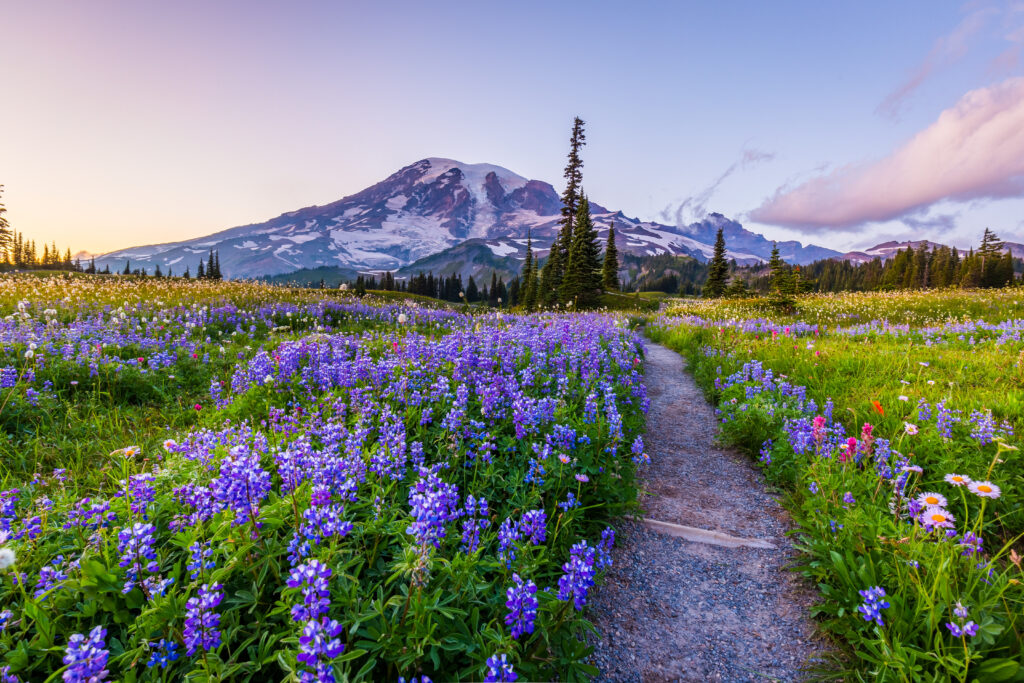
Best Mount Rainier Operators: 4 Commercial Operators Compared for 2026
Mount Rainier (14,410 feet / 4,392m) is the most glaciated peak in the lower 48 United States and the dominant Denali preparation peak for American climbers building toward international expedition objectives. The mountain delivers authentic high-altitude glacier mountaineering experience within US National Park infrastructure — complex glacier systems, fast-changing weather, and structured commercial framework managed through National Park Service concession authorization. The commercial operator field is structurally constrained to four operators reflecting NPS regulatory framework: RMI Expeditions (oldest and largest, founded 1969), Alpine Ascents International, International Mountain Guides (IMG), and Mountain Madness. For American climbers building toward Denali, Aconcagua, or international 6,000-7,000m commercial expeditions, Mount Rainier delivers structurally specific value as the standard US glaciated training peak with comprehensive operator continuity to subsequent international expedition objectives.
4,392m / Cascade Range
price range
structure
season
Mount Rainier occupies a structurally specific position in American commercial mountaineering: the most glaciated peak in the lower 48 United States, the standard Denali preparation peak, and the dominant US-direct training mountain for American climbers building toward international expedition objectives. The mountain’s 26 named glaciers covering 36 square miles provide authentic high-altitude glacier mountaineering experience within US National Park Service infrastructure — climbers experience genuine glacier travel with rope teams, crevasse navigation, expedition camp logistics, and fast-changing alpine weather without international travel complexity. The NPS concession framework structurally constrains Mount Rainier commercial guiding to authorized operators (RMI, Alpine Ascents International, IMG plus CUA permit operators) ensuring consistent operational standards and environmental stewardship. For climbers building toward Denali, Aconcagua, or international 6,000-7,000m commercial expeditions, Mount Rainier delivers structurally specific preparation framework with comprehensive operator continuity. This comparison evaluates 4 commercial Mount Rainier operators against the eight criteria framework.
Mount Rainier is widely regarded as the standard Denali preparation peak for American commercial mountaineering progression. The skills overlap with Denali commercial framework includes glacier travel with rope teams (essential Denali skill), crevasse rescue technique, expedition camp logistics with sled-pulling capability (Denali requirement), winter conditions training during shoulder seasons, multi-day high camp rotation, and crampon/ice axe technique on glaciated terrain. RMI’s Mt. McKinley Prep Course and Mountain Madness’s Denali Prep Course on Mount Rainier are explicitly designed for Denali commercial expedition aspirants — the same operators run both Mount Rainier preparation and Denali commercial expeditions, providing seamless operator continuity. Many serious Denali aspirants attempt Mount Rainier (specifically the multi-day Emmons Glacier expedition style) one season before targeting Denali in the following May-June commercial window.
Mount Rainier’s structural accessibility — short approach, US infrastructure, dominant commercial framework — can mask the mountain’s genuine technical demands. Mike Gauthier, the long-time Mount Rainier climbing ranger, has noted that international climbers frequently report a hard day on Mount Rainier matches a hard day in any mountain range. The combination of glaciated terrain (crevasse hazards), 9,000+ foot elevation gain (Paradise to summit), fast-changing alpine weather, and physical demands of multi-day expedition logistics produces genuine alpine mountaineering challenge. Climbers should arrive with strong cardiovascular fitness (multi-day high camp endurance), comfort moving on glaciated terrain, basic alpine equipment familiarity, and appropriate technical climbing preparation. Most operators include training day(s) covering crampon, ice axe, rope team, and crevasse rescue technique — but training days cannot substitute for prior alpine experience for serious commercial routes.
4 operators evaluated against the eight criteria framework. Pricing is 2026-estimated and should be verified directly with operators. The NPS concession framework structurally constrains Mount Rainier commercial guiding to a small number of authorized operators — three year-round concessioners (RMI, AAI, IMG) plus limited CUA permit operators (Mountain Madness). The structural similarity in route options (Disappointment Cleaver, Emmons Glacier dominant) means evaluation focuses on commercial structure, training framework, group size, guide-client ratio, and Denali / international expedition continuity. Twice-yearly review cycle. Next scheduled review: September 2026.
Why Mount Rainier? The Standard US Glaciated Training Peak
Mount Rainier occupies a structurally distinctive position in American commercial mountaineering:
Most glaciated peak in the lower 48 United States. Mount Rainier features 26 named glaciers covering approximately 36 square miles — more glaciated terrain than any other peak in the continental United States. The Emmons Glacier is the largest glacier in the contiguous US. The complex glacier systems develop authentic high-altitude glacier mountaineering experience including crevasse navigation, snow bridge crossings, glacier camp logistics, and rope team travel. For climbers building toward Denali, Aconcagua, or international 6,000-7,000m commercial expeditions, the glaciated character of Mount Rainier is structurally specific preparation that other US peaks cannot match.
Standard Denali preparation peak. Mount Rainier’s structural role as Denali preparation peak is institutional within American commercial mountaineering. RMI’s Mt. McKinley Prep Course, Mountain Madness’s Denali Prep Course, Alpine Ascents International’s 8-day Mountaineering Course, and IMG’s broader Mount Rainier programs all serve as Denali preparation frameworks. The skills overlap is direct — glacier travel with rope teams, crevasse rescue, expedition camp logistics with sled-pulling capability, multi-day high camp rotation, and winter conditions training during shoulder seasons. The same operators run Mount Rainier preparation and Denali commercial expeditions, providing seamless operator continuity.
NPS concession framework structurally limits operators. Mount Rainier National Park manages commercial guiding through a structured concession framework. Three operators hold authorized year-round concessioner status: RMI Expeditions (since 1968), Alpine Ascents International, and International Mountain Guides (IMG). RMI was the only licensed guiding concession until additional concessioners were added in the late 1990s — RMI’s historical dominance reflects 50+ years of institutional Mount Rainier commercial expertise. Additional operators including Mountain Madness operate through Commercial Use Authorization (CUA) permits with limited annual climb dates. The NPS concession framework structurally limits Mount Rainier commercial guiding to a small number of operators ensuring consistent operational standards and environmental stewardship.
Multiple route options for varied commercial frameworks. Mount Rainier offers multiple commercial route options through different operators:
- Disappointment Cleaver (DC) via Camp Muir — most popular standard route used by RMI’s largest commercial program; 3-4 day standard format
- Emmons-Winthrop Glacier via Camp Schurman — second-most popular route, less crowded with more vertical gain on largest glacier in contiguous US; 4-5 day expedition format
- Kautz Glacier — moderately technical route requiring ice climbing capability
- Fuhrer Finger — remote alpine-style route with small team
- Liberty Ridge — serious technical alpine objective beyond standard commercial framework
- Little Tahoma — 11,138 feet satellite peak, separate climbing objective
Structurally accessible cost framework. Mount Rainier commercial expeditions range $1,500-$3,500 depending on operator, route, and program length — meaningfully below international expedition pricing while delivering authentic glacier mountaineering experience. Three-day standard programs (RMI, AAI, IMG) typically run $1,500-$2,200. Four-to-five day programs typically run $2,200-$3,000. Eight-day mountaineering courses with summit climb run $3,000-$3,500+. Total all-in budget after international travel, climbing permit ($66/year), and ancillary costs typically runs $2,500-$5,500 — accessible to American climbers as introduction to expedition mountaineering.
May-September primary climbing season. Mount Rainier’s commercial climbing season runs May through September, with peak season June-August offering most stable conditions. Late May through early June often features more snow on routes; July-August typically offers warmer temperatures with potentially more variable conditions; September can deliver excellent conditions but with shorter daylight. Winter mountaineering programs run November-May through CUA-permitted operators (Mountain Madness, others) for ski touring, avalanche education, and Denali preparation in winter conditions.
2026 Mount Rainier Operator Awards
Four operators selected to represent the structural diversity of the Mount Rainier commercial operator field — historical dominant concessioner, premium expedition specialist, technical training specialist, and CUA-permitted boutique operator. Each delivers structurally distinct value for different client priorities.
RMI Expeditions
RMI Expeditions is the oldest and largest commercial guide service on Mount Rainier — founded by Lou Whittaker in 1969 and the only licensed guiding concession on the mountain from 1968 until the late 1990s. Over 50 years of institutional Mount Rainier expertise provides structurally distinctive operational depth. The operator runs the most extensive Mount Rainier program portfolio: classic Disappointment Cleaver climbs (multi-day formats), Expedition Skills Seminar at 10,000 feet, Mt. McKinley Prep Course explicitly for Denali aspirants, technical Kautz Glacier and Fuhrer Finger climbs, Emmons Glacier expedition style, and Little Tahoma satellite peak climbs.
RMI’s commercial framework includes 3:1 client-to-guide ratio for standard climbs, comprehensive program portfolio for varied climber capability levels, and direct operator continuity to RMI Denali expeditions. Co-owner Peter Whittaker (whose uncle Jim was the first American to summit Everest in 1963) brings family climbing heritage to the operator framework. Pricing for the 4-day Disappointment Cleaver climb typically runs $1,500-$2,000 (verify 2026 pricing directly). For American climbers prioritizing the historical dominant Mount Rainier operator with comprehensive program portfolio and Denali progression continuity, RMI delivers structurally specific value.
Read RMI Expeditions profile →Alpine Ascents International (AAI)
Seattle-based Alpine Ascents International is the authorized Mount Rainier and Denali concessioner with structurally distinctive premium expedition framework. AAI’s 8-day Mountaineering Course on Mount Rainier via the Emmons Glacier route is one of the operator’s signature programs — explicitly designed as Denali preparation with comprehensive instruction in crevasse rescue, glacier travel, navigation, climbing protection, and steep snow climbing. The 8-day format is structurally distinctive — limited to 4 departures per year reflecting premium operator capacity constraints. Beyond the Mountaineering Course, AAI offers 3-day Camp Muir Disappointment Cleaver climbs, 4-day Emmons climbs, and broader 8-10 day mountaineering programs.
The 2025 season was AAI’s strongest in recent years with 65+ teams and 225+ climbers reaching the summit — the most climbers reaching the top of Rainier in a season since 2019. AAI operates with 2:1 client-to-guide ratio (more guide-intensive than RMI’s 3:1 standard), three full days on the mountain for Camp Muir program (including two nights at altitude), and integrated Seattle-to-mountain transportation. Pricing for the 3-day Camp Muir DC climb runs $1,627; 4-day Emmons climb runs $2,068; 8-day Mountaineering Course typically $3,000+. For climbers prioritizing premium expedition framework with structured Denali progression continuity, AAI delivers structurally specific value.
Read Alpine Ascents International profile →International Mountain Guides (IMG)
International Mountain Guides (IMG) is the third authorized Mount Rainier concessioner with headquarters in Ashford, WA, just outside Mount Rainier National Park. IMG’s commercial framework emphasizes training-based program structure — the 3.5-day Camp Muir Disappointment Cleaver Summit Climb begins with half-day instructional orientation at IMG Headquarters before the mountain ascent, providing structured pre-mountain skill development. The operator’s broader Mount Rainier portfolio includes 4.5-day Emmons climbs, comprehensive Mountaineering Day Schools, Advanced Mountaineering Day Schools, and Mt. Baker / Mt. Rainier combined 7-day programs.
IMG’s institutional expertise includes founder/partner George Dunn (500+ Mount Rainier ascents) and senior guide Eric Simonson (significant Mount Rainier and Himalayan history). The operator emphasizes among the lowest client-to-guide ratios in the industry believing this maximizes training experience and success rate. Pricing for the 3.5-day Disappointment Cleaver climb runs $2,595 non-peak / $2,995 peak season; 4.5-day Emmons climb proportionally higher. IMG’s broader portfolio includes Everest, Cho Oyu, Manaslu, and Aconcagua expeditions providing structural operator continuity to international 8000m commercial expeditions. For climbers prioritizing training-based commercial framework with experienced institutional Mount Rainier expertise, IMG delivers structurally specific value.
Read IMG profile →Mountain Madness
Seattle-based Mountain Madness operates Mount Rainier through CUA (Commercial Use Authorization) permit framework rather than year-round concessioner status. The CUA permit framework limits Mountain Madness to one summer summit climb per year via the Emmons Glacier route plus Winter CUA permit allowing ski touring, avalanche course teaching, and Denali preparation in winter conditions (November to May). The operational constraint produces structurally specific commercial value — climbers who book the limited annual Mount Rainier slot receive Mountain Madness’s broader institutional expedition expertise applied to single-trip Mount Rainier commercial framework.
Mountain Madness’s structurally distinctive Mount Rainier value-add is the Denali Prep Course held on Mount Rainier — explicitly designed for climbers aspiring to participate in or lead Denali, Mount Logan, Vinson Massif, or other large glaciated peak expeditions. The course covers extended living on glaciers in extreme weather, sled-pulling, secure camp building, navigating crevassed terrain, fixed rope ascending, and trip plan formulation. Beyond Mount Rainier, Mountain Madness operates comprehensive international expedition portfolio (Aconcagua, Ecuador volcanoes, Bolivia, Nepal, Everest, Ama Dablam) providing operator continuity to subsequent international objectives. For climbers prioritizing CUA-permitted boutique commercial framework with strong Denali preparation and broader international portfolio, Mountain Madness delivers structurally appropriate fit.
Read Mountain Madness profile →2026 Mount Rainier Cost Breakdown
NPS climbing permit and regulatory framework
Mount Rainier National Park requires a climbing permit ($66 per person, valid for one calendar year) for anyone climbing above 10,000 feet or on glaciers. The permit is purchased via Recreation.gov or in person at a park ranger station. Wilderness camping permits are also required for overnight use, with reservations available after March 15 ($20 reservation fee). For climbers booking commercial guided programs through RMI, AAI, IMG, or Mountain Madness, the operator handles permit registration, reservation, and check-in/check-out logistics. Maximum group size is 12 climbers per team. All climbers must carry blue bags for solid human waste disposal — waste must be packed out and disposed of at designated locations. Independent climbers without prior glacier travel experience are strongly recommended to use guided programs.
Three-day standard programs ($1,500-$2,200)
Three-day Disappointment Cleaver standard programs through RMI (4-day option), AAI (3-day Muir), or IMG (3.5-day) typically range $1,500-$2,200. The standard program structure includes Day 1 trailhead departure from Paradise (5,400 ft) with hike to Camp Muir (10,080 ft), Day 2 mountaineering skills training at Camp Muir, Day 3 summit attempt via Disappointment Cleaver and descent to Paradise. The compressed timeline demands strong cardiovascular fitness and altitude tolerance — climbers should arrive trained for sustained altitude effort.
Four-to-five day Emmons programs ($2,000-$3,000)
Four-to-five day Emmons Glacier programs through RMI, AAI (4-day), or IMG (4.5-day) typically range $2,000-$3,000. The Emmons route from White River trailhead via Camp Schurman delivers more vertical gain (longer expedition format), less crowded route (Emmons less commercial than DC), and access to the largest glacier in the contiguous US. The expedition style format develops genuine multi-day expedition logistics including camp setup at Camp Schurman, expedition camp life, and longer summit day commitment. Mountain Madness’s annual single climb typically uses Emmons route with comparable pricing.
Eight-day mountaineering courses ($3,000-$3,500+)
Eight-day mountaineering courses with summit climb (AAI, RMI Expedition Skills Seminar) typically range $3,000-$3,500+. The 8-day format provides comprehensive mountaineering instruction across crevasse rescue systems, glacier travel, navigation, climbing protection, steep snow climbing, and integrated summit attempt. The 8-day format is the standard Denali preparation framework through commercial operators — climbers seeking serious Denali preparation should consider the 8-day mountaineering course rather than standard 3-day summit climb.
Pricing context within American commercial
Mount Rainier pricing positioning within American commercial mountaineering framework:
- Mount Rainier: $1,500-$3,500 (this comparison)
- Pico de Orizaba: $2,000-$4,500 (Mexico, 5,636m)
- Mount Hood: $400-$800 (Oregon, 11,249 ft)
- Aconcagua: $4,500-$9,000 (Argentina, 6,961m)
- Denali: $9,000-$15,000 (Alaska, 6,190m)
- Cho Oyu: $22,000-$45,000 (Tibet, 8,188m)
- Everest Nepal-side: $45,000 median commercial / $76,000 international Western
For Denali aspirants, Mount Rainier delivers structurally specific preparation at approximately 10-25% of Denali commercial cost — many serious Denali aspirants attempt Mount Rainier (specifically the multi-day Emmons Glacier expedition style) one season before targeting Denali in the following May-June commercial window.
Annual climbing pass framework
The Mount Rainier climbing permit is valid for one calendar year — climbers paying $66 can climb multiple times within the calendar year without additional permit fees. For climbers building Mount Rainier capability across multiple climbs, the annual pass framework supports cost-efficient skill development through multiple operator programs in a single season. Some operators offer multi-climb discount programs for climbers building toward Denali through extended Mount Rainier preparation.
Who Should Climb Mount Rainier in 2026?
Strong fit — American climbers building toward Denali commercial expeditions
For American climbers building toward Denali commercial expeditions, Mount Rainier delivers structurally specific preparation framework. The skills overlap with Denali commercial framework includes glacier travel with rope teams, crevasse rescue technique, expedition camp logistics with sled-pulling capability, multi-day high camp rotation, winter conditions training, and crampon/ice axe technique on glaciated terrain. The same operators run Mount Rainier preparation and Denali commercial expeditions — RMI’s Mt. McKinley Prep Course, AAI’s 8-day Mountaineering Course, and Mountain Madness’s Denali Prep Course are explicitly designed for Denali aspirants.
Strong fit — climbers seeking authentic US-direct glacier mountaineering experience
For climbers seeking authentic high-altitude glacier mountaineering experience without international travel complexity, Mount Rainier delivers structurally specific value. The 26 named glaciers covering 36 square miles provide complex glacier systems with crevasse navigation, snow bridge crossings, and multi-day glacier camp logistics. The US National Park infrastructure provides predictable operational framework, English-language commercial communication, and accessible Pacific Northwest travel logistics from US gateway cities.
Strong fit — value-conscious American climbers seeking accessible expedition introduction
For value-conscious American climbers seeking accessible expedition mountaineering introduction, Mount Rainier’s $1,500-$3,500 pricing range delivers structurally specific value. The accessible cost framework means climbers can attempt Mount Rainier multiple times if needed for skill development without commercial commitment exceeding subsequent Denali or international expedition investment. Total all-in budget after travel, permits, and ancillary costs typically runs $2,500-$5,500 — accessible to American climbers as introduction to expedition mountaineering.
Strong fit — climbers building international expedition operator continuity
For climbers building international expedition operator continuity, Mount Rainier’s commercial operator field provides structural progression continuity. RMI runs Aconcagua, Denali, Everest, Cho Oyu, and broader international expeditions; AAI runs Aconcagua, Denali, Everest, Mount Vinson, Cho Oyu, and broader international portfolio; IMG runs Everest, Cho Oyu, Manaslu, Aconcagua expeditions; Mountain Madness runs Aconcagua, Ecuador volcanoes, Bolivia, Nepal, and broader international portfolio. Climbers prioritizing single-operator progression from Mount Rainier through international objectives find structurally appropriate fit across all four featured operators.
Less optimal — first-time hikers without prior backpacking experience
Despite the structural accessibility, Mount Rainier demands genuine multi-day backpacking and alpine experience. Climbers without prior backpacking experience face significant difficulty with multi-day pack loads (45-70 lbs depending on program), hut-based or tent camping at altitude, and sustained physical effort across 9,000+ foot elevation gain. Operators recommend prior backpacking experience and basic camping competency before Mount Rainier commercial programs.
Less optimal — climbers seeking technical rock climbing experience
Mount Rainier’s commercial routes (Disappointment Cleaver, Emmons, Kautz Glacier) are primarily glacier mountaineering objectives rather than technical rock climbing. Climbers seeking technical rock climbing skill development should consider alpine objectives like Mount Stuart (Cascades), Wind River Range, or Wyoming Tetons rather than Mount Rainier. The Liberty Ridge route on Mount Rainier offers serious technical alpine climbing but is beyond standard commercial framework.
Less optimal — climbers requiring fixed-departure scheduling certainty for international travel
Mount Rainier’s weather variability and route condition changes can affect commercial program scheduling — operators typically reserve flexibility for weather-related schedule adjustments. Climbers booking international flights around Mount Rainier commercial programs should plan buffer days for weather-related extension or rescheduling. Operators with multiple departure dates per season (RMI, AAI, IMG with weekly summer departures) provide more rebooking flexibility than Mountain Madness’s single annual climb framework.
Less optimal — climbers without prior altitude experience
Mount Rainier’s 14,410 foot altitude exceeds most US peaks (only outranked by Denali in the lower 48 + Alaska) and demands genuine altitude tolerance. Climbers without prior 10,000+ foot altitude experience may experience altitude sickness symptoms during the compressed 3-day Disappointment Cleaver program timeline. The 4-5 day Emmons program or 8-day mountaineering course provides longer acclimatization framework. Climbers should consider prior altitude experience (Mount Whitney, Colorado 14ers, or similar) before Mount Rainier commercial programs.
Frequently Asked Questions About Mount Rainier Operators
How much does Mount Rainier cost in 2026?
Mount Rainier commercial expeditions in 2026 range $1,500-$3,500 depending on operator, route, and program length. Three-day standard programs (RMI, AAI, IMG) typically run $1,500-$2,200. Four-to-five day programs (RMI 4-day DC, AAI 4-day Emmons, IMG 4.5-day Emmons) typically run $2,200-$3,000. Eight-day mountaineering courses with summit climb (AAI, RMI Expedition Skills Seminar) run $3,000-$3,500+. Total all-in budget after international travel, climbing permit ($66/year), and ancillary costs typically runs $2,500-$5,500. Mount Rainier is structurally accessible compared to international expedition pricing — approximately 10-25% of Denali commercial cost while delivering authentic glacier mountaineering preparation.
Why is Mount Rainier considered the best Denali preparation peak?
Mount Rainier (14,410 feet) is the most glaciated peak in the lower 48 United States and structurally develops the specific skills required for Denali commercial expeditions. The skills overlap includes glacier travel with rope teams (essential Denali skill), crevasse rescue technique, expedition camp logistics with sled-pulling capability (Denali requirement), winter conditions training during shoulder seasons, multi-day high camp rotation, and crampon/ice axe technique on glaciated terrain. RMI’s Mt. McKinley Prep Course, AAI’s 8-day Mountaineering Course, and Mountain Madness’s Denali Prep Course on Mount Rainier are explicitly designed for Denali commercial expedition aspirants. Many serious Denali aspirants attempt Mount Rainier (specifically the multi-day Emmons Glacier expedition style) one season before targeting Denali in the following May-June commercial window.
What is the NPS concession framework for Mount Rainier guiding?
Mount Rainier National Park manages commercial guiding through a structured concession framework. Three operators hold authorized year-round concessioner status: RMI Expeditions (since 1968), Alpine Ascents International, and International Mountain Guides (IMG). RMI was the only licensed guiding concession until additional concessioners were added in the late 1990s. Other operators including Mountain Madness operate through Commercial Use Authorization (CUA) permits with limited annual climb dates — Mountain Madness has CUA for one summer summit climb per year plus Winter CUA for ski touring, avalanche education, and Denali preparation. The NPS concession framework structurally limits Mount Rainier commercial guiding to a small number of operators ensuring consistent operational standards and environmental stewardship.
What climbing permits are required for Mount Rainier in 2026?
Mount Rainier National Park requires a climbing permit ($66 per person, valid for one calendar year) for anyone climbing above 10,000 feet or on glaciers. Wilderness camping permits are also required for overnight use, with reservations available after March 15 ($20 reservation fee). For climbers booking commercial guided programs through RMI, AAI, IMG, or Mountain Madness, the operator handles permit registration, reservation, and check-in/check-out logistics. Maximum group size is 12 climbers per team. All climbers must carry blue bags for solid human waste disposal — waste must be packed out and disposed of at designated locations. Independent climbers without prior glacier travel experience are strongly recommended to use guided programs.
What are the standard Mount Rainier climbing routes?
Mount Rainier’s most popular commercial climbing routes are the Disappointment Cleaver (DC) and Emmons-Winthrop Glacier. The Disappointment Cleaver via Camp Muir is the most popular standard route used by RMI’s largest commercial program (3-4 day format). The Emmons Glacier (longest glacier in the contiguous US) via Camp Schurman is the second-most popular route, less crowded with more vertical gain (4-5 day expedition format). The Kautz Glacier offers moderately technical climbing. The Fuhrer Finger is a remote alpine-style route. The Liberty Ridge is a serious technical alpine objective beyond standard commercial framework. Little Tahoma (11,138 feet) is a satellite peak offering separate climbing objective.
When is the best time to climb Mount Rainier?
Mount Rainier’s primary commercial climbing season runs May through September, with peak season June-August offering most stable conditions. Late May through early June often features more snow on routes and colder temperatures requiring full winter equipment. July-August typically offers warmer temperatures with potentially more variable conditions including thunderstorms. September can deliver excellent conditions but with shorter daylight and cooling temperatures. Winter mountaineering programs run November-May through CUA-permitted operators (Mountain Madness, others) for ski touring, avalanche education, and Denali preparation in winter conditions. The mountain’s fast-changing alpine weather means climbers should plan buffer days for weather-related schedule adjustments regardless of season.
Should I book the 3-day Disappointment Cleaver or 4-5 day Emmons climb?
The choice depends on client priorities. The 3-day Disappointment Cleaver climb (RMI 4-day, AAI 3-day Muir, IMG 3.5-day) suits climbers prioritizing compressed timeline and standard commercial framework — most popular route, established Camp Muir infrastructure, cost-efficient pricing ($1,500-$2,200). The 4-5 day Emmons climb (RMI, AAI 4-day, IMG 4.5-day) suits climbers prioritizing genuine expedition style experience — less crowded route via White River trailhead and Camp Schurman, more vertical gain on largest glacier in contiguous US, longer expedition format developing multi-day expedition logistics ($2,000-$3,000). For Denali preparation specifically, the longer Emmons format is structurally more appropriate as it develops the expedition camp logistics required for Denali commercial framework. For first-time climbers without prior expedition experience, the shorter DC format may be more accessible.
Mount Rainier (14,410 feet / 4,392m) is the most glaciated peak in the lower 48 United States and the dominant Denali preparation peak for American climbers building toward international expedition objectives — delivering authentic high-altitude glacier mountaineering experience within US National Park infrastructure through a structurally constrained NPS concession framework. For climbers prioritizing the historical dominant Mount Rainier operator with comprehensive program portfolio, RMI Expeditions delivers institutional 50+ year Mount Rainier expertise with the most extensive program portfolio (classic DC climbs, Expedition Skills Seminar, Mt. McKinley Prep Course, technical Kautz Glacier, Emmons expedition style, Little Tahoma satellite peak). For climbers prioritizing premium expedition specialist framework, Alpine Ascents International delivers signature 8-day Mountaineering Course on Emmons Glacier explicitly designed as Denali preparation, alongside 3-day Camp Muir DC and 4-day Emmons climbs with 2:1 client-to-guide ratio. For climbers prioritizing training-based commercial framework, International Mountain Guides (IMG) delivers IMG Headquarters Ashford WA-based instructional orientation with experienced institutional Mount Rainier expertise (founder George Dunn, 500+ Mount Rainier ascents). For climbers prioritizing CUA-permitted boutique commercial framework, Mountain Madness delivers single annual summer summit climb plus Winter CUA Denali Prep Course on Mount Rainier with broader international portfolio continuity. For Denali aspirants, Mount Rainier delivers structurally specific preparation at approximately 10-25% of Denali commercial cost — many serious Denali aspirants attempt Mount Rainier one season before targeting Denali in the following May-June commercial window. The NPS concession framework structurally constrains commercial guiding to authorized operators ensuring consistent operational standards and environmental stewardship. Mount Rainier demands genuine technical preparation despite structural accessibility — climbers should arrive with strong cardiovascular fitness, prior backpacking experience, and basic alpine equipment familiarity. Verify current 2026 pricing, route availability, weather framework, and specific program inclusions directly with operators.
Sources and Verification
This comparison was built from publicly available information about commercial Mount Rainier operators, National Park Service regulatory framework, and industry reference sources. Pricing should be verified directly with operators before booking. NPS climbing permit fees and operator commercial frameworks may evolve season-to-season — verify current requirements close to departure dates. Next scheduled review: September 2026.
- NPS Mount Rainier Climbing — Official NPS climbing regulatory framework verification.
- RMI Expeditions Mount Rainier — Historical dominant concessioner program documentation.
- Alpine Ascents International Mount Rainier — Premium expedition concessioner program documentation.
- IMG Mount Rainier Programs — IMG Mount Rainier authorized concessioner program documentation.
Fact-checked April 29, 2026 · Next scheduled review: September 2026
Mount Rainier and American Mountaineering Operator Resources
Mount Rainier: Standard Denali Preparation Peak
Mount Rainier delivers structurally specific Denali preparation at approximately 10-25% of Denali commercial cost. The most glaciated peak in the lower 48 develops the glacier travel, expedition camp logistics, and rope team skills required for Denali success.