
Last updated September 18, 2026
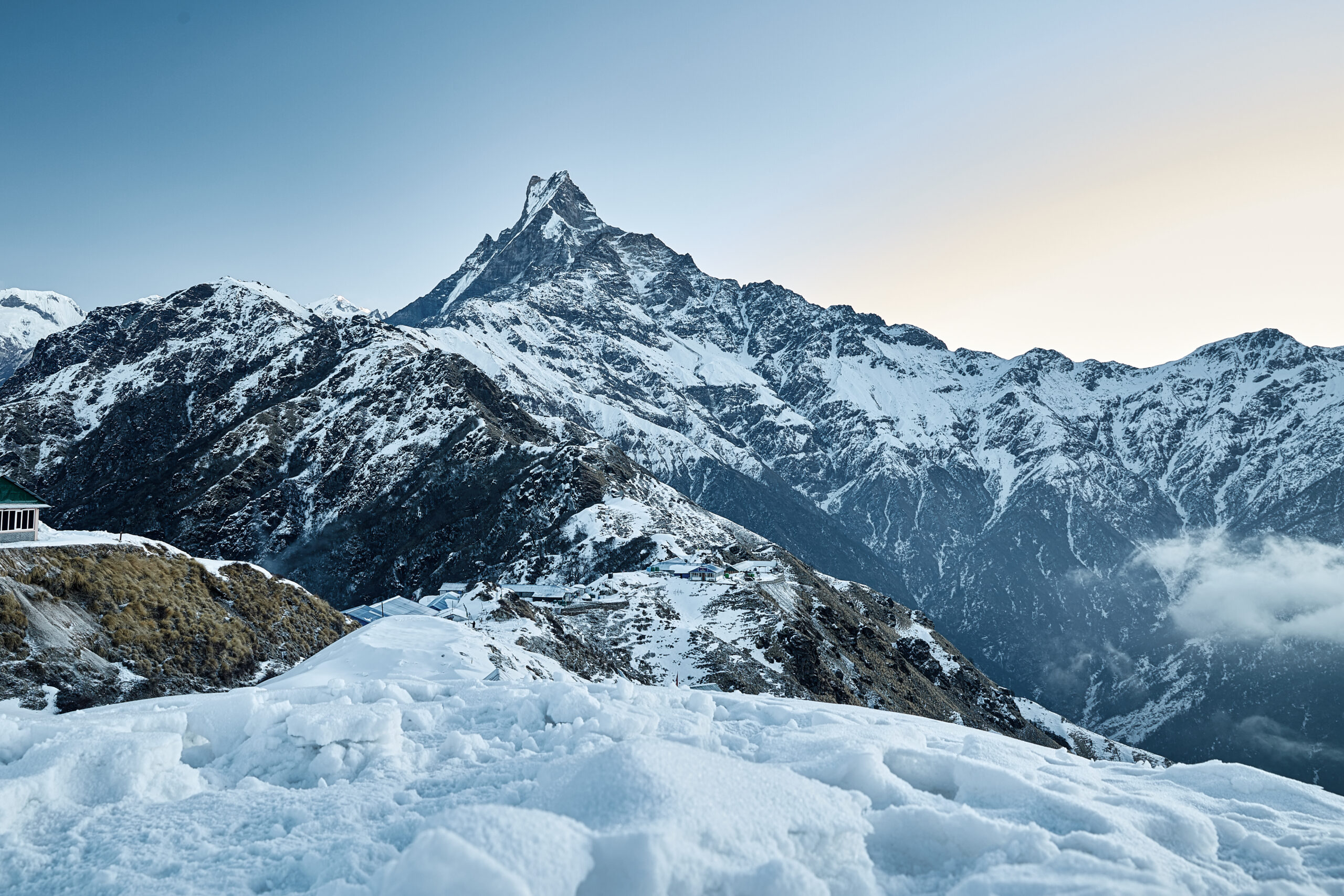
Mardi Himal Guide: Trek the Ridge or Climb the Summit
Mardi Himal is really two different objectives sharing one name: a popular teahouse trek that normally turns around near the 4,200-meter Upper Viewpoint, and a separate mountaineering climb to the peak itself. Choose the version first—then build the permits, guide support, fitness, gear and itinerary around that objective.
What is the Mardi Himal Trek—and does it reach the summit?
No. The standard Mardi Himal Trek does not summit Mardi Himal. Most trekking itineraries climb from the Pokhara side through Forest Camp, Low Camp and High Camp before reaching the Upper Viewpoint at roughly 4,200 meters. Longer walking itineraries may continue toward Mardi Himal Base Camp around 4,500 meters.
The mountain summit is a separate mountaineering objective more than 1,000 vertical meters above the walking route. It requires a climbing program, technical equipment, trained guide support and current authorization. If your goal is scenery and a short Annapurna trek, stop at the viewpoint. If your goal is the true summit, book and prepare for a climbing expedition—not a teahouse trek with one extra day added.
Mardi Himal Trek & Peak Climb
Mardi Himal Rises Directly North of Pokhara Beneath Machhapuchhre
The trekking ridge climbs from the southern Annapurna foothills toward Machhapuchhre. The mountain’s compact geography is a major reason the trek can move from subtropical forest to 4,000-meter alpine terrain in only a few days.
Pokhara · Kande · Mardi Himal · Machhapuchhre
Use this for regional orientation only. It is not a summit-navigation map.

The Famous Mardi Himal “Trek” Is a Ridge Walk Below the Mountain’s True Summit.
That distinction matters for almost every planning question: permit type, guide qualifications, technical equipment, itinerary length, insurance and cost.
Trek to the Viewpoint or Climb the Peak?
The right answer depends on whether you want a short Himalayan trekking experience or an actual mountaineering objective.
Mardi Himal Trek
- Typical duration: about 5–7 days from the road-access side near Pokhara.
- Normal high point: Upper Viewpoint around 4,200 m.
- Longer option: continue toward Base Camp around 4,500 m.
- Teahouse-based walking route; no glacier equipment in normal dry trekking conditions.
- Main challenges: rapid altitude gain, steep trail, weather, snow in colder periods and long viewpoint day.
- Best fit: hikers who want a shorter Annapurna trek with close views of Machhapuchhre and Annapurna South.
Mardi Himal Summit
- Commonly published summit elevation: 5,587 m; Himalayan Database uses a lower 5,553 m figure.
- Requires a separate climbing plan above the trekking route.
- Expect snow / ice travel and technical equipment rather than a marked teahouse trail.
- Use a qualified climbing guide and registered agency for summit authorization and logistics.
- Mardi Himal is currently royalty-free, but “free royalty” does not mean “no paperwork.”
- Best fit: trekkers who already have basic crampon, ice-axe and rope-team experience.

The Trek Builds Quickly From Forest to 4,000-Meter Ridge
Exact village and overnight sequences vary, but the elevation progression below explains why acclimatization deserves more attention than the trek’s short distance suggests.
Road-access start near the Pokhara side. Some itineraries begin or connect through Phedi, Dhampus or Australian Camp instead.
Rhododendron and oak forest. The route begins gaining altitude steadily, but this still feels more like hill trekking than alpine travel.
The forest opens and the high peaks become dominant. From here, altitude becomes an increasingly important pacing variable.
The highest regular lodge area and the launch point for the early-morning ridge walk toward the viewpoints.
The standard trekking high point for many itineraries. This is the dramatic ridge viewpoint most travelers mean when they say they “did Mardi Himal.”
A longer extension beyond the usual viewpoint. It is still not the mountain summit and should not be marketed as one.
Separate mountaineering terrain above the trekking route. Summit teams need climbing authorization, appropriate guide support and technical equipment.

Mardi Himal Gains Height Faster Than Its “Easy Nepal Trek” Reputation Suggests.
Because the trail can move from the Pokhara foothills to High Camp in only a few days, the biggest planning improvement is often slowing the ascent—not walking faster.
Autumn for Clarity; Spring for Rhododendrons
The two classic Nepal trekking windows work well on Mardi Himal, but the trek and the summit climb should not be treated as having identical condition requirements.
| Season | Trek | Summit climb | Main tradeoff |
|---|---|---|---|
| October–November | Strongest all-around trekking window: clearer post-monsoon views and generally stable trail weather. | Common climbing window when snow/ice conditions and operator logistics align. | Busier lodges and popular dates need earlier booking. |
| March–May | Excellent spring trekking, especially through the rhododendron forests. | Common pre-monsoon climbing period. | More haze and increasing pre-monsoon instability later in spring. |
| December–February | Possible, but colder with greater chance of snow and icy ridge travel. | More serious cold / snow conditions; requires explicit winter planning. | Shorter days, colder lodges and fewer margin days. |
| June–September | Monsoon rain, cloud, muddy trails and leeches reduce the route’s main visual appeal. | Generally poor fit for a recreational summit program. | Low visibility and unstable weather dominate planning. |
Mardi Himal Is Royalty-Free—but the Trek and Summit Still Require Formal Planning
Three separate ideas are often confused online: conservation-area entry, trekker registration / guide rules, and climbing-peak royalty.
For the standard Mardi Himal Trek
Nepal Tourism Board’s current TIMS page explicitly lists Mardi Himal Trek among the Annapurna routes where foreign trekkers must be accompanied by a licensed trekking guide and carry a trekking-agency-issued TIMS card. NTB currently lists TIMS at NPR 2,000 for non-SAARC trekkers and NPR 1,000 for SAARC trekkers. The trek also lies inside the Annapurna Conservation Area, so an ACAP permit is required.
For the Mardi Himal summit
The mountain is currently listed among Nepal’s royalty-free peaks. That means the climbing royalty is $0—not that a foreign climber can simply continue above the trekking route without climbing administration, a qualified guide or a registered agency. Treat the summit as a separate climbing objective and have the agency confirm the current NMA paperwork, insurance, guide certification and any deposit requirements in writing.
Do not budget a $350–$500 Mardi Himal royalty.
Those figures belong to fee-paying NMA trekking peaks and should not be copied onto Mardi Himal. Current Nepal climbing sources and the Global Summit Guide Nepal Trekking Peaks hub identify Mardi Himal as royalty-free. Your real summit cost still includes agency support, climbing guide, ACAP/TIMS administration, food, lodging/camp logistics, technical gear and insurance.

Use the Agency to Solve Paperwork; Use the Guide to Solve the Mountain.
NTB’s current system ties TIMS issuance to registered trekking agencies on Mardi Himal. For a summit climb, the support problem becomes larger: climbing authorization, technical guide, equipment and high-camp logistics all need to be explicit before departure.
Separate Trek Cost From Summit-Climb Cost
The old “permit + package” arithmetic overstated the summit royalty. A better budget starts with the support model and then adds the costs unique to each objective.
| Cost layer | Trek to viewpoint / Base Camp | Full summit climb |
|---|---|---|
| ACAP + TIMS | Required for foreign trekkers on the route. | Still part of the approach logistics. |
| Peak royalty | Not applicable. | Currently $0 for Mardi Himal. |
| Guide | Licensed trekking guide under current NTB TIMS rule. | Qualified climbing guide / agency support appropriate to the summit terrain. |
| Accommodation | Mostly teahouse-based. | Teahouse approach plus additional climbing / camp logistics as the program requires. |
| Technical gear | Normal trekking gear in dry conditions; seasonal traction may be added. | Mountaineering boots, crampons, axe, harness, helmet and rope-team system as conditions require. |
| Insurance | Policy covering trekking to the itinerary’s maximum altitude and evacuation. | Policy must explicitly cover technical mountaineering and the summit elevation. |
| Contingency | Useful for weather, transport and illness. | More important because summit weather and technical conditions can delay or cancel the climb. |
Package quotes are more useful than a fake universal total.
Guide wages, porter support, lodge style, private transport, technical equipment and summit staffing can move the price far more than the now-zero peak royalty. Ask operators for an itemized quote that separates government / conservation fees from commercial services.
The Trek Is Moderate—But the Elevation Gain Is Compressed
Mardi Himal is shorter than many famous Nepal routes. That does not automatically make it easier physiologically.
Steep but Non-Technical
Expect long stair-like climbs, forest trail and exposed ridge walking. In normal dry-season trekking conditions, ropes and glacier systems are not part of the standard trek.
Fast Gain to 4,200 m
The itinerary’s short duration can create a rapid ascent profile. The limiting factor for a fit hiker may be acclimatization rather than leg strength.
Snow Changes the Ridge
Fresh snow or ice can make the upper ridge much more consequential. Current local conditions should decide whether extra traction or a lower turnaround is appropriate.

Machhapuchhre Dominates the Trek—and Makes the Viewpoint Feel Like a Summit Experience.
That visual drama is why the trekking route can be completely satisfying without adding a technical peak climb. The mountain you are walking toward is not the same as the point most trekking itineraries reach.
The Peak Is a Climb, Not a “Harder Version” of the Trek
Commercial sources commonly describe Mardi Himal as an introductory trekking peak, but the step above Base Camp still introduces real mountaineering systems.
Crampons + Ice Axe
You should know how to move efficiently on firm snow or ice and manage an axe before summit day rather than learning the basics under time pressure.
Roped Travel
Understand harness use, clipping, spacing and guide commands. Independent teams need a much deeper rescue skill set than guided clients.
5,500 m+ Performance
The upper mountain adds serious altitude to the technical work. Prior experience around 4,000–5,000 m is much more useful than arriving with gym fitness alone.
Pre-Dawn Summit Travel
Gloves, footwear and layering must still allow you to operate technical equipment when cold and tired.
Conditions Decide Difficulty
Fresh snow, hard ice, cloud and wind can change the climb far more than a static grade suggests.
Use a Climbing Guide
A trekking guide and a summit climbing guide solve different problems. Confirm the guide’s mountaineering qualification for the peak, not simply familiarity with the teahouse trek.
Build Time Into High Camp Instead of Racing the Short Itinerary
The route’s convenience creates pressure to move quickly. A better plan treats High Camp and the upper ridge as altitude decisions rather than mileage decisions.
| Decision | Trek-only traveler | Summit climber |
|---|---|---|
| Before Mardi | Arriving in Pokhara rested helps, but it does not create high-altitude acclimatization. | Recent experience above 4,000 m is valuable before adding a 5,500 m+ summit objective. |
| High Camp | Consider itinerary space to assess symptoms before the viewpoint push. | Use the approach as deliberate acclimatization rather than merely transport to climbing terrain. |
| Pace | Steady enough to talk and fuel rather than chasing the fastest lodge-to-lodge time. | Preserve energy for technical movement and the descent after the summit attempt. |
| Symptoms | Worsening headache, nausea, dizziness or poor coordination should change the plan. | Do not let summit logistics override altitude symptoms; descend when clinically indicated. |

Mardi Himal’s Elevation and First-Ascent Record Are Messier Than Most Guidebooks Admit
Rather than hide source conflicts, this guide keeps them visible so readers know which numbers are stable and which ones are not.
5,587 m Is Commonly Published
5,587 meters is the figure used by many modern trekking and climbing references and remains the headline number on Global Summit Guide. The Himalayan Database, however, lists Mardi Himal at 5,553 meters. Treat the difference as a source discrepancy, not a meaningful planning difference.
Himalayan Database: April 23, 1962
The Himalayan Database records the first ascent on April 23, 1962 by J. O. M. Roberts, Ang Tshering Sherpa and Tenzing Nindra Sherpa. Many trekking pages instead repeat a 1961 Basil Goodfellow attribution. For historical work, the Himalayan Database record is the stronger source.
Why this matters
Neither discrepancy changes how you should prepare for the trek or summit. It does matter for source quality. A modern mountain guide should distinguish well-supported historical records from repeated tourism copy.

The Trek Can Be a First Nepal Objective; the Summit Can Be a First Himalayan Climbing Objective.
Those are both useful roles—but only if the itinerary, skills and guide support match the version of Mardi Himal you actually intend to do.
Which Mardi Himal Experience Fits You?
Use the simplest objective that delivers the experience you want. The true summit is not automatically the “better” trip.
Upper Viewpoint
Choose the standard trek if you want dramatic Annapurna scenery, teahouse travel and meaningful altitude without technical mountaineering.
Base Camp Extension
Add the 4,500-meter extension if conditions, itinerary and acclimatization support it and you want a higher walking objective.
Mardi Himal Summit
Choose the peak only if you specifically want snow-and-ice mountaineering and arrive with the skills—or an operator program designed to teach and manage them.
Mardi Himal FAQ
The questions below resolve the most common confusion between the trek and the mountain itself.
How high is Mardi Himal?
Mardi Himal is commonly listed at 5,587 meters (18,330 feet), while the Himalayan Database lists 5,553 meters. Global Summit Guide keeps 5,587 m as the headline figure but notes the database discrepancy.
How high does the Mardi Himal Trek go?
The standard trek normally turns around at the Upper Viewpoint around 4,200 meters. Longer itineraries may continue toward Mardi Himal Base Camp around 4,500 meters. Neither point is the mountain summit.
Do I need a guide for the Mardi Himal Trek?
Nepal Tourism Board’s current TIMS guidance explicitly lists Mardi Himal Trek among the routes where foreign trekkers need a licensed trekking guide and a trekking-agency-issued TIMS card.
What permits are required for Mardi Himal?
Foreign trekkers on the standard route need the Annapurna Conservation Area permit and the current TIMS/guide arrangement. A summit climb is a separate climbing objective and should be arranged through a registered agency with current NMA authorization and qualified climbing guide support.
How much is the Mardi Himal climbing royalty?
Mardi Himal is currently listed as a royalty-free climbing peak, so the peak royalty is $0. That does not remove conservation permits, TIMS, guide services, agency administration, insurance or climbing logistics.
Is the Mardi Himal Trek technical?
In normal dry-season trekking conditions, the standard teahouse trek is not a technical climb. Snow or ice can increase the seriousness of the upper ridge. The true summit is a separate mountaineering climb that requires technical equipment and skills.
What is the best time for Mardi Himal?
October–November is usually the strongest all-around trekking window for clear post-monsoon views. March–May is also popular, especially for rhododendron bloom. Winter is colder and snowier; monsoon generally offers poor visibility and wetter trails.
Who made the first ascent of Mardi Himal?
The Himalayan Database records the first ascent on April 23, 1962 by J. O. M. Roberts, Ang Tshering Sherpa and Tenzing Nindra Sherpa. Many tourism sources repeat a different 1961 attribution, so the historical record should be cited carefully.
Use Official Rules for Trekking—and Historical Databases for Climbing History
Mardi Himal has an unusually high amount of duplicated tourism information online. Permit rules, royalty status and first-ascent history are therefore separated by source type rather than blended together.
Verify again before travel
Permit procedure, TIMS administration, local fees, guide rules, lodge availability, snow conditions and summit-climb paperwork can change. Have the registered agency confirm the final document list and climbing authorization in writing before you pay the final balance.

Global Summit Guide
This guide distinguishes the popular Mardi Himal teahouse trek from the much less common summit climb. Government travel rules, climbing-history records and current peak-fee sources are kept separate so a trek package is not mistaken for summit authorization.
Mardi Himal: Trekking Peaks, Readiness, Altitude & Operators
This page owns the Mardi Himal trek-versus-summit decision. Use the collection and planning pages below to compare the next objective, close preparation gaps and verify the support model.

You Do Not Need the Summit to Have the Mardi Himal Experience.
Trek the ridge if you want one of Nepal’s strongest short high-altitude journeys. Climb the peak only when the mountaineering itself is the goal—and build the permit, guide, skills and weather plan accordingly.
Mardi Himal & the Annapurna Trekking Peaks
Mardi Himal is one of the Annapurna region’s newest objectives. Explore the area’s other peaks below.
Mardi Himal & the Sacred Walks of the Himalaya
A quieter trek beneath the Annapurna giants, Mardi Himal shares its ground with some of the world’s great sacred routes. Explore the Himalayan pilgrimages and the wider collection below.
Was this helpful?
🏔Related peaks nearby
🧭Explore & compare
Global Summit Guide is an independent mountaineering resource founded in 2026. The team combines first-hand trekking and climbing experience with in-depth research and professional health and nutrition review to help climbers choose objectives, prepare properly, and stay safe.
Health, altitude, and nutrition content is reviewed by Taylor Ludlow (Registered Nurse) and Brigg Hoopes (Nutritionist).
What We Don't Know Yet
Mountain information changes quickly. This box explains the limits of what this page can responsibly promise.
- Permit availability, reservation windows, quotas, and official fee rules may change after this page is updated.
- Total trip cost can change with flights, lodging, guide pricing, permits, gear rentals, transportation, and exchange rates.
- Visa, passport, vaccination, border, insurance, and local transportation rules may change before your trip.
Verify current conditions with official land managers, guide services, local forecasts, and current route reports before booking or climbing.
Mountaineering, rock and ice climbing, glacier travel, and high-altitude activity are inherently dangerous and can result in serious injury or death. The information on Global Summit Guide is provided for general informational and educational purposes only and is not a substitute for professional instruction, qualified guiding, proper equipment, or your own judgment and experience.
Route conditions, weather, snowpack, permits, regulations, and hazards change constantly and may differ from what is described here. Details may be incomplete, out of date, or contain errors. Always verify current information with local authorities, certified guides, and official sources before making any decision in the mountains.
Nothing on this site is medical, legal, or financial advice. Our fitness, acclimatization, altitude, and nutrition content is general in nature; consult a qualified physician before beginning any strenuous exercise program or exposing yourself to high altitude.
You are solely responsible for your own safety and decisions. To the fullest extent permitted by law, Global Summit Guide and its team accept no liability for any loss, injury, damage, or expense arising from use of, or reliance on, this information. By using this site you acknowledge these risks and accept these terms.
Some links on this site may be affiliate links. If you buy through them we may earn a small commission at no extra cost to you; this never affects our recommendations.
Global Summit Guide recommendation path
Next Best Mountain to Research
Use these recommendations to continue the right planning path instead of stopping on one page.
Use current permit, weather, route, and operator information before booking or climbing.
Search Flights, Hotels & Rental Cars
Have the mountain or destination picked? Use Expedia to compare the flights, lodging and rental cars that fit your actual trip dates. For mountain travel, consider arriving early enough for delays and adding a buffer night after the climb before a fixed flight home.
Compare current flight, hotel and car options.
Affiliate disclosure: Global Summit Guide may earn a commission if you book through this link, at no additional cost to you.