<
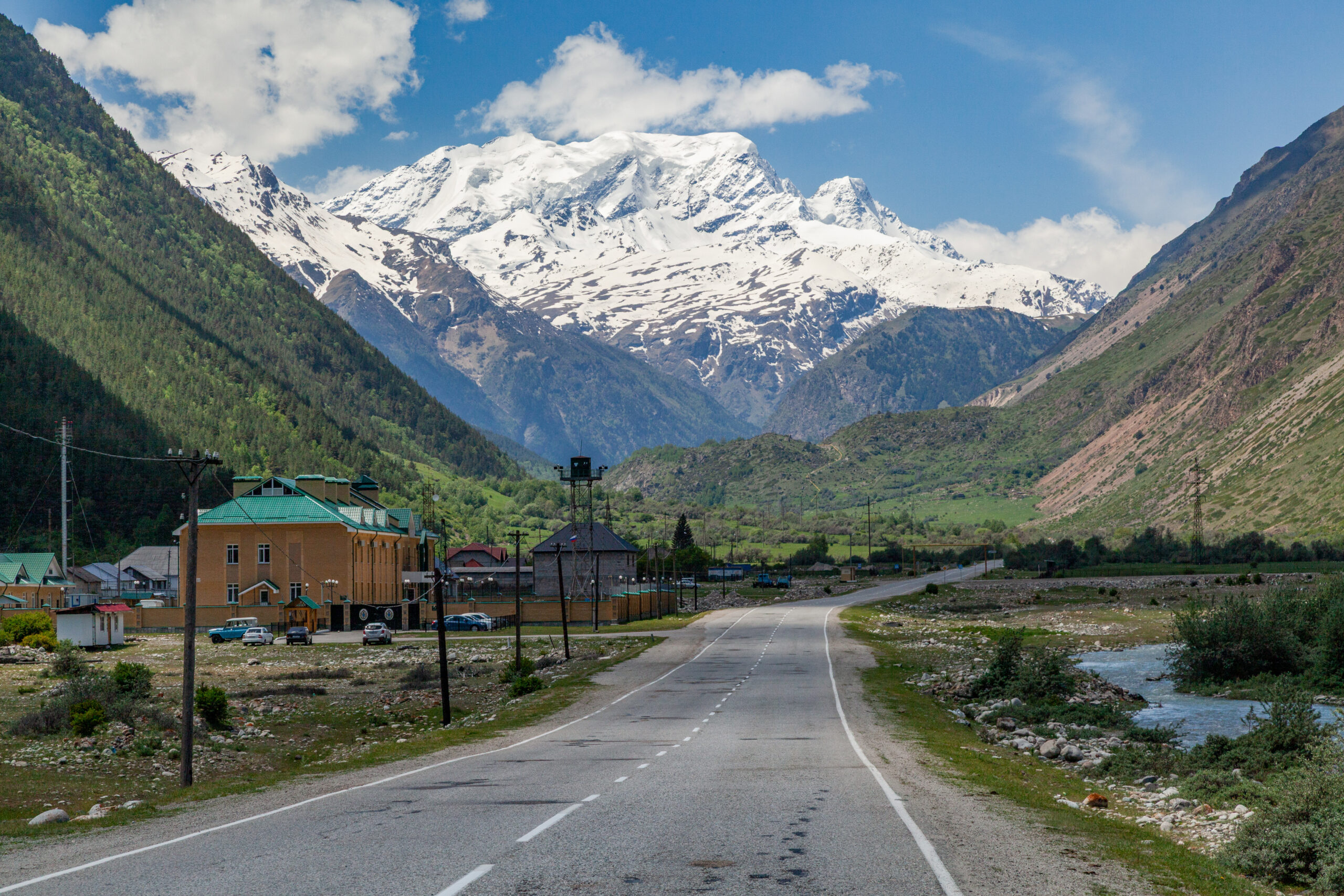
Mount Elbrus the highest peak in Europe at 5642 meters elevation showing the iconic twin summit dormant volcano in the Caucasus Mountains of southern Russia near the Georgia border representing one of the two most popular Seven Summits objectives compared in this guide alongside Mount Kilimanjaro at 5895 meters elevation in Tanzania Africa highlighting the standard South Route approach via cable car and chairlift to approximately 3800 meters before the climb to Pastukhov Rocks at 4800 meters and ultimately the summit at 5642 meters during the typical 7 to 10 day Mount Elbrus climbing expedition
Mountain Comparisons · Seven Summits · 2026

Elbrus vs Kilimanjaro: Which Is Harder to Climb?

The complete 2026 comparison of the two most popular Seven Summits — Mount Elbrus (5,642m / 18,510 ft, Europe’s highest peak in the Caucasus, Russia) and Mount Kilimanjaro (5,895m / 19,341 ft, Africa’s highest peak in Tanzania). Covering technical difficulty, success rates, costs, beginner suitability, and the question every Seven Summits aspirant asks: which of these two should you climb first?

📋 Editorial Standards

This Elbrus vs Kilimanjaro comparison combines our editor’s first-hand Mount Kilimanjaro climbing experience with extensively researched Mount Elbrus information sourced from Kilimanjaro National Park authority, the UIAA alpine grading system, established Caucasus mountaineering literature, and major Russia-based and Tanzania-based guide operators. Trail mileages, elevation figures, success rates, and permit specifics are cross-referenced with multiple sources. No affiliate partnerships influence recommendations.

⚡ The Verdict in One Sentence

Mount Elbrus is harder than Mount Kilimanjaro despite being 253 meters lower — Elbrus requires basic mountaineering skills (crampons, ice axe, rope team travel) and faces severe Caucasus weather, while Kilimanjaro is a non-technical walk-up on every standard route. Specifically, this means Kilimanjaro is the better first Seven Summit for climbers without prior mountaineering experience; Elbrus is the better first Seven Summit for climbers with basic technical skills.

The data: Elbrus has a slightly higher success rate (60-75%) than Kilimanjaro (40-70% varying by route), but this is misleading — Kilimanjaro’s lower rates reflect rushed 5-day itineraries; on 8-9 day routes Kilimanjaro success rises to 85-90%. Both peaks are excellent first Seven Summits depending on your starting experience level.

253 m
Kili higher by
Grade F
Elbrus alpine grade
Walk-up
Kilimanjaro
Both 7S
Seven Summits members

MOUNT ELBRUS

Caucasus · Russia · Europe’s Highest Peak

5,642 m
18,510 ft · West summit · Twin-peak volcano
Country
Russia
Range
Caucasus Mountains
Standard route
South Route via Azau
Trip duration
7-10 days
Difficulty grade
F (Facile) to PD-
Technical level
Basic mountaineering
Success rate
~60-75%
Best season
June-September
Cost (full trip)
$1,500-3,500
Seven Summits rank
3rd easiest

MOUNT KILIMANJARO

Tanzania · Africa’s Highest Peak · Free-Standing

5,895 m
19,341 ft · Uhuru Peak · Highest free-standing mountain
Country
Tanzania
Range
Free-standing volcano
Standard routes
7 (Marangu, Machame, Lemosho…)
Trip duration
5-9 days
Difficulty grade
Non-technical hike
Technical level
Walk-up only
Success rate
~40-70% route-dependent
Best season
Jan-Mar, Jun-Oct
Cost (full trip)
$1,500-4,000+
Seven Summits rank
2nd easiest

⚡ Quick Answer: Elbrus vs Kilimanjaro

Which is harder? Elbrus is harder despite being lower — requires basic mountaineering skills and faces severe Caucasus weather.

Mount Elbrus (5,642m): Grade F (basic mountaineering), South Route via Azau cable car, 7-10 days, $1,500-3,500, ~60-75% success, June-September. Mount Kilimanjaro (5,895m): Non-technical walk-up, 7 standard routes (Machame/Lemosho recommended), 5-9 days, $1,500-4,000+, ~40-70% success (route-dependent, up to 90% on 8-9 day routes), Jan-Mar/Jun-Oct.

Seven Summits progression: Most climbers start with Kilimanjaro (no technical skills required), then Elbrus (basic mountaineering introduction), then Aconcagua, then Denali, then bigger peaks.

How This Comparison Was Built — Honest Editorial Framing

This Elbrus vs Kilimanjaro comparison uses different evidence standards for each peak based on our team’s direct climbing experience — we believe in being explicit about this distinction:

★ Kilimanjaro: First-Hand Experience

Travis Ludlow has personally summited Mount Kilimanjaro via the standard route. Specifically, this means the Kilimanjaro sections of this comparison include personal observations about acclimatization, gear performance, summit day dynamics, and trail conditions that supplement the published data sources.

✓ Elbrus: Research-Based Analysis

Mount Elbrus is outside our editorial team’s direct climbing experience to date. Specifically, the Elbrus sections synthesize information from major Caucasus mountaineering literature, established Russia-based guide operators, the UIAA alpine grading system, and published Elbrus expedition reports.

Notably, this transparency is important because comparison content benefits from being honest about which peak the author has actually climbed and which is researched. Generally, our Kilimanjaro coverage reflects first-hand knowledge; our Elbrus coverage reflects research synthesis with appropriate sourcing.

🏔 The Seven Summits Decision Framework

The Elbrus vs Kilimanjaro decision sits across three primary dimensions. First, technical experience: do you have basic mountaineering skills (crampons, ice axe, rope team travel)? If yes, either peak works as first Seven Summit; if no, Kilimanjaro first. Second, weather tolerance: Elbrus faces severe Caucasus weather; Kilimanjaro’s equatorial location is comparatively stable. Third, logistics complexity: Kilimanjaro’s Tanzania infrastructure is travel-friendly; Russian visa and logistics for Elbrus add complexity.

Generally, the right question isn’t “which is harder” — both are demanding 5,500m+ peaks requiring respect — but “which fits your specific experience and travel style.” Notably, the strongest answer for most first-time Seven Summits climbers: Kilimanjaro first to establish altitude tolerance, then Elbrus second to develop technical skills, progressing toward Aconcagua and Denali for bigger objectives.

Mount Elbrus (5,642m / 18,510 ft) and Mount Kilimanjaro (5,895m / 19,341 ft) are two of the seven peaks comprising the Seven Summits — the highest mountains on each continent that have become the standard mountaineering progression challenge. Generally, both peaks are considered among the most beginner-friendly of the Seven Summits — Kilimanjaro for being non-technical (a pure high-altitude hike), Elbrus for being technically modest (basic mountaineering skills only). Specifically, climbing both Kilimanjaro and Elbrus is widely considered the standard introduction to Seven Summits mountaineering, building the altitude tolerance and technical foundation needed before progressing to harder Seven Summits like Aconcagua (6,961m), Denali (6,190m), and ultimately Mount Everest (8,849m). Notably, both peaks attract tens of thousands of climbers annually because they offer 5,500m+ summit experience with manageable technical requirements compared to harder Seven Summits — they are the entry points into “real” high-altitude mountaineering for most first-time alpinists.

Key Takeaways

  • Kilimanjaro is higher: 5,895m vs 5,642m (Elbrus) — 253m difference.
  • Elbrus is technically harder: Grade F basic mountaineering vs Kilimanjaro walk-up.
  • Kilimanjaro is easier to climb first: No mountaineering skills required.
  • Elbrus has more severe weather: Caucasus storms vs Kilimanjaro tropical stability.
  • Both Seven Summits: 2nd and 3rd easiest depending on Kosciuszko inclusion.
  • Similar cost: Both approximately $1,500-4,000 per person.
  • Similar duration: Elbrus 7-10 days; Kilimanjaro 5-9 days.
  • Success rates: Elbrus 60-75%; Kilimanjaro 40-70% route-dependent (up to 90%).
  • Both dormant volcanoes — Kilimanjaro is largest free-standing mountain.
  • Default first choice: Kilimanjaro for non-technical climbers.

✓ Editorial Trust Signals

  • First-hand Kili: Travis summited Kilimanjaro
  • Research-based Elbrus: Honest framing
  • Independent: No affiliate sponsorship
  • Cross-referenced: UIAA, parks authorities
  • Last verified: June 9, 2026
  • Review cycle: Quarterly
  • Safety review: Dawson Ludlow (WFA)
  • Gear review: Walker Ludlow
Updated June 2026 · 31st of 50 mountain comparisons · Two of the most popular Seven Summits · Elbrus 5,642 m · Kilimanjaro 5,895 m · Complete climbing guide + decision rubric

The Fundamental Difference Between Mount Elbrus and Mount Kilimanjaro

Mount Elbrus and Mount Kilimanjaro are the two most popular Seven Summits and the standard entry points into high-altitude mountaineering for first-time Seven Summits climbers. Generally, they are often presented as “the easy two” of the Seven Summits, but they offer fundamentally different climbing experiences. Specifically, the comparison comes down to a single key observation: Kilimanjaro is higher (5,895m vs 5,642m) but technically easier; Elbrus is lower but technically more demanding. Neither is a casual hike — both are 5,500m+ peaks requiring serious preparation, proper guide services, multi-day expedition duration, and respect for high altitude — but they emphasize different aspects of what makes a Seven Summit climb challenging.

What distinguishes them most clearly is what type of difficulty each presents. Generally, Kilimanjaro’s difficulty is pure altitude management — fitness, acclimatization profile, and willingness to push through the discomfort of climbing into thin air on a non-technical trail. Specifically, Elbrus’s difficulty combines basic mountaineering skills (crampons, ice axe, rope team travel) with severe Caucasus weather that can turn a moderate climb into a serious emergency in hours. Notably, this difference shapes the entire decision calculus: Kilimanjaro requires fitness and altitude tolerance; Elbrus requires those plus mountaineering competence and weather judgment.

Side-by-Side Comparison Table

The complete comparison across every dimension that matters when choosing between Mount Elbrus and Mount Kilimanjaro as a first Seven Summit:

DimensionMount ElbrusMount Kilimanjaro
Summit elevation5,642 m (18,510 ft)5,895 m (19,341 ft)
CountryRussiaTanzania
ContinentEurope (highest peak)Africa (highest peak)
Mountain typeDormant stratovolcano (twin summit)Dormant stratovolcano (three cones)
Standard routeSouth Route via AzauMarangu / Machame / Lemosho (multiple)
Alpine gradeF (Facile) to PD-Non-technical (walk-up)
Technical demandCrampons, ice axe, rope team travelHiking only — no technical gear
Base camp elevation~3,800 m (cable car accessed)Varies by route, ~2,800-3,000 m start
High camp elevation~4,800 m (Pastukhov Rocks) or barrels~4,600-4,700 m (Barafu, Kibo)
Trip duration7-10 days5-9 days (7+ recommended)
Approach styleCable car + chairlift to upper mountainLong multi-day walking approach
Cost (full trip)$1,500-3,500$1,500-4,000+
Permit / feesRussian visa, regional permitsKilimanjaro National Park fees $800-1,200
Mandatory guide service?Recommended but not strictly requiredYES — Tanzanian regulation
Success rate~60-75%~40-90% (route-dependent)
Best seasonJune-SeptemberJanuary-March, June-October
Weather severitySevere — Caucasus stormsStable — tropical equatorial
Crevasse hazardModerate (rope team protection)None (no glaciated terrain)
Cold exposureSummit -20°F typicalSummit -15°F to -25°F
Required gearCrampons, ice axe, harness, rope (group)Hiking boots, warm clothing, no technical gear
Seven Summits ranking3rd easiest2nd easiest
Best forClimbers with basic mountaineering skillsClimbers without prior mountaineering

How to Climb Mount Elbrus — The Complete Guide

Mount Elbrus (5,642 meters / 18,510 feet) is Europe’s highest peak and one of the Seven Summits — making it the obvious objective for any climber pursuing the Seven Summits or seeking entry into high-altitude mountaineering. Generally, climbing Mount Elbrus is a 7-10 day expedition based in the Baksan Valley of the Caucasus Mountains in southern Russia, near the Georgia border. Specifically, the standard South Route uses cable cars and chairlifts to access the upper mountain — making Elbrus the most accessible high peak in Europe with respect to approach logistics, though the climbing itself still requires basic mountaineering competence.

What makes climbing Mount Elbrus distinctive among Seven Summits is the combination of moderate technical demands with severe weather exposure. Generally, the South Route is rated Grade F (Facile) to PD- in alpine grading — meaning it requires basic mountaineering skills (crampon and ice axe proficiency, rope team travel for crevasse protection, basic snow climbing technique) but no advanced technical climbing. Specifically, the climbing itself is essentially a long glacier walk to a summit dome — fundamentally different from technical alpine climbs requiring fixed-rope ascending or roped lead climbing. Notably, however, Elbrus weather is notorious for sudden violent storms with high winds and rapid temperature drops, which dramatically affects the effective difficulty.

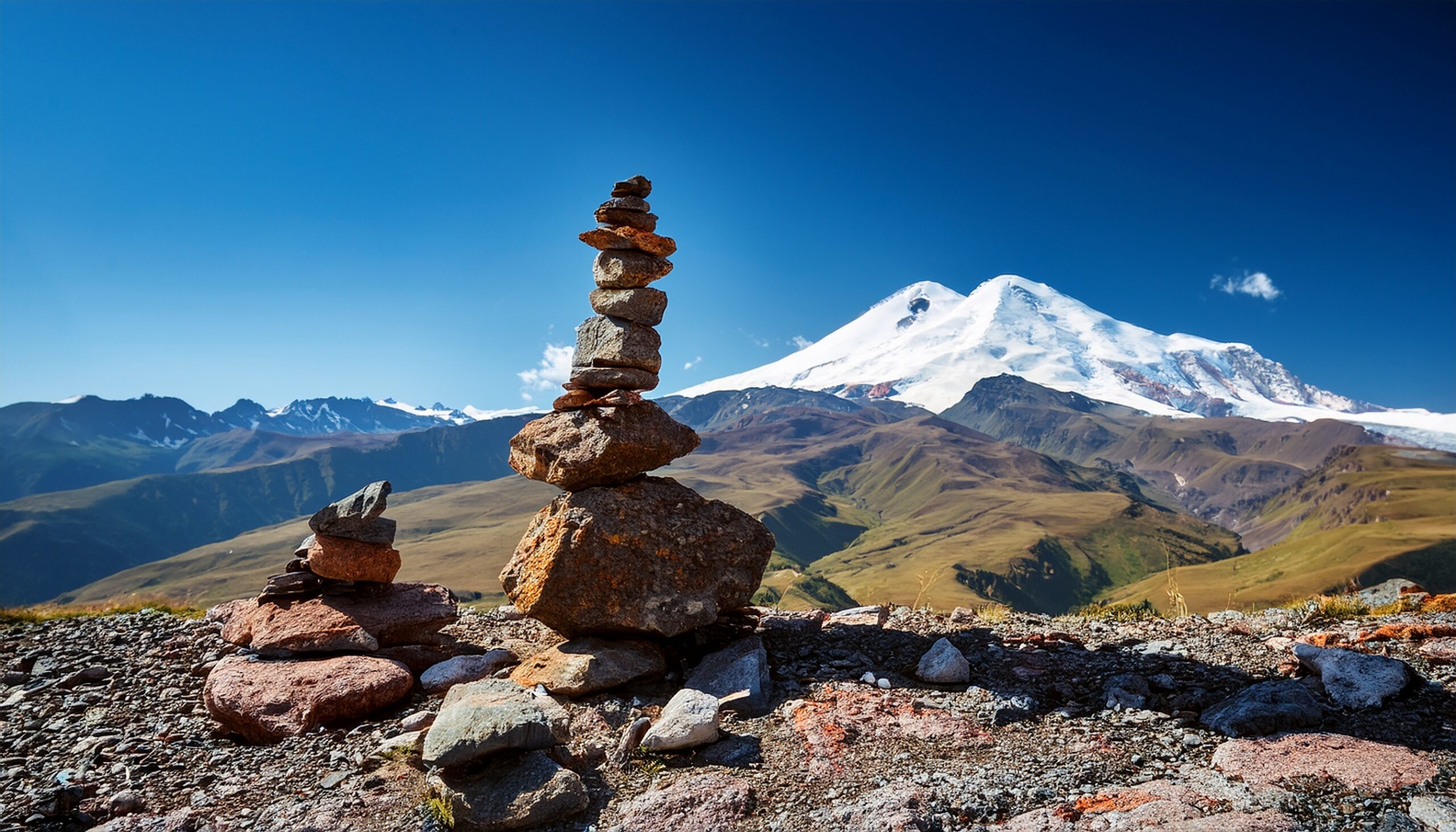
Rock cairns and trail markers in the foreground with the iconic twin summit dome of Mount Elbrus the highest peak in Europe at 5642 meters elevation in the background representing the standard South Route approach from the village of Azau in the Baksan Valley of the Caucasus Mountains southern Russia near the Georgia border showing the type of high altitude terrain and route navigation that climbers encounter on the typical 7 to 10 day Mount Elbrus climbing expedition with the dormant stratovolcano twin summit dome visible against the daytime sky
Mount Elbrus from the standard South Route approach. Generally, Mount Elbrus is a dormant stratovolcano with two summits — the west summit at 5,642 meters (the official high point) and the east summit at 5,621 meters. Specifically, the standard South Route ascends from the village of Azau via cable car and chairlift to approximately 3,800 meters, where climbers stay in mountain huts or barrel-shaped “barrels” accommodation before the summit push. Notably, the route uses snowcat transport from 3,800m to approximately 5,000m for many commercial parties — a controversial practice that simplifies the climb but reduces the mountaineering experience.Photo: Mount Elbrus from approach route. Adobe Stock licensed image, Global Summit Guide media library.

Elbrus Standard Route — The South Route in Detail

The standard route up Mount Elbrus is the South Route from the Baksan Valley town of Azau:

DayActivityElevation
Day 1-2Arrival Mineralnye Vody airport (MRV); transfer to Terskol or Cheget~2,000 m
Day 3Acclimatization hike — Mount Cheget or Baksan Valley side peak3,000-3,400 m
Day 4Cable car / chairlift to Garabashi station; settle in huts/barrels3,800 m
Day 5Acclimatization climb to Pastukhov Rocks; technical skills review4,800 m
Day 6Rest day or weather buffer3,800 m
Day 7Summit day — early start (1-3 AM), snowcat to 5,000m optional, climb to summit 8-12 hours total5,642 m (summit)
Day 8Weather buffer / second summit attempt if needed3,800 m
Day 9-10Descent, return to Mineralnye Vody, departureVarious

Elbrus Difficulty — What to Expect

Climbing Mount Elbrus presents three primary difficulty categories:

  1. Altitude: 5,642m places Elbrus in the very high altitude zone where physiological effects become severe. Generally, climbers need to acclimatize properly through multi-day stays at 3,800m and acclimatization rotations to 4,800m before the summit push.
  2. Technical mountaineering: Crampon and ice axe proficiency required; rope team travel for crevasse protection on the upper glacier; basic snow climbing technique. Specifically, these skills can be learned in 2-3 days of mountaineering instruction before the climb.
  3. Weather: The Caucasus Mountains see violent storms with sustained winds over 50 mph and rapid temperature drops. Specifically, summit attempts are weather-dependent — guide services build 1-2 buffer days into 7-10 day itineraries to allow for storms.

Mount Elbrus Cost — Full Expedition Budget

Cost ItemEstimated Range
International flights to Mineralnye Vody (MRV)$700-1,500 (from North America via Moscow or Istanbul)
Russian visa$50-200 depending on nationality and processing
Local transport (airport to Baksan Valley)$50-150 round trip
Accommodation in Baksan Valley$200-500 (4-6 nights at $40-80/night)
Cable car / chairlift$30-50 round trip
Mountain huts / barrels$80-200 (2-3 nights at 3,800m)
Snowcat transport (5,000m)$50-100 if used
Guide service$800-1,800 per climber for group; $2,500-4,500 private
Equipment rental (if needed)$100-300 (crampons, ice axe, harness)
Food and tips$200-400
Travel insurance$80-150
TOTAL ESTIMATED RANGE$1,500-3,500 typical; $4,000+ premium

How to Climb Mount Kilimanjaro — Everything You Need to Know

Mount Kilimanjaro (5,895 meters / 19,341 feet) is Africa’s highest peak, one of the Seven Summits, and the highest free-standing mountain in the world — rising from approximately 900m base elevation to 5,895m summit, a vertical rise of nearly 5,000 meters. Generally, climbing Mount Kilimanjaro is widely considered the most accessible Seven Summit because it requires no technical mountaineering skills — just fitness, willingness to manage altitude, and a mandatory Tanzanian guide service that handles all logistics. Specifically, the climb takes 5-9 days depending on route choice; 7+ day routes are strongly recommended for higher success rates.

What makes climbing Mount Kilimanjaro distinctive is the route variety and acclimatization choices. Generally, Kilimanjaro has seven established climbing routes — Marangu, Machame, Lemosho, Rongai, Northern Circuit, Umbwe, and Shira — each with different characteristics, scenery, success rates, and durations. Specifically, route choice substantially affects summit success: the popular 5-day Marangu route (“Coca-Cola route”) sees ~40-50% success due to inadequate acclimatization time, while 8-9 day Lemosho route attempts see 85-90% success rates with proper acclimatization profiles. Notably, this route diversity is unique among Seven Summits — Elbrus, Aconcagua, and others have one or two standard routes; Kilimanjaro has seven.

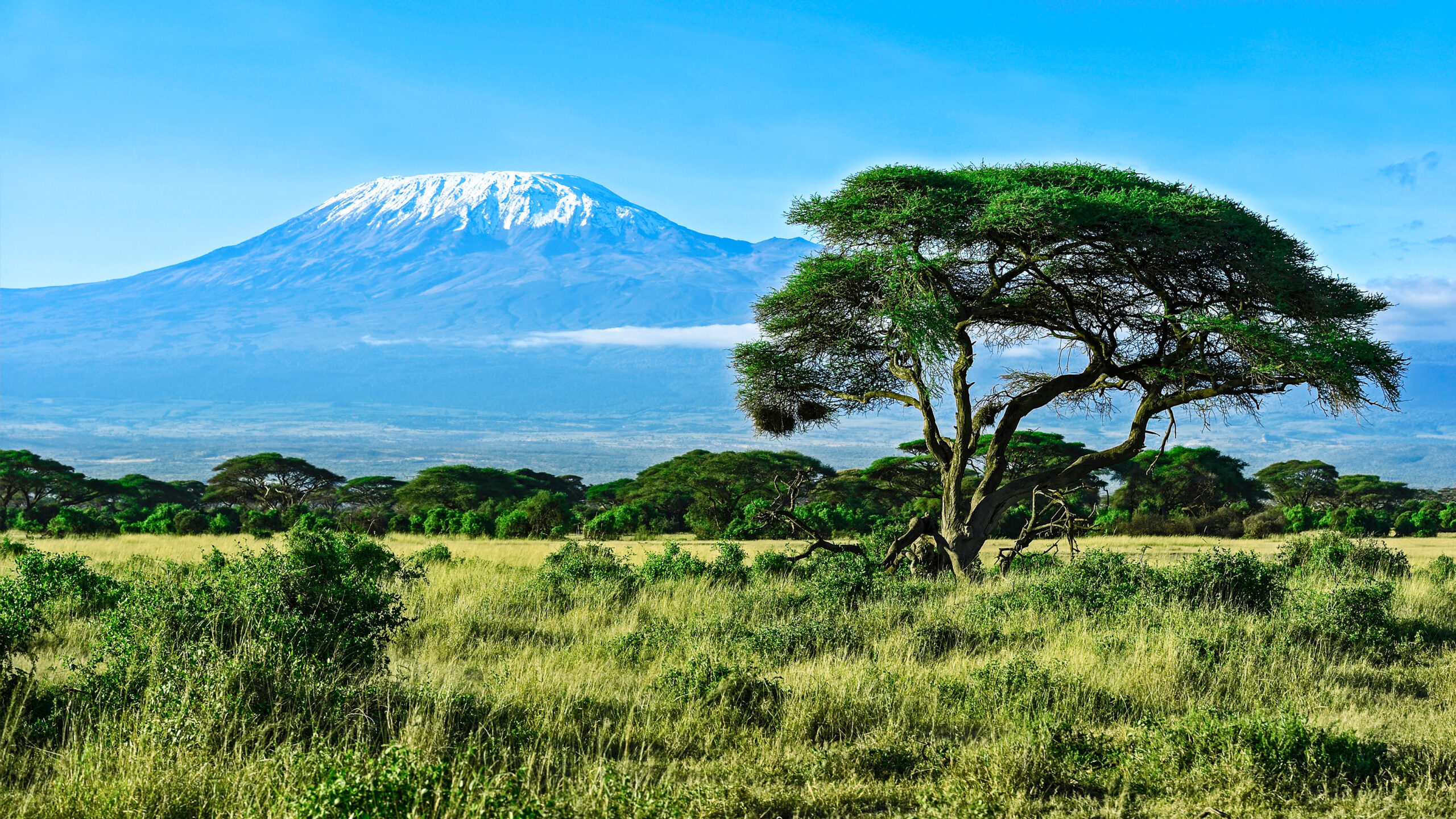
Mount Kilimanjaro the highest peak in Africa at 5895 meters elevation viewed from Amboseli National Park in Kenya showing the iconic snow capped summit dome of the dormant stratovolcano that rises 4995 meters from its base making it the highest free standing mountain in the world and one of the Seven Summits along with Mount Elbrus in Europe representing the standard non technical walk up climbing objective accessed via seven established routes including Marangu Machame Lemosho Rongai Northern Circuit Umbwe and Shira routes from Tanzania
Mount Kilimanjaro viewed from Amboseli National Park in Kenya. Generally, Kilimanjaro’s iconic appearance — a massive isolated snow-capped dome rising from the Tanzania-Kenya borderland savanna — makes it one of the most recognizable mountains on Earth. Specifically, the summit (Uhuru Peak at 5,895m) sits on the Kibo crater rim, the highest of three volcanic cones (Kibo, Mawenzi at 5,149m, and Shira at 3,962m). Notably, Kilimanjaro is dormant but not extinct — the most recent eruption was approximately 200,000 years ago, but volcanic activity remains possible in geological terms. The mountain is also famous for its rapidly receding summit glaciers — a visible marker of climate change.Photo: Mount Kilimanjaro from Amboseli National Park. Adobe Stock licensed image, Global Summit Guide media library.

Kilimanjaro Route Comparison

RouteDurationDifficultySuccess RateScenery
Marangu (Coca-Cola)5-6 daysLowest physical~40-50% (5-day) / ~60% (6-day)Hut accommodation; single up/down
Machame (Whiskey)6-7 daysModerate~60-75% (7-day)Excellent variety; Barranco Wall
Lemosho7-8 daysModerate~85-90% (8-day)Best scenic variety; remote start
Rongai6-7 daysModerate~65-75% (7-day)Northern approach; drier
Northern Circuit8-9 daysModerate~90%+ (9-day)Longest route; full mountain circumnavigation
Umbwe5-6 daysHardest (steep)~50-60%Steepest; experienced trekkers only
Shira7-8 daysModerate~75-80%Western approach; high entry start

Kilimanjaro Difficulty — The Honest Truth

Climbing Mount Kilimanjaro presents two primary difficulty categories — neither involving technical mountaineering:

  1. Altitude management: Kilimanjaro’s 5,895m summit places it in the very high altitude zone where altitude sickness (AMS, HAPE, HACE) becomes a real risk. Generally, acclimatization is the single biggest determinant of summit success — climbers on 8-9 day routes succeed at 85-90% rates; climbers on rushed 5-day routes succeed at only 40-50%.
  2. Physical endurance: The standard summit day (typically Day 6 on Machame route) involves a midnight start, 6-8 hours of ascent in cold temperatures from Barafu Camp (4,673m) to Uhuru Peak (5,895m), then 4-6 hours of descent — total 10-14 hours of effort on summit day.
ℹ️ First-Hand Field Observation: Kilimanjaro Summit Day

From Travis Ludlow’s personal Kilimanjaro summit experience: the actual climbing on summit day is not technically difficult — it is physically grueling at altitude. Specifically, the midnight-to-dawn climb from Barafu Camp involves slow, deliberate steps in headlamp light through volcanic scree, with the cold and altitude creating the primary challenge. Generally, climbers move at a pace described as “pole pole” (slowly slowly in Swahili) — the Tanzanian guides set a methodical pace that allows altitude management. Notably, reaching Uhuru Peak as the sun rises over the African landscape is one of the most spectacular sunrises in mountaineering — well worth the difficulty.

Mount Kilimanjaro Cost — Full Expedition Budget

Cost ItemEstimated Range
International flights to Kilimanjaro Airport (JRO)$1,000-1,800 (from North America)
Tanzania visa$50-100 depending on nationality
Kilimanjaro National Park fees$800-1,200 (varies by route days)
Mandatory guide service$1,500-3,500 per climber depending on operator tier
Porter and cook services (included in guide service)Bundled
Accommodation (camping or huts)Bundled with guide service
Equipment rental (if needed)$50-200 (boots, jacket, sleeping bag)
Tips for guide team$200-400 standard tip
Hotel before/after climb in Moshi/Arusha$100-300
Travel insurance$80-150
TOTAL ESTIMATED RANGE$1,500-4,000+ typical; $5,000+ premium operator
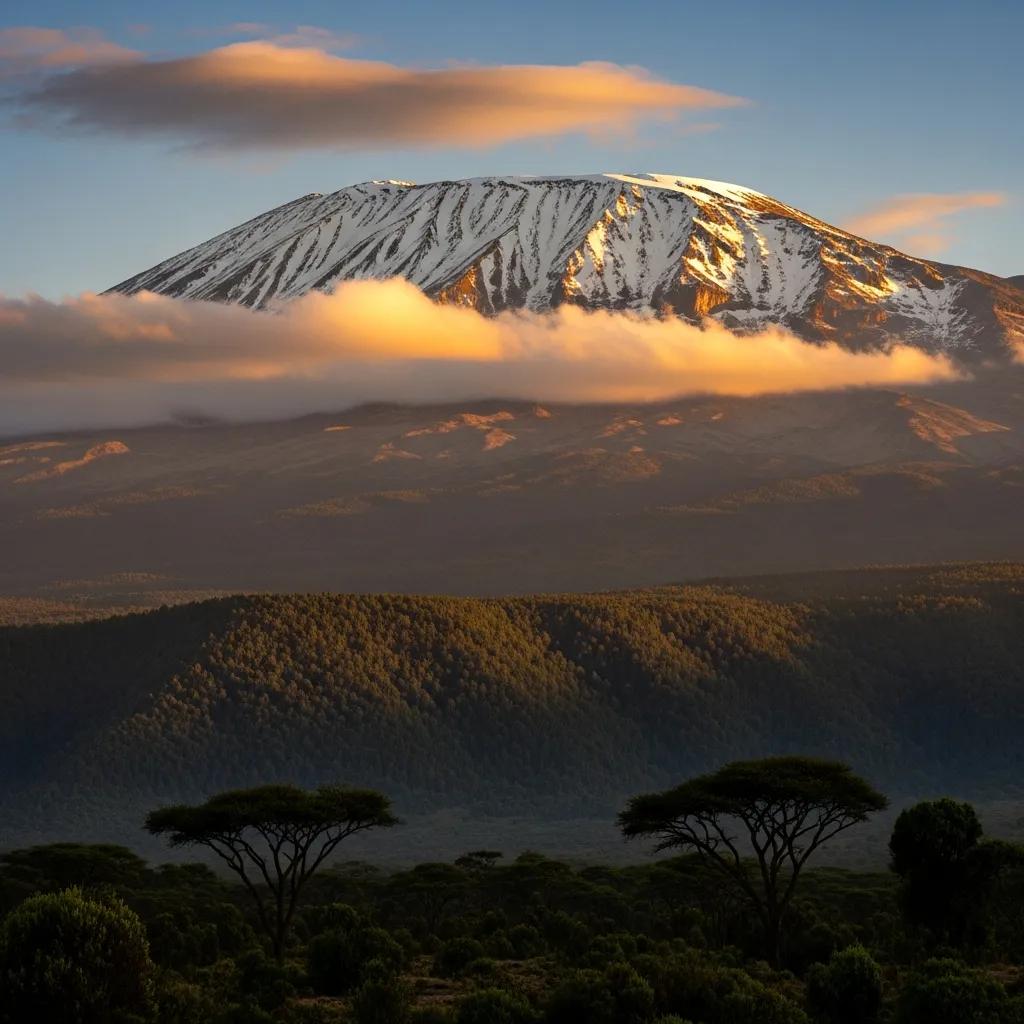
Stunning view of Mount Kilimanjaro at sunrise showing the iconic snow capped summit dome of Uhuru Peak at 5895 meters elevation glowing in the early morning golden light symbolizing the adventure and climbing aspirations of mountaineers who pursue the Seven Summits beginning with this dormant stratovolcano in Tanzania Africa which is widely considered the most accessible Seven Summit and the standard first Seven Summit choice for climbers without prior mountaineering experience because it requires only fitness and acclimatization rather than technical mountaineering skills
Kilimanjaro at sunrise — the iconic Seven Summits aspiration moment. Generally, reaching Uhuru Peak at sunrise (after a midnight start from Barafu Camp) is the defining experience of a Kilimanjaro climb. Specifically, climbers typically arrive at the summit between 5:30-7:00 AM as the sun rises over the African savanna far below — providing one of the most photographed moments in mountaineering. Notably, this sunrise summit timing is built into every standard guided itinerary because both the daytime weather window and the visual experience favor early summit arrivals.Photo: Mount Kilimanjaro at sunrise. Adobe Stock licensed image, Global Summit Guide media library.

Is Elbrus Harder Than Kilimanjaro?

Yes, Mount Elbrus is harder than Mount Kilimanjaro despite being approximately 253 meters lower. Generally, the difficulty difference comes from three specific factors that override the altitude advantage Kilimanjaro might seem to have:

Difficulty FactorMount ElbrusMount KilimanjaroHarder Peak
Technical mountaineering skillsCrampons, ice axe, rope team, basic snow climbingNone — walk-up onlyElbrus (decisively)
Glacier travelRequired on upper mountainNone — no glaciated terrain on climbElbrus
Crevasse hazardReal — rope team protection requiredNoneElbrus
Weather severitySevere Caucasus storms with high windsStable tropical equatorial weatherElbrus
Altitude5,642 m5,895 mKilimanjaro (+253 m)
Acclimatization burdenSelf-contained 7-10 days5-9 days; longer routes helpSimilar
Summit day duration8-12 hours from 3,800m10-14 hours from 4,673m (Barafu)Kilimanjaro slightly longer
Cold exposureSummit -20°F typicalSummit -15°F to -25°FSimilar
Logistics complexityRussian visa, Caucasus logisticsTanzania visa, established tourismElbrus
Fatality rateHigher than Kilimanjaro per attemptLower than Elbrus per attemptElbrus (higher fatality)
Overall difficultyTechnical + weather + altitudeAltitude + endurance onlyElbrus

Specifically, the most important factor is technical skill requirement. Generally, Kilimanjaro is a pure high-altitude hike — no rope, no crampons, no ice axe, no technical mountaineering skills required on any of the standard routes. Mount Elbrus requires basic mountaineering: rope team travel for crevasse protection, crampon and ice axe use, ability to walk in roped formation on glacier terrain, and basic snow climbing for the upper mountain. Notably, the climbing skills required for Mount Elbrus can be learned in 2-3 days of mountaineering instruction before the climb, but the requirement still distinguishes Elbrus from Kilimanjaro as a “real” mountaineering objective versus a non-technical high-altitude trek.

ℹ️ The Counterintuitive Reality of Lower-Altitude Higher-Difficulty

Generally, the most surprising aspect of the Elbrus vs Kilimanjaro comparison for new climbers is that the higher peak is actually easier. Specifically, this counterintuitive truth comes from understanding what “hard” means in mountaineering: altitude alone is one factor, but technical demands and weather exposure can override altitude. Notably, this same dynamic appears throughout mountaineering — the world’s hardest peaks are often not the highest peaks. K2 (8,611m) is harder than Everest (8,849m) despite being lower. Mount Hood (3,429m) is more difficult than Kilimanjaro (5,895m) due to its glaciated upper mountain. The takeaway: elevation is not the primary difficulty indicator.

Where Do Elbrus and Kilimanjaro Sit in the Seven Summits Difficulty Order?

The Seven Summits Difficulty Order (Easiest to Hardest)

Both Mount Elbrus and Mount Kilimanjaro sit firmly in the easier half of the Seven Summits — making them the standard “first Seven Summit” choices for new climbers. Specifically, here is the consensus difficulty ranking:

  1. Mount Kosciuszko (Australia, 2,228m) — Hardly a hike; included in Bass List only
  2. Mount Kilimanjaro (Africa, 5,895m) — Non-technical walk-up; 2nd easiest with Kosciuszko included, easiest without
  3. Mount Elbrus (Europe, 5,642m) — Basic mountaineering; 3rd easiest
  4. Aconcagua (South America, 6,961m) — Sustained high altitude; longer expedition
  5. Carstensz Pyramid (Oceania, 4,884m) — Technical rock climbing required (Messner List)
  6. Denali (North America, 6,190m) — Self-supported expedition; severe weather
  7. Mount Vinson (Antarctica, 4,892m) — Logistics extreme; technical modest
  8. Mount Everest (Asia, 8,849m) — Ultimate Seven Summit; death zone

Generally, the standard Seven Summits progression order — what most climbers actually do, regardless of pure difficulty ranking — is: Kilimanjaro → Elbrus → Aconcagua → Denali → Vinson → Carstensz/Kosciuszko → Everest. Notably, this is also the recommended order for new Seven Summits climbers because each peak builds on the skills and altitude experience developed on the previous peak.

Our existing coverage of the Seven Summits difficulty order: Seven Summits Difficulty Order Complete Guide →

Which Should You Climb First?

The straightforward answer: climb Mount Kilimanjaro first if you have no prior mountaineering experience; climb Mount Elbrus first if you already have basic mountaineering skills from US Pacific Northwest peaks or European Alps experience. Generally, here’s why each ordering makes sense:

The Case for Kilimanjaro First

  • No technical skills required — climbers can attempt with fitness training only
  • Established Tanzania infrastructure — easy logistics, mandatory guide service handles everything
  • Better acclimatization options — 7+ day routes allow proper acclimatization
  • Lower fatality rate — safer than Elbrus per attempt
  • Builds altitude tolerance for future Seven Summits
  • Establishes whether high-altitude climbing suits you before investing in technical mountaineering training
  • Higher consensus first Seven Summit — what most Seven Summits climbers actually do first

The Case for Elbrus First

  • Builds technical skills early — crampon, ice axe, rope team experience transfers directly to bigger peaks
  • Lower altitude than Kilimanjaro — slightly easier acclimatization
  • Better preparation for Aconcagua, Denali — technical foundation matters for harder Seven Summits
  • Shorter trip duration than longer Kilimanjaro routes
  • Sometimes lower cost than premium Kilimanjaro operators
  • Climbers with US PNW or Alps experience already have the necessary skills
DECISION RUBRIC · CLIMB ELBRUS

Choose Mount Elbrus If…

  • You have basic mountaineering experience — Mount Rainier, Mount Hood, Mount Baker, or Alps peaks
  • You want technical skills development for future Aconcagua and Denali climbs
  • You want Europe’s highest peak on your Seven Summits log
  • You prefer shorter trip duration than longer Kilimanjaro routes
  • You’re comfortable with Caucasus weather variability
  • You prefer cable car + chairlift approach over multi-day walking approach
  • You want lower-altitude introduction to Seven Summits (5,642m vs 5,895m)
  • You can secure a Russian visa and handle Russia logistics
  • You want a more “mountaineering” experience rather than trekking
  • You’re following the Aconcagua-Denali progression path
DECISION RUBRIC · CLIMB KILIMANJARO

Choose Mount Kilimanjaro If…

  • You have no prior mountaineering experience — Kilimanjaro is the natural first Seven Summit
  • You want pure altitude experience without learning technical skills
  • You prefer established tourism logistics — Tanzania infrastructure is excellent
  • You want Africa’s highest peak and the world’s highest free-standing mountain
  • You want the famous “sunrise summit” experience
  • You can commit 7-9 days on a longer route for higher success
  • You prefer stable tropical weather over Caucasus storms
  • You want maximum success probability — 8-9 day routes deliver 85-90%
  • You’re starting Seven Summits as a hiker rather than mountaineer
  • You want the most photographed Seven Summit experience

Common Mistakes on Both Peaks

⚠ The 10 Most Common Elbrus & Kilimanjaro Mistakes

(1) Choosing the wrong Kilimanjaro route — 5-day Marangu has 40-50% success vs 85-90% on 8-9 day routes. (2) Underestimating Elbrus weather — Caucasus storms can be severe and sudden. (3) Skipping basic mountaineering instruction for Elbrus — crampon, ice axe, rope team skills are required. (4) Inadequate acclimatization on either peak — both demand proper altitude profile. (5) Underestimating cold — summit temperatures regularly -15°F to -25°F on both peaks. (6) Choosing budget operators for Kilimanjaro — lower-tier operators have worse safety records and lower success rates. (7) Not building summit day buffer — weather days are essential on Elbrus. (8) Skipping the Erratic Rock briefing for Patagonia or equivalent for Tanzania — pre-climb briefings are valuable. (9) Inadequate fitness preparation — both require sustained 6-8 hour days at altitude. (10) Underestimating Russian visa complexity for Elbrus — start visa process 2-3 months ahead.

Seven Summits Progression Pathway

For climbers using Elbrus and Kilimanjaro as steps toward the Seven Summits, here’s the typical progression:

StageSuggested ObjectivesWhy
Stage 1: FoundationMount Rainier, Mount Hood, Mount Baker, or Alps 4,000m peaksBasic mountaineering skills for Elbrus
Stage 2: First Seven SummitMount Kilimanjaro (5,895m)Altitude experience; no technical demands
Stage 3: Second Seven SummitMount Elbrus (5,642m)Technical introduction; European peak
Stage 4: Sustained altitudeAconcagua (6,961m)Higher altitude; expedition logistics
Stage 5: Self-supported expeditionDenali (6,190m)Self-sufficiency; severe weather
Stage 6: Logistics challengeMount Vinson (4,892m)Antarctica logistics; cold management
Stage 7: Technical or alternateCarstensz Pyramid (4,884m) or Kosciuszko (2,228m)Technical climbing or easy completion
Stage 8: Ultimate Seven SummitMount Everest (8,849m)Death zone; supplemental oxygen

Frequently Asked Questions About Elbrus vs Kilimanjaro

Is Elbrus harder than Kilimanjaro?

Yes, Mount Elbrus is harder than Mount Kilimanjaro despite being approximately 253 meters lower. The difficulty difference comes from three factors. First, Elbrus requires basic mountaineering skills (crampons, ice axe, rope team travel, basic glacier navigation) that Kilimanjaro does not require — Kilimanjaro is a non-technical walk-up trail on every standard route. Second, Elbrus weather is significantly more severe than Kilimanjaro — the Caucasus Mountains see violent storms with high winds and rapid temperature drops, while Kilimanjaro’s tropical equatorial location provides comparatively stable conditions. Third, Elbrus has higher fatality rates than Kilimanjaro despite lower altitude — primarily because of weather-related deaths and the requirement for technical skills that purely fit hikers may lack. Elbrus is approximately Grade F (Facile) to PD- in alpine grading; Kilimanjaro has no technical alpine grade because it requires no technical mountaineering.

Which is the easiest Seven Summit to climb first?

Mount Kilimanjaro is widely considered the easiest Seven Summit to climb first because it requires no technical mountaineering skills — just fitness, acclimatization, and willingness to manage altitude. The consensus first-Seven-Summit progression is: Kilimanjaro (Africa, easiest), then Elbrus (Europe, basic mountaineering introduction), then Aconcagua (South America, sustained altitude), then Denali (North America, self-supported expedition), then Vinson (Antarctica, logistics challenge), then either Carstensz Pyramid (Oceania, technical) or Kosciuszko (Australia, hardly a hike), finishing with Mount Everest (Asia, the ultimate). Kilimanjaro first is the standard recommendation because climbers can attempt it with prior fitness training only, without needing to learn ice axe, crampons, rope team travel, or technical alpine skills. Mount Kosciuszko in Australia is technically easier than Kilimanjaro at only 2,228m but is sometimes excluded from the Seven Summits in favor of Carstensz Pyramid.

How do you climb Mount Elbrus?

You climb Mount Elbrus via the standard South Route, which uses the cable car and chairlift system from the village of Azau to access the upper mountain. The standard 7-10 day Elbrus climbing itinerary includes: Day 1-2 arrival at Mineralnye Vody airport, transfer to the Baksan Valley town of Terskol or Cheget, Day 3-4 acclimatization hikes in the Baksan Valley, Day 5-6 cable car to approximately 3,800m, hut/barrel accommodation, acclimatization climbs to Pastukhov Rocks at 4,800m, Day 7-8 summit attempt from the Barrels or Diesel Hut, weather-dependent summit push 8-12 hours round trip from 3,800m, Day 9-10 buffer day and return. The South Route summit day uses snowcat transport to approximately 5,000m for many commercial operators (saving the lowest section of the climb), then climbers walk roped together with crampons and ice axe to the summit. Basic mountaineering skills are required: rope team travel, ice axe self-arrest, crampon proficiency. Costs $1,500-3,500.

How do you climb Mount Kilimanjaro?

You climb Mount Kilimanjaro via one of seven standard routes — Marangu, Machame, Lemosho, Rongai, Northern Circuit, Umbwe, or Shira. The recommended routes for first-time climbers are Machame (6-7 days) or Lemosho (7-8 days) because they offer good acclimatization profiles and high success rates. A typical 7-day Machame route itinerary: Day 1 Machame Gate to Machame Camp (3,000m), Day 2 to Shira Camp (3,840m), Day 3 acclimatization Lava Tower (4,630m) descend to Barranco Camp (3,950m), Day 4 over the Barranco Wall to Karanga Camp (3,995m), Day 5 to Barafu Camp (4,673m), Day 6 summit Uhuru Peak (5,895m), descend to Mweka Camp, Day 7 to Mweka Gate. Kilimanjaro is a non-technical walk — no rope, crampons, or ice axe required. Tanzanian regulations require all climbers to use registered Tanzanian guide services. Total cost typically USD 1,500-4,000+ including park fees, guide service, accommodation, and travel.

What is the elevation of Mount Elbrus and Mount Kilimanjaro?

Mount Elbrus stands at 5,642 meters (18,510 feet) at its highest summit (the west summit); the east summit is approximately 5,621 meters (18,442 feet). Mount Kilimanjaro stands at 5,895 meters (19,341 feet) at Uhuru Peak, the highest point on the Kibo crater rim. Kilimanjaro is 253 meters higher than Elbrus. Both peaks fit firmly in the very high altitude category (above 5,500m) where altitude effects become significantly more severe. Kilimanjaro is the highest free-standing mountain in the world (it rises from approximately 900m base to 5,895m summit — a 4,995m vertical rise), while Elbrus is the highest peak in Europe but rises from approximately 2,000m base elevation (a 3,642m vertical rise). Both are dormant volcanoes.

What is the success rate for Elbrus vs Kilimanjaro?

Elbrus has an approximate 60-75% success rate; Kilimanjaro has an approximate 40-70% success rate that varies significantly by route choice. Elbrus success rates depend primarily on weather windows — well-acclimatized parties with stable weather summit at 70-85% rates, while parties caught in storms see significantly reduced summit success. Kilimanjaro success rates vary much more by route: the 5-day Marangu route sees only 40-50% success due to inadequate acclimatization time, while 8-9 day Lemosho route attempts see 85-90% success rates because of better acclimatization profiles. The comparison reveals an important truth — Kilimanjaro fitness alone is not enough to guarantee success because altitude acclimatization is the primary determinant; choose 7+ day routes for higher success. Both peaks see fatalities annually despite their accessibility, often from altitude sickness (HACE, HAPE) or weather-related events on Elbrus.

Where do Elbrus and Kilimanjaro fit in the Seven Summits difficulty order?

In the Seven Summits difficulty order (easiest to hardest): Mount Kosciuszko (Australia, 2,228m) is easiest if included, followed by Mount Kilimanjaro (Africa, 5,895m), then Mount Elbrus (Europe, 5,642m), then Aconcagua (South America, 6,961m), then Denali (North America, 6,190m), then Mount Vinson (Antarctica, 4,892m), and finally Mount Everest (Asia, 8,849m). In the alternate Bass List, Kilimanjaro is #2 and Elbrus is #3 in difficulty order. In the Messner list using Carstensz Pyramid instead of Kosciuszko, Carstensz Pyramid sits between Aconcagua and Denali due to its technical climbing requirements. Kilimanjaro and Elbrus are considered the two most beginner-friendly Seven Summits — Kilimanjaro for being non-technical, Elbrus for being technically modest. Climbing both Kilimanjaro and Elbrus is often the recommended introduction to Seven Summits mountaineering before progressing to Aconcagua and the more demanding peaks.

Should I climb Elbrus or Kilimanjaro first?

You should climb Kilimanjaro first if you are a Seven Summits beginner without prior mountaineering experience; climb Elbrus first if you already have basic mountaineering training. Kilimanjaro first is the standard recommendation because: it requires no technical skills (just fitness and acclimatization), it has more route choices and longer acclimatization options, it has lower fatality rates than Elbrus despite higher altitude, and the Tanzania climbing infrastructure is well-developed for first-time visitors. Elbrus first makes sense if: you already have ice axe and crampon experience from US Pacific Northwest peaks (Mount Rainier, Mount Hood) or European Alps, you want to develop technical skills before Aconcagua progression, or you specifically want to start with Europe’s highest peak. Many climbers do BOTH on consecutive trips before progressing to Aconcagua, building technical skills (Elbrus) and altitude tolerance (Kilimanjaro) in preparation for the bigger Seven Summits.

How much does it cost to climb Elbrus vs Kilimanjaro?

Both Mount Elbrus and Mount Kilimanjaro cost approximately USD 1,500-4,000 per person for a fully-guided expedition including all major costs. Mount Elbrus costs typically range USD 1,500-3,500 including: international flights to Mineralnye Vody, ground transfers, accommodation in the Baksan Valley, cable car and snowcat transport, guide services, group equipment (rope, glacier travel gear), and food. Mount Kilimanjaro costs typically range USD 1,500-4,000+ including: international flights to Kilimanjaro International Airport (JRO) or Arusha, mandatory park fees (approximately USD 800-1,200 per person for typical 7-day route), mandatory guide service (Tanzanian regulation), porters and cook, accommodation in tents or huts, all meals on the mountain. Kilimanjaro costs scale with route choice (longer routes are more expensive due to additional park days) and guide service tier (budget vs premium). Both peaks have similar total trip economics.

What gear do I need for Elbrus vs Kilimanjaro?

Mount Elbrus requires basic mountaineering gear; Mount Kilimanjaro requires only trekking gear. Elbrus essential gear includes: B2 mountaineering boots, steel crampons (10-12 point), walking ice axe, climbing harness, helmet, rope (group), warm summit clothing (parka, layers, gloves rated to -20°F), gaiters, trekking poles. Kilimanjaro essential gear is significantly simpler: sturdy hiking boots (waterproof), warm summit jacket (-15°F rated), layers for variable equatorial conditions, sleeping bag rated to 20°F, trekking poles, headlamp, water purification, sun protection. The gear difference reflects the fundamental difficulty difference: Elbrus requires technical mountaineering equipment; Kilimanjaro is essentially a long high-altitude hike. Climbers who learn gear on Elbrus build skills directly applicable to Aconcagua, Denali, and bigger Seven Summits; Kilimanjaro gear stays in the hiking domain.

Methodology & Editorial Standards

How This Comparison Was Built

1. Editorial Approach: Mixed First-Hand and Research-Based

This Elbrus vs Kilimanjaro comparison uses different evidence standards for each peak based on direct editorial team experience. Specifically, Travis Ludlow has personally summited Mount Kilimanjaro — this means the Kilimanjaro sections include first-hand observations about acclimatization, gear performance, summit day dynamics, and trail conditions. Mount Elbrus is outside our editorial team’s direct climbing experience to date — the Elbrus sections synthesize information from major Caucasus mountaineering literature, established Russia-based guide operators, the UIAA alpine grading system, and published Elbrus expedition reports.

2. Tanzania National Parks Authority

Kilimanjaro route specifics, park fees, regulations, and conservation rules are sourced from Kilimanjaro National Park — the official authority for Mount Kilimanjaro.

3. UIAA Alpine Grading

Technical difficulty grades (F, PD-) for Mount Elbrus are sourced from UIAA (International Climbing and Mountaineering Federation) standards.

4. Major Guide Operators

Operational details, success rate ranges, and route specifics are cross-referenced with published trip reports from major guide operators including IMG, Mountain Madness, Alpine Ascents International, Adventure Consultants, Madison Mountaineering, Pilgrim Tours, and Russia-based Elbrus operators.

5. Editorial Independence

No affiliate partnerships with guide services or expedition operators influence recommendations. Cost ranges are presented from public information across multiple operators. The article generates revenue only through Google AdSense display ads when applicable.

6. Update Cycle

This comparison is reviewed quarterly. Next scheduled review: September 2026. Permit fees, regulations, and operator pricing change; verify current information with the relevant authorities and expedition operators before planning.

Affiliate disclosure: Global Summit Guide does not maintain affiliate partnerships with Tanzania-based, Russia-based, or other guide services, expedition operators, gear brands, or tour companies mentioned in this comparison. No commission is earned from any external link clicks. This page contains no sponsored content. The site is supported by Google AdSense (Display Ads) when applicable.

Sources and References

Numbered Source References

This Mount Elbrus vs Mount Kilimanjaro comparison synthesizes data from authoritative national park authorities, mountaineering organizations, and established expedition operator resources.

  1. Kilimanjaro National Park · https://www.tanzaniaparks.go.tz/national-parks/kilimanjaro-national-park — Official Kilimanjaro information.
  2. UIAA (International Climbing and Mountaineering Federation) · https://www.theuiaa.org/ — Alpine grading standards.
  3. Russian Mountaineering Federation · Caucasus climbing data and Elbrus standard routes.
  4. Tanzania Tourism Board · National travel information for Kilimanjaro climbs.
  5. American Alpine Journal · Historical climbing expedition reports for both peaks.
  6. Major US-based guide operators · IMG, Mountain Madness, Alpine Ascents, Adventure Consultants, Madison Mountaineering — trip reports and operational data for both peaks.
  7. Russia-based Elbrus operators · Pilgrim Tours, Russian guide services — operational data.
  8. Tanzania-based Kilimanjaro operators · Operational data and route specifics.
  9. Wilderness Medical Society · 2024 altitude sickness consensus guidelines.
  10. Global Summit Guide first-hand experience · Travis Ludlow Mount Kilimanjaro climb (personal).
  11. Global Summit Guide internal research — Cross-referenced from existing Seven Summits content and progression plans.

Methodology note. Quarterly review cycle — next review September 2026. Permit fees, regulations, and operator pricing update annually; verify current information before trip planning.

About the Author

Travis Ludlow

Editor & Route Research, Global Summit Guide

Travis Ludlow is the editor of Global Summit Guide, an independent mountaineering and high-altitude hiking resource. Travis has personally climbed Mount Kilimanjaro (Tanzania), Pico de Orizaba and Iztaccíhuatl (Mexico), and Rainier-class peaks, and has authored Global Summit Guide’s progression coverage for major Seven Summits objectives including Mount Everest, Aconcagua, and Denali.

Specifically, this Elbrus vs Kilimanjaro comparison combines Travis’s first-hand Mount Kilimanjaro climbing experience with extensively researched Mount Elbrus information — Elbrus is outside our editorial team’s direct climbing experience to date. Notably, the editorial process at Global Summit Guide includes safety review by Dawson Ludlow (Wilderness First Aid certified) and gear review by Walker Ludlow.

Expertise areas: Seven Summits progression, high-altitude trekking, Kilimanjaro route selection, mountaineering training. Editorial role: Editor and route research for Global Summit Guide’s 700+ published articles. Approach: Honest framing about first-hand vs research-based content, cross-referenced against authoritative sources. Read more about the Global Summit Guide editorial team →

Continue Your Seven Summits Research

Choose Your Path Into the Seven Summits

Mount Elbrus and Mount Kilimanjaro are the two best entry points into the Seven Summits — both demand respect, both reward preparation, and both can serve as the foundation for years of progression toward bigger peaks. Generally, most climbers benefit from starting with Kilimanjaro to establish altitude tolerance, then progressing to Elbrus for technical skills development. Specifically, this two-peak introduction provides the experience foundation for Aconcagua, Denali, and ultimately Mount Everest. Notably, the most important next step is choosing a qualified guide service with strong safety records — start research 6-12 months ahead of your target season.

Seven Summits Hub → Altitude Sickness Pillar →
Language »