<

Tag: South America Seven Summits

  • Aconcagua mountain range with climbers and pack animals traversing a rocky trail in a high-altitude landscape.

    Aconcagua Normal Route Conditions 2026-2027: Permits, Camps, Weather & What to Expect This Season

    Home · Mountains · Aconcagua · Normal Route Conditions

    Aconcagua Normal Route Conditions 2026-2027: Permits, Camps, Weather & What to Expect This Season

    Everything you need to know about climbing Aconcagua’s Normal Route from Plaza de Mulas in the 2026-2027 austral summer. Permit costs, camp-by-camp status, weather windows, gear requirements, and recent climber reports for South America’s highest peak. Season opens November 1, 2026.

    6,961m
    Summit Elevation
    Nov 1
    2026-2027 Season Opens
    $1,640
    2026-27 Permit (Unassisted)
    14-18
    Expedition Days (Typical)
    2026-2027 Season Opens November 1 · Plaza de Mulas Base Camp 4,260m · Normal Route from Horcones · Aconcagua Full Guide →
    Last updated May 24, 2026 — verified for the 2026-2027 austral summer season opening November 1, 2026

    If you’re planning to climb Aconcagua’s Normal Route this season, you need answers to specific questions. When does the 2026-2027 season open? How much do permits cost now? What’s the status at Plaza de Mulas base camp? Do I need crampons all the way from there, or only on summit day? This page answers those questions for the current season, with information verified against Mendoza Province park advisories, recent climber reports, and 2026-2027 operator updates.

    The 2026-2027 Aconcagua season opens on November 1, 2026 and runs through March 31, 2027. The peak window is mid-December through end of January — that’s when weather is statistically most stable and base camp infrastructure is fully operational. November and late February through March are shoulder periods with cheaper permits but greater weather risk.

    Two key changes affect 2026-2027 climbers. First, permit costs have risen sharply: international climbers pay $1,640 USD unassisted (up from $1,400 in 2024-2025) or $1,170 USD assisted. Second, all major local operators have removed minimum logistics packages — the “minimum mule service” option that climbers used to qualify for the assisted rate has been replaced with a “basic” package that includes 7 days of full board at base camp. Some operators are trialling these new packages for 2026 specifically, so 2027-2028 pricing may shift.

    Aconcagua Normal Route Live Conditions Snapshot

    Here’s the current status as of May 24, 2026, ahead of the November season opening. This snapshot will update through the 2026-2027 season as conditions evolve.

    2026-2027 Season Status — Updated May 24, 2026

    Park & Permits
    Aconcagua Provincial Park opens November 1, 2026. Permit office at Mendoza issues climbing permits. Book by August 2026 for prime December-January dates.
    Opens Nov 1
    Plaza de Mulas Base Camp
    4,260m. Full operational from November 1 through end of February. Operator camps (Inka, Aconcagua Express, Grajales, etc.) establish through October.
    Opens Nov 1
    High Camps
    Camp Canada (5,050m), Nido de Cóndores (5,400m), Plaza Cólera/Berlin (5,950m). All operational during peak season.
    Operational
    Permits (Non-Latin American)
    $1,640 USD unassisted / $1,170 USD assisted on Normal Route. 20-day permit limit. Possible early-bird discount through August 2026.
    Required
    Permits (Latin American)
    $1,050 USD unassisted / $660 USD with local logistics on Normal Route. Mexican through Argentine nationals qualify.
    Required
    Crampons Required
    Summit day from Plaza Cólera and on the Canaleta gully. Early-season climbers may need them on Nido de Cóndores slopes too.
    Required
    Mule Services
    All gear hauled from Horcones to Plaza de Mulas by muleteers. Cost included in operator packages or ~$400 USD independently.
    Active
    Ranger Stations
    Permits signed at Horcones entrance, Confluencia (3,300m), and Plaza de Mulas. Daily check-ins required during expedition.
    Active

    Plan your booking timeline. Permits don’t sell out, but operator packages and high-season base camp infrastructure do. Climbers targeting prime December-January 2026-2027 dates should book operator services by July or August 2026. Last-minute bookings for late February or March are possible but often face limited tent availability at Plaza de Mulas and reduced muleteer support as the season winds down.

    Aconcagua Location & Plaza de Mulas Live Weather

    Aconcagua sits in Mendoza Province, Argentina, in the central Andes about 112 km west of Mendoza city and 15 km east of the Chilean border. The Normal Route starts at Horcones Valley entrance (2,950 m) and reaches the summit at 6,961 m via Plaza de Mulas base camp. Summit coordinates: 32.6532°S, 70.0109°W.

    Plaza de Mulas Temp
    Loading…
    Wind
    Conditions
    Tomorrow

    Live weather data from Open-Meteo at Plaza de Mulas coordinates (4,260m). Summit temperatures at 6,961m typically run 25-30°C colder than base camp. The Viento Blanco — sustained 80-150 km/h winds — is the dominant weather hazard on summit day. Always check MeteoBlue or Mountain-Forecast 24-48 hours before any summit attempt.

    Aconcagua Normal Route At a Glance

    Summit elevation6,961 m (22,841 ft) — South America’s highest peak; one of the Seven Summits
    LocationMendoza Province, Argentina (15 km from Chilean border)
    Coordinates32.6532°S, 70.0109°W
    RouteNormal Route from Horcones Valley via Plaza de Mulas
    Technical gradeF+ to PD (non-technical at altitude; scrambling on scree)
    Base camp (Plaza de Mulas)4,260 m / 13,976 ft
    High campsCamp Canada 5,050m → Nido de Cóndores 5,400m → Plaza Cólera/Berlin 5,950m
    Vertical gain (BC → summit)~2,700 m (8,858 ft)
    Total expedition length14-18 days from Mendoza to summit and back
    2026-2027 season datesNovember 1, 2026 through March 31, 2027
    Peak windowMid-December 2026 through end of January 2027
    ParkAconcagua Provincial Park (Mendoza Province)
    Permits (non-Latin American)$1,640 USD unassisted / $1,170 USD assisted on Normal Route (20-day limit)
    Permits (Latin American)$1,050 USD unassisted / $660 USD with logistics
    Crampons requiredSummit day from Plaza Cólera and the Canaleta gully
    Mule serviceStandard ~$400 USD round trip Horcones to Plaza de Mulas
    2026-2027 guided cost$5,500-$8,500 USD typical (16-21 day program with IFMGA-certified guide)
    Summit success rate~40% historically; varies 30-60% by season and operator
    Children restrictionUnder 14 cannot enter past Quebrada del Durazno (3,100 m); 14-21 needs notarized parental consent
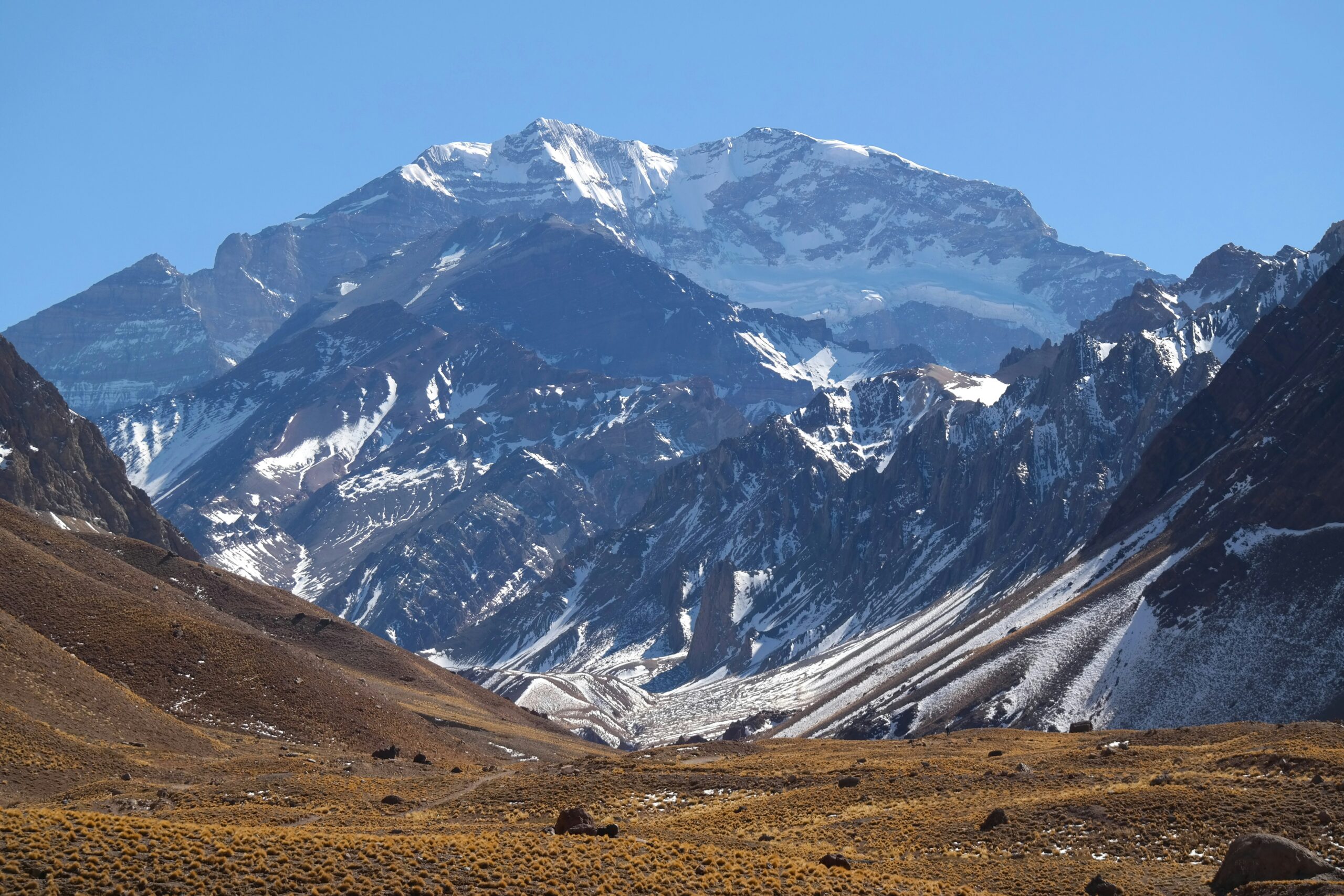
    Aconcagua Normal Route 2026-2027 season showing the route from Horcones Valley through Plaza de Mulas base camp at 4,260 meters to the 6,961-meter summit of South America's highest peak
    Aconcagua’s Normal Route from Horcones Valley to the 6,961-meter summit. Plaza de Mulas base camp (4,260 m) sits in the foreground, with the route ascending through Camp Canada, Nido de Cóndores, and Plaza Cólera before the final summit push via the Canaleta gully. The 2026-2027 season runs November 1 through March 31.

    2026-2027 Permit Costs & Booking Strategy

    Aconcagua permits have risen sharply for the 2026-2027 season. The Mendoza Province permit office sets prices, and they vary by your nationality, your route, and whether you hire local logistics. Here’s the breakdown.

    Normal Route Permits (Horcones Valley)

    Climber CategoryUnassistedAssisted (with local logistics)Notes
    International (non-Latin American)$1,640 USD$1,170 USDMost common category; 20-day permit limit
    Latin American (Mexican through Argentine)$1,050 USD$660 USDRequires proof of nationality
    Argentine nationalsReduced rate (varies)Reduced rateConfirmed at permit office

    Polish Glacier & 360° Traverse Permits (Vacas Valley)

    Climber CategoryUnassistedAssisted
    International$1,900-$2,000 USD$1,400-$1,600 USD
    Latin American$1,300 USD$820 USD

    How the Assisted Discount Works

    The Mendoza permit office gives you the cheaper “assisted” rate if you hire any local services on the mountain. Historically that meant climbers could buy a basic mule service for ~$300-$400 USD and immediately qualify for the $470 USD permit discount — making the assistance essentially pay for itself.

    For 2026-2027, this calculation has shifted. All major operators (Inka, Aconcagua Express, Grajales, Mendoza Expeditions) have removed the “minimum” logistics packages from their offerings. The new “basic” package with Inka now includes 7 days of full board at Plaza de Mulas plus a few nights of accommodation, running $1,400-$2,000 USD instead of the old $300-$400 mule-only price. The permit discount still applies, but the logistics no longer pays for itself the same way.

    Early-Bird Pricing

    The Mendoza permit office traditionally offers an early-bird rate through end of August for next-season permits. For 2025-2026, the early-bird rate was $980 USD (vs $1,520 main season). For 2026-2027, similar discounts are likely but not yet confirmed. Climbers planning a January 2027 summit should monitor the Mendoza Province park website (mendoza.gov.ar/aconcagua) starting July 2026.

    Permit Validation Requirements

    • Mendoza office: Permit purchase and initial validation at the Mendoza Province park office in Mendoza city
    • Horcones ranger station: Permit signed before park entrance; passport and yellow fever certificate may be checked
    • Confluencia camp (3,300m): Ranger signature required; route plan confirmed
    • Plaza de Mulas (4,260m): Ranger signature required; medical check available; expedition timeline reviewed

    The 20-day permit limit is real. International climbers on the Normal Route have a strict 20-day window inside the park, counted from the day you check in at Horcones. The clock doesn’t stop for weather delays. Plan your buffer days carefully — if your acclimatization runs slow and you push the 20-day limit, rangers can require you to descend before your summit window. Most operator itineraries are designed for 16-18 days inside the park to maintain 2-4 days of weather buffer.

    The Camp Progression: Plaza de Mulas to Summit

    The Normal Route uses a four-camp progression above Plaza de Mulas. Each camp serves a specific acclimatization purpose, and most expeditions use a carry-and-return pattern to move equipment progressively higher while sleeping at lower altitudes. Here’s how the standard sequence works.

    Plaza de Mulas Base Camp (4,260 m)

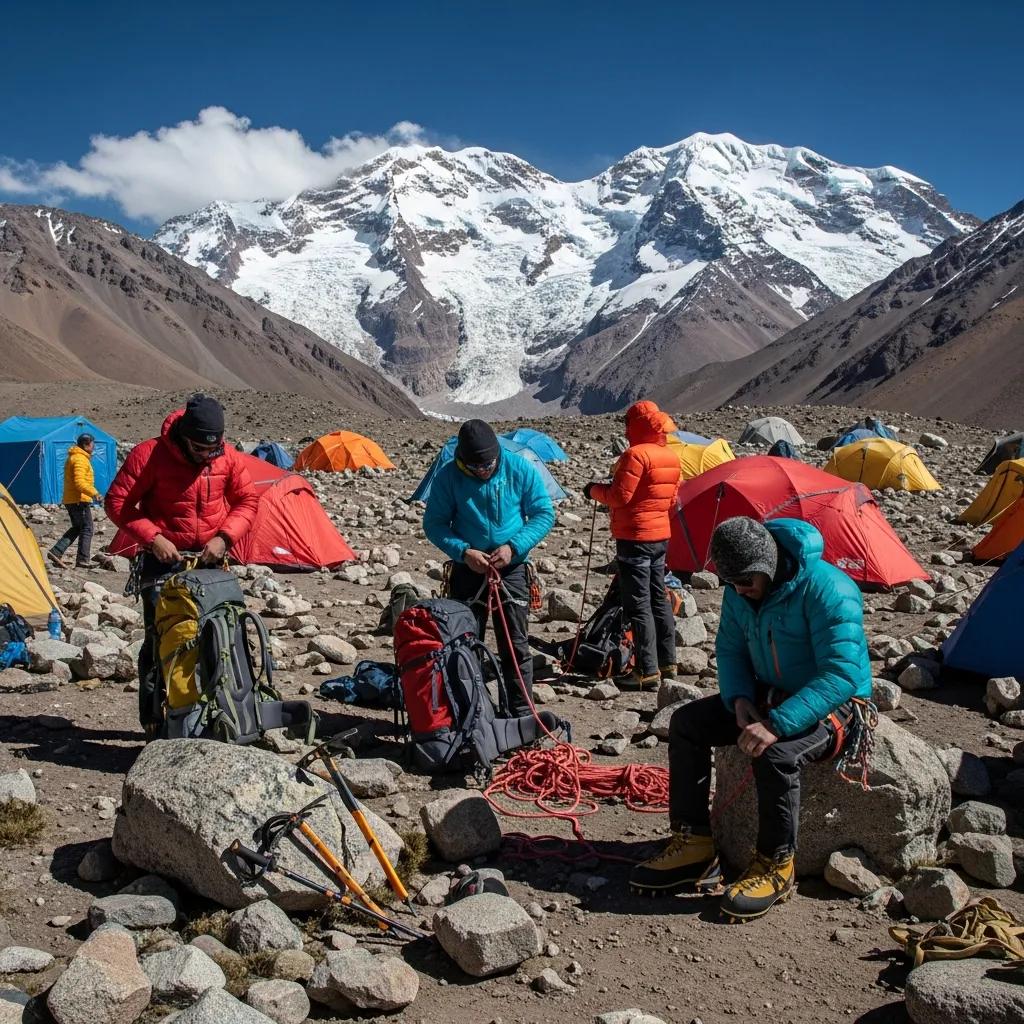
    Plaza de Mulas is the operational hub for every Normal Route expedition. Operator camps cluster on the moraine, with major outfits running heated mess tents, dining services, basic medical checkpoints, and gear storage. The base camp is genuinely comfortable by mountaineering standards — most climbers spend 4-5 days here for acclimatization between arriving from Confluencia and starting carries to the high camps.

    What to expect: Daytime temperatures of 0-15°C depending on season; nights down to -10°C in early or late season. Strong UV. Limited running water for hygiene. Operator camps serve hot meals and have charging stations. The Plaza de Mulas medical tent operates during peak season and can address altitude-related issues. Cell coverage is generally non-existent; satellite phones and InReach devices are the standard for communication.

    Camp Canada (5,050 m)

    Camp Canada sits roughly 800 meters above Plaza de Mulas on a moraine bench. The route from base camp climbs steady scree slopes for 3-5 hours, with the camp emerging on a small flat plateau just above the first major rise.

    Most expeditions do a carry day to Camp Canada (drop gear, return to Plaza de Mulas to sleep), then move and sleep at Canada the following day or two days later. The camp is bare-bones — your tent only, no operator infrastructure. Temperatures drop notably from Plaza de Mulas, with summit-evening lows of -15 to -20°C even in peak season.

    Nido de Cóndores (5,400 m)

    Nido de Cóndores is the second high camp and a major acclimatization waypoint. The route from Camp Canada climbs through a steep scree section before traversing a broad shoulder to reach the camp at 5,400 m. Time from Canada to Nido is 3-5 hours.

    Some operators use Nido de Cóndores as their primary summit-launching camp, skipping Plaza Cólera entirely. This is a common pattern for groups with limited time inside the 20-day window — summit attempts from Nido add roughly 90 minutes to summit day compared to launching from Plaza Cólera, but eliminate one camp setup. The terrain at Nido is exposed; tents need to be anchored against wind.

    Plaza Cólera / Berlin Camp (5,950 m)

    Plaza Cólera (also called Berlin Camp or Cólera in earlier guidebooks) sits at 5,950 m and serves as the highest camp on the Normal Route. Most expeditions spend 1-2 nights here before summit day. Temperatures at this elevation routinely hit -25 to -30°C overnight, even in peak season.

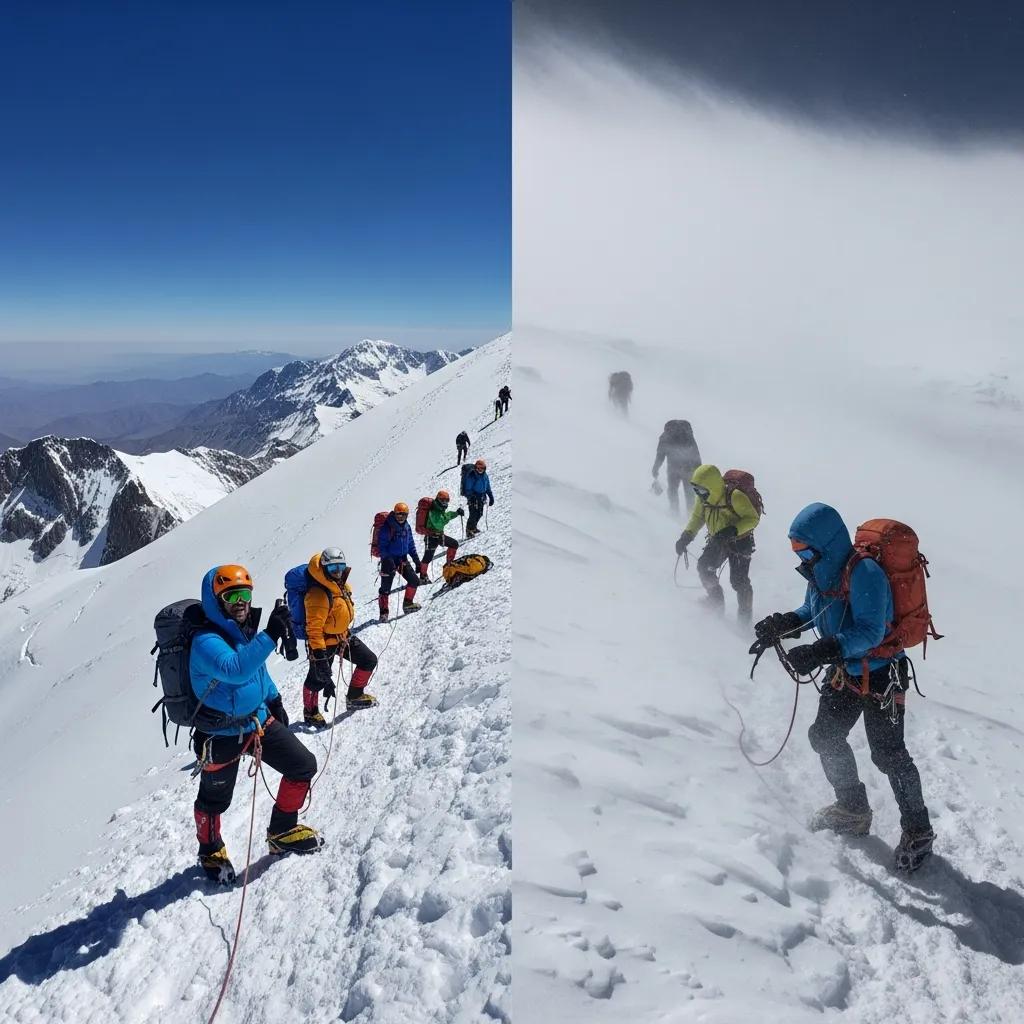
    The camp area is rocky and exposed, with limited flat ground for tent placement. Wind is the dominant factor — sustained winds of 40-80 km/h are common, and the Viento Blanco (sustained 100-150 km/h) can pin teams down for multiple days. Most climbers use this camp for the final acclimatization push and the launching point for the summit attempt at 4:00-5:00 AM.

    Summit Day from Plaza Cólera

    Summit day from Plaza Cólera typically runs 8-12 hours up and 4-6 hours down. The route ascends the broad south flank of the upper mountain via a series of switchbacks, gaining roughly 1,000 vertical meters to reach the Canaleta — the final 300-meter gully below the summit. Most climbers reach the Canaleta entrance around 11:00 AM if they departed Plaza Cólera by 5:00 AM.

    The Canaleta is the crux of the summit day. The gully holds snow and ice on cold days, requiring crampons and an ice axe for safe ascent. On warmer days, the Canaleta becomes loose scree that climbers describe as “two steps up, one slide back.” Either condition is tiring at 6,800+ meters where every breath delivers less than half the oxygen of sea level. Above the Canaleta, the summit ridge runs north for 100 meters to the summit cross.

    Are Crampons Necessary on the Aconcagua Normal Route Right Now?

    Yes, crampons are required equipment on every Aconcagua Normal Route expedition, regardless of season. The question is when you put them on. Here’s how that breaks down across the 2026-2027 climbing window.

    November 2026 (Season Opening)

    Early-season climbers find more snow on the route than mid-season climbers. Fresh November snow can persist on the slopes between Camp Canada and Nido de Cóndores, requiring crampons earlier on the route than peak-season climbers experience. The Canaleta is typically icy in November mornings, with afternoon sun softening conditions.

    November protocol: Carry crampons from Plaza de Mulas. Put them on at Camp Canada or Nido de Cóndores depending on snow conditions. Use them continuously from Plaza Cólera through the Canaleta and back to high camp. Early-season teams should expect 1-2 extra days of weather delays from late-spring storms.

    December 2026 – January 2027 (Peak Season)

    Peak season offers the most consistent route conditions. Most climbers wear crampons only on summit day from Plaza Cólera, with the rest of the route accessible in approach shoes and trekking poles. The Canaleta is typically a mix of consolidated snow patches and loose scree, with crampons useful for the snow sections and tricky on the scree.

    Peak-season protocol: Crampons on at Plaza Cólera or just above. Stay on through the Canaleta. Remove for the final scree to the summit if the terrain is dry. Most guided parties use this approach.

    February-March 2027 (Late Season)

    Late-season conditions vary year to year. Some seasons see the Canaleta become almost entirely scree by mid-February, with crampons useful only for occasional ice patches. Other seasons see early autumn snow returning by late February, requiring full crampon use from Plaza Cólera again. Watch the Plaza de Mulas radio updates and operator reports for current conditions.

    Late-season protocol: Always carry crampons. Plan to use them above Plaza Cólera. Be prepared for variable conditions on the Canaleta — some teams take crampons off and on multiple times during the summit push as the terrain changes.

    The Canaleta is where things go wrong. Multiple Aconcagua fatalities involve climbers who reached the Canaleta exhausted, in worse weather than the start of summit day, with degrading conditions on the descent. Even if you didn’t need crampons on the ascent, conditions can change before you descend. Always have your crampons, ice axe, and helmet with you on every summit attempt. The Canaleta has a reputation for breaking summit dreams — climbers who turn around here often have made the right call.

    Month-by-Month 2026-2027 Conditions: What to Expect

    MonthConditionsWeather StabilityCrowdsBest/Worst For
    NovemberCold, snowier routeVariable; spring stormsLowBest: cheaper permits, fewer climbers. Worst: weather risk.
    DecemberStabilizing conditionsImprovingBuildingBest: route consolidating, decent weather. Worst: holiday crowding.
    JanuaryPeak season — best routeMost stableMaximumBest: prime weather windows. Worst: crowded camps, queues.
    FebruaryDrier route, more screeDecent; Viento Blanco returnsReducingBest: less crowded. Worst: late-season wind events.
    MarchLate-season; variableRisky; season closingMinimalBest: quiet route. Worst: declining infrastructure, more weather risk.

    November 2026: Season Opening

    November opens cool and unpredictable. Plaza de Mulas operators are still setting up infrastructure during the first two weeks. Weather windows are shorter than mid-season — three to four good days then a storm cycle. Permit costs may include early-bird discounts. Recommended for experienced climbers comfortable with weather flexibility and willing to accept lower summit probability for fewer crowds.

    December 2026: Building Toward Peak

    December sees the route stabilize and crowds begin building. The first two weeks remain quieter; mid-December onwards fills up rapidly. Holiday-season climbers (Christmas and New Year) face maximum operator pricing and peak base camp crowding. The weather typically improves through the month, with January conditions usually starting by Christmas.

    January 2027: Peak Season

    January is the most reliable month for Aconcagua summits. Weather windows open every 3-5 days, base camp infrastructure is fully operational, and most successful expeditions schedule for this window. The trade-off is maximum crowding — Plaza de Mulas can have 100+ climbers at peak, and summit day on a calm-weather day can see 50+ climbers on the upper mountain simultaneously.

    February 2027: Quieter Window

    February brings reduced crowds as the holiday season ends. Weather remains generally favorable through mid-February, then becomes increasingly unpredictable in the final week. Some operators end their fixed-date programs by February 15-20, with later trips becoming custom departures. The Viento Blanco events that struck the 2025-2026 season in early February are a recurring late-season pattern.

    March 2027: Season Closing

    March is the end of the climbing window. Operator camps begin breaking down by mid-March. Park infrastructure reduces. Weather risk increases significantly. Climbers booking March departures should expect a very different experience than peak-season climbers — quieter, colder, with less support infrastructure. The park officially closes March 31, 2027.

    Recent Aconcagua Trip Reports (2025-2026 Season Synthesis)

    The 2025-2026 season ran November 1, 2025 through March 31, 2026. Here’s a synthesis of patterns reported by climbers, operators, and guide services during the season — useful context for 2026-2027 planning.

    Permit Price Shock

    The 2025-2026 season saw the largest single-year permit increase in Aconcagua history. Permits jumped from $800 USD (2024-2025) to $1,520 USD (2025-2026) — nearly doubling. The shock left many climbers scrambling to budget. The 2026-2027 increase to $1,640 USD is less dramatic but continues the upward trend that began with Argentina’s currency reforms in 2023-2024.

    Operator Package Consolidation

    All major operators removed minimum logistics packages during the 2025-2026 season. The “basic mule service for $300” option that climbers historically used to qualify for assisted permit rates disappeared. Inka, Aconcagua Express, Grajales, and Mendoza Expeditions all moved to packages starting around $1,400-$2,000 USD that include full base camp board and accommodation. Some operators told climbers these new packages were “trial pricing for 2025-2026” with the possibility of reverting in 2026-2027. As of May 2026, the consolidated packages remain the standard.

    2025-2026 Weather Patterns

    The 2025-2026 season had relatively stable mid-January weather with several productive summit windows. Many climbers reached the summit during a 5-day high-pressure system from January 16-20, 2026. Early February brought sustained Viento Blanco events that pinned multiple parties at Plaza Cólera for 3-4 days. Late February conditions were variable but reasonable for experienced parties willing to accept weather risk.

    Summit Success Rates

    Operator success rates for the 2025-2026 season averaged 35-50%, in line with historical norms. The major guide services reported the following ranges: Inka Expeditions ~40-45%, Aconcagua Express ~45-50%, Grajales ~35-40%. Independent climbers (no operator) saw lower success rates around 25-35%, reflecting the typically less-experienced solo and small-team profile. The Viento Blanco events in early February affected late-season summit rates significantly.

    Equipment and Logistics Notes from 2025-2026

    • Mule service capacity: Standard 60 kg per climber; additional loads cost extra. Some climbers reported muleteer load limits being enforced more strictly than in previous seasons.
    • Plaza de Mulas medical tent: Operational during peak season but with limited supplies. Climbers with serious altitude issues are typically descended rather than treated on-site.
    • Communication: Garmin InReach devices became the dominant communication method, with operator-provided satellite phones used as backup. No cell coverage above Confluencia.
    • Trash management: Strict pack-out rules enforced. Rangers check trash inventory at Plaza de Mulas before approving descent.
    • Heliport status: Mendoza Province operates a helicopter rescue service from Plaza de Mulas during peak season. Costs ~$8,000-$12,000 USD without insurance coverage.
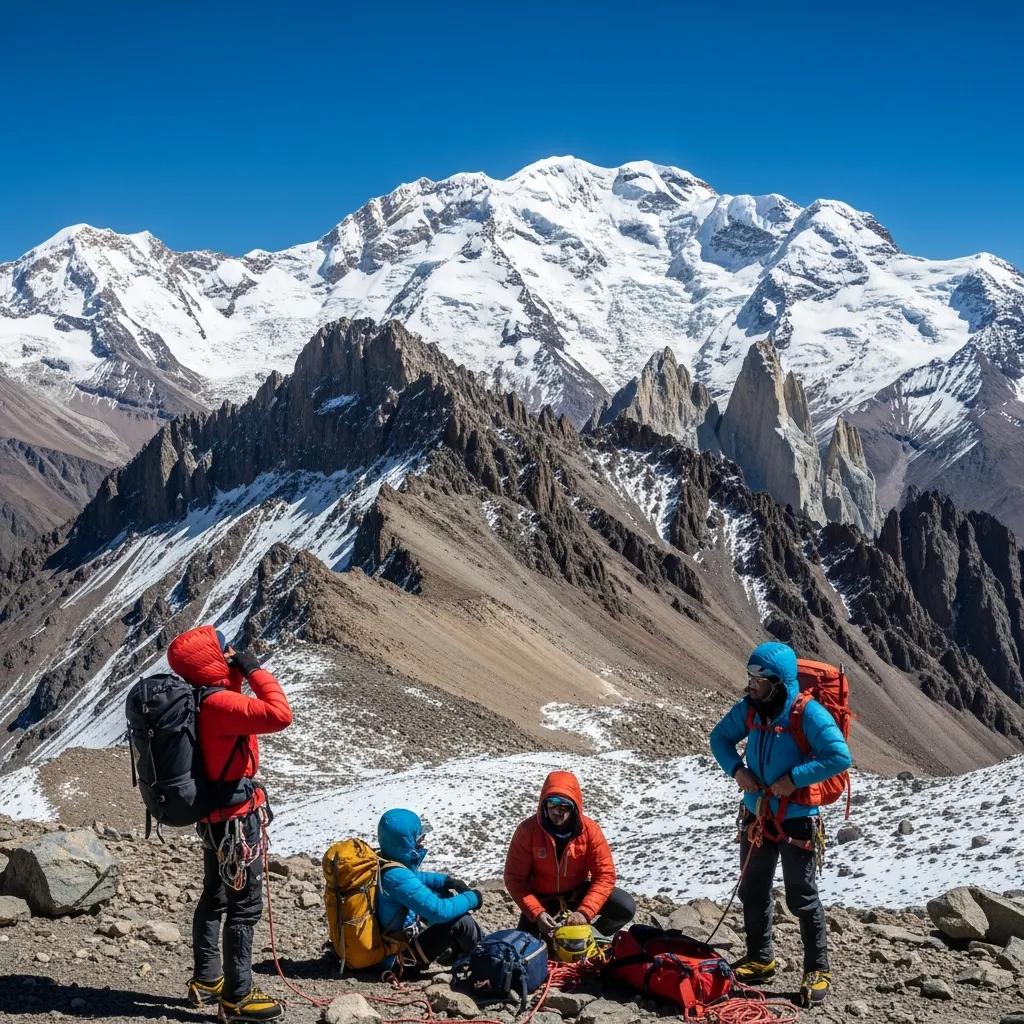
    Aconcagua high camp Plaza Cólera Berlin Camp at 5,950 meters with climbers preparing for summit day on South America's highest peak during 2026-2027 austral summer season
    Plaza Cólera (Berlin Camp) at 5,950 meters — the highest camp on Aconcagua’s Normal Route and the launching point for summit day. The 2026-2027 season runs November 1, 2026 through March 31, 2027, with peak weather windows opening December through January. Wind exposure here is severe — sustained 40-80 km/h is typical, with Viento Blanco events reaching 100-150 km/h.

    Required Gear for the 2026-2027 Aconcagua Normal Route

    Aconcagua’s Normal Route is technically non-difficult (F+ grade) but the altitude makes gear matter enormously. Cold, wind, and UV at 6,961 meters punish every weak link in your kit. Here’s the standard 2026-2027 equipment list.

    Footwear

    ItemSpec / ExampleNotes
    Double mountaineering bootsLa Sportiva G2 SM, Scarpa Phantom 6000, Millet Everest SummitB3-rated with built-in gaiter
    Crampons12-point steelSemi-automatic or step-in binding
    Approach shoesTrail runners or light hikersHorcones to Plaza de Mulas trek
    Camp bootiesInsulated down bootiesBase camp and high camps
    Mountaineering socksWool/synthetic blend4-5 pairs for multi-week expedition
    Vapor barrier sock linersRBH Designs or similarRecommended for summit day

    Clothing System

    LayerItemNotes
    BaseTop and bottom (merino or synthetic)2-3 sets
    MidFleeceActive climbing range
    Light insulationSynthetic or down sweaterWorking layer
    Heavy insulationDown parka-20°C rated; high camp + summit day
    Hardshell jacketGore-Tex Pro or equivalentWind + precipitation protection
    Hardshell pantsFull side-zip preferredFor crampon transitions
    Soft shell pantsSchoeller or similarLower mountain + base camp
    Hat + balaclavaWarm hat + balaclavaFrostbite protection
    Sun hat or capLight + breathableUV at altitude severe
    Gloves (3 pairs)Light climbing + insulated + expedition mittensMittens -30°C rated minimum

    Technical Equipment

    ItemSpecNotes
    Ice axe50-60cm general mountaineeringSingle tool sufficient
    HelmetClimbing-ratedRequired on Canaleta
    Climbing harnessAlpine, adjustable leg loopsFor rope work if needed
    Trekking polesAdjustable, 3-sectionEssential for approach + descent
    Belay deviceATC-Guide or similarFor rope work if needed
    Locking carabiners2-3 lockingAnchor + rope work
    Prusik cord6mm × 1-2 lengthsEmergency self-rescue

    Camping & Expedition Equipment

    ItemSpecNotes
    Expedition backpack70-90LCapacity for high camp moves
    4-season tentBombproof for high windUsually provided by operator
    Sleeping bag-20 to -30°C rated800+ fill down preferred
    Sleeping bag linerSilk or syntheticAdds warmth, protects bag
    Sleeping pads (2)Closed-cell foam + inflatable insulatedCritical insulation from cold ground
    Stove + fuelWhite gas (MSR XGK)Provided by operator at base; carried up
    Cooking pots + utensilsGroup equipmentProvided by operator
    Water bottles2-3L total, insulated NalgenesInsulating sleeves required
    Thermos1L vacuum insulatedFor hot drinks at high camp
    Water purificationFilter or tabletsRequired above base camp water
    Aconcagua summit Canaleta gully crampons crux 300-meter final ascent to 6,961 meter peak of South America with ice axe and trekking poles
    The Canaleta — the 300-meter gully below Aconcagua’s summit and the crux of the Normal Route. Crampons are required here when the gully holds snow and ice; on warmer days the terrain becomes loose scree that climbers describe as “two steps up, one slide back.” Either condition is exhausting at 6,800+ meters, where every breath delivers less than half the oxygen of sea level.

    Personal Items & Safety

    ItemSpecNotes
    Headlamp + spare batteriesLithium for coldEssential for 4:00-5:00 AM summit start
    Sunscreen + lip balmSPF 50+ with SPF lip balmUV burns fast at altitude
    Glacier glasses (Cat 4)+ backup pairEssential snow glare protection
    First aid kitBlister care, ibuprofen, electrolytes, AMS medsCustomize to team needs
    Diamox / acetazolamide250mg twice daily typicalDiscuss with doctor; common preventive
    Satellite communicatorGarmin InReach or sat phoneNo cell above Confluencia
    Passport + visaValid Argentine entry stampRequired at park entrance
    Travel insuranceHelicopter evacuation coverageRequired by most operators
    CashUSD and Argentine pesosTips, snacks, emergencies

    2026-2027 Booking Strategy

    Aconcagua doesn’t require advance reservations the way Denali or Vinson Massif do, but operator capacity and prime dates fill rapidly. Here’s the practical booking timeline for 2026-2027.

    July-August 2026: Early-Bird Window

    This is the optimal window to book. Major operators publish 2026-2027 departures by mid-2026 with early-bird incentives. Some offer 20-30% discounts on permits when booked through their packages before August. Andes Specialists, Inka Expeditions, Aconcagua Express, and major international operators (Adventure Consultants, Alpine Ascents, Mountain Madness) typically have full 2026-2027 schedules published by July 2026.

    September-October 2026: Standard Booking

    By September 2026, prime mid-January dates are largely booked. Climbers booking in this window typically find availability in early December or late February. Operator pricing is at standard 2026-2027 rates with no early-bird discounts. Equipment rental shops in Mendoza begin accepting reservations for crampons, expedition tents, and other gear.

    November 2026: Last-Minute Bookings

    The season opens November 1, 2026. Climbers booking after this date face limited operator availability. Some last-minute spots open as cancellations occur, particularly 2-3 weeks before climb dates. Independent climbers without operator services can secure permits and arrange mule services in Mendoza, but should expect longer lead times and reduced flexibility.

    December 2026 – January 2027: In-Season Bookings

    Booking during peak season is possible but increasingly difficult. Operator camps at Plaza de Mulas are at capacity, and last-minute climbers may need to camp on the moraine outside the operator zones. This is not recommended for first-time Aconcagua climbers.

    Frequently Asked Questions About Aconcagua Normal Route Conditions

    When does the Aconcagua 2026-2027 season open?

    The Aconcagua climbing season opens on November 1, 2026 and runs through March 31, 2027. Mendoza Province’s Aconcagua Provincial Park enforces these dates for permits and ranger station access. The peak window is mid-December 2026 through end of January 2027, when weather is statistically most stable. November and late February through March are shoulder periods with cheaper permits but greater weather risk.

    How much do Aconcagua permits cost for the 2026-2027 season?

    International climbers (non-Latin Americans) pay $1,640 USD unassisted or $1,170 USD assisted on the Normal Route from Horcones Valley. Latin American climbers pay $1,050 USD unassisted from Horcones or $660 USD with local logistics. Polish Glacier and 360-degree Traverse routes from Vacas Valley cost more: $1,640 to $2,000 USD depending on assistance level. Early-bird permit discounts may be available through August 2026, with prices potentially dropping to $1,200 range.

    What is the route from Plaza de Mulas to the Aconcagua summit?

    The Normal Route from Plaza de Mulas Base Camp (4,260 m) ascends through four progressively higher camps to the 6,961-meter summit. The standard camp sequence runs Camp Canada (5,050 m), then Nido de Cóndores (5,400 m), then Plaza Cólera also called Berlin Camp (5,950 m), and finally summit day. Total vertical gain from Plaza de Mulas to summit is approximately 2,700 meters. Most expeditions take 14-18 days from Mendoza to summit and back.

    Do I need crampons on the Aconcagua Normal Route?

    Yes, crampons are required for summit day and on the Canaleta gully at high altitude. The standard transition point is at Plaza Cólera (5,950 m) or just above, where the terrain becomes scree mixed with snow patches. The Canaleta — the final 300-meter gully below the summit — is consistently icy on cold days and requires crampons and an ice axe for safe ascent. Early-season climbers (November to mid-December) often need crampons earlier on the route due to fresh snow.

    What weather should I expect on Aconcagua in 2026-2027?

    December and January represent peak conditions, with Plaza de Mulas daytime temperatures of 10-15°C and summit-day temperatures averaging -20 to -30°C with wind. The Viento Blanco — the white wind — is the dominant weather hazard. Sustained winds above 80 km/h on summit day are common in late November and again in February. Most successful summit attempts occur in calm weather windows that open every 4-7 days. Plan for 2-3 days of weather buffer at high camp.

    How long does it take to climb Aconcagua?

    A standard guided Aconcagua expedition runs 16-21 days door-to-door from Mendoza. The breakdown is approximately: 1-2 days in Mendoza for permit processing and gear prep, 3-4 days trek to Plaza de Mulas via Confluencia, 4-5 days at Plaza de Mulas for acclimatization, 4-6 days moving through high camps with carry-and-return cycles, 1 summit day with weather buffer, then 2-3 days descent to Horcones. Total expedition days inside the park typically run 16-19 days. Independent climbers sometimes complete the round trip in 12-14 days; rapid-ascent specialists can do it in 7-10 days with significant altitude risk.

    What is the Aconcagua summit success rate?

    Historical Aconcagua summit success rates average around 40%, with significant variation by operator and season. Top operators with strong itineraries and IFMGA-certified guides see rates of 50-60%. Less-experienced operators run 25-35%. Independent climbers without operator support typically see 25-35% success. The Normal Route is statistically the easiest route on Aconcagua, but the combination of altitude, cold, and Viento Blanco wind events explains why so many strong climbers don’t summit. Weather is the dominant variable — climbers who get a good summit window during their 20-day permit usually succeed.

    How much does a guided Aconcagua expedition cost in 2026-2027?

    Guided Aconcagua expeditions in 2026-2027 typically cost $5,500-$8,500 USD for the standard 16-21 day Normal Route program. Andes Specialists lists $6,750 USD for their 17-day Normal Route trip. International operators like Adventure Consultants or Alpine Ascents charge $8,000-$11,000 USD with IFMGA-certified guides. Local Mendoza-based operators offer trips from $4,500-$6,000 USD. Total trip budget including international flights to Mendoza, gear, tips, and insurance typically runs $7,500-$13,000 USD.

    What is the Viento Blanco?

    The Viento Blanco — Spanish for “white wind” — is the dominant weather hazard on Aconcagua. It’s a sustained high-altitude wind event that can last 2-7 days, with wind speeds reaching 100-150 km/h at Plaza Cólera and higher on summit day. The wind picks up loose snow and creates whiteout conditions that make summit attempts impossible. Multiple Aconcagua fatalities involve climbers attempting summit pushes during Viento Blanco events. Standard procedure is to wait it out at Plaza Cólera or descend to Plaza de Mulas. Pre-trip weather forecasting (MeteoBlue, Mountain-Forecast) is essential.

    Can I climb Aconcagua independently without a guide?

    Yes, Aconcagua’s Normal Route is one of the most popular peaks in the world for independent climbing. The Mendoza Province permit system allows unassisted climbing. Independent climbers need to handle their own permit purchase, mule service contracts (~$400 USD round trip), base camp logistics, and route navigation. Success rates for independent climbers run lower than for guided parties — typically 25-35% vs 45-60% for guided trips — reflecting the higher experience requirement. First-time 6,000m climbers should strongly consider hiring a guide service, at minimum for the high-camp progression. Experienced 6,000m climbers can usually self-organize successfully.

    Aconcagua Planning Resources

    Sources & Further Reading

    • Mendoza Province Aconcagua Provincial Park — official permit office and 2026-2027 season information
    • Inka Expediciones — 2026-2027 operator packages and current Plaza de Mulas conditions
    • Aconcagua Express — base camp and high camp operations for 2026-2027
    • Grajales Expediciones — Mendoza-based operator with 2026-2027 trip schedules
    • Andes Specialists — 2026-2027 Normal Route program ($6,750 USD) and itinerary
    • Adventure Consultants — international operator with 2026-2027 Aconcagua program
    • SummitClimb — 2026-2027 Normal Route expedition planning and cost analysis
    • Andesport Aconcagua Expeditions — official permit pricing reference
    • Ian Taylor Trekking — Aconcagua season analysis and 2026 climbing observations
    • ExplorersWeb — 2024-2025 and 2025-2026 season opening coverage
    • Brooke Beyond — independent climbing trip report and 2026-2027 permit pricing research
    • MeteoBlue, Mountain-Forecast — Aconcagua summit weather forecasting
    • Wikipedia — Aconcagua (route descriptions, elevation references, first ascent history)

    Last updated: May 24, 2026. Next scheduled update: October 31, 2026 (pre-season verification before November 1 opening).

    Planning a 2026-2027 Aconcagua Expedition?

    For the complete Aconcagua climbing guide including training plans, permit details, route comparisons, and operator selection, see our pillar guide.

    Read the Full Aconcagua Guide →
Language »