
Last updated July 12, 2026
K2 Logistics: The Baltoro Approach & Base-Camp Support System
Before anyone touches the Abruzzi Spur, a whole machine has to move them, their food, and their gear from Islamabad to 5,150 m. This is how K2 logistics actually work – the approach, the porters, the base-camp support, the comms, and the people who run it all.
On K2, logistics is not a footnote to the climb – it is most of the expedition. The permit is a small slice of the cost; the rest is the long Baltoro approach, the porter chain, weeks of base-camp support, comms, and rescue planning. That’s a big part of why K2 runs two to three times the price of Everest.
The ground system runs on Pakistani specialists: permits and liaison officers in Gilgit-Baltistan, porter networks on the Baltoro, and base-camp infrastructure at 5,150 m. Understanding that chain is how you judge a program – and how you avoid the weak links that end expeditions early.
What this page covers (and what it doesn’t)
K2 has a lot of moving parts, so here’s the lane this page owns – and where to go for the rest, so you land on the right guide:
- This page = ground logistics: the Baltoro approach, porters, base-camp support, comms and rescue, and the Pakistani ground-logistics role.
- Routes, the Bottleneck & death rate → the full K2 climb guide and K2 route comparison.
- Ranking summit operators → our K2 operators comparison (10 programs on eight criteria).
- Permit process & fees → the permits & fees guide (Gilgit-Baltistan royalty and rules).
On this page
The logistics chain
From the capital to the Godwin-Austen Glacier – every link matters.
There is no road to K2. Reaching Base Camp is a chain of stages, and each one is a place where a plan can stall. The first is often the trickiest: the Islamabad–Skardu flight is weather-dependent and cancels often, so operators build in buffer days and a fallback drive up the Karakoram Highway. From Skardu, a jeep runs to Askole, the last village and the trailhead. Everything above Askole moves on foot, carried by porters, up the Baltoro Glacier to Concordia and on to K2 Base Camp at 5,150 m. A ground-logistics operator owns this whole chain – transport, porters, permits, and the camp waiting at the top.
The Baltoro approach map
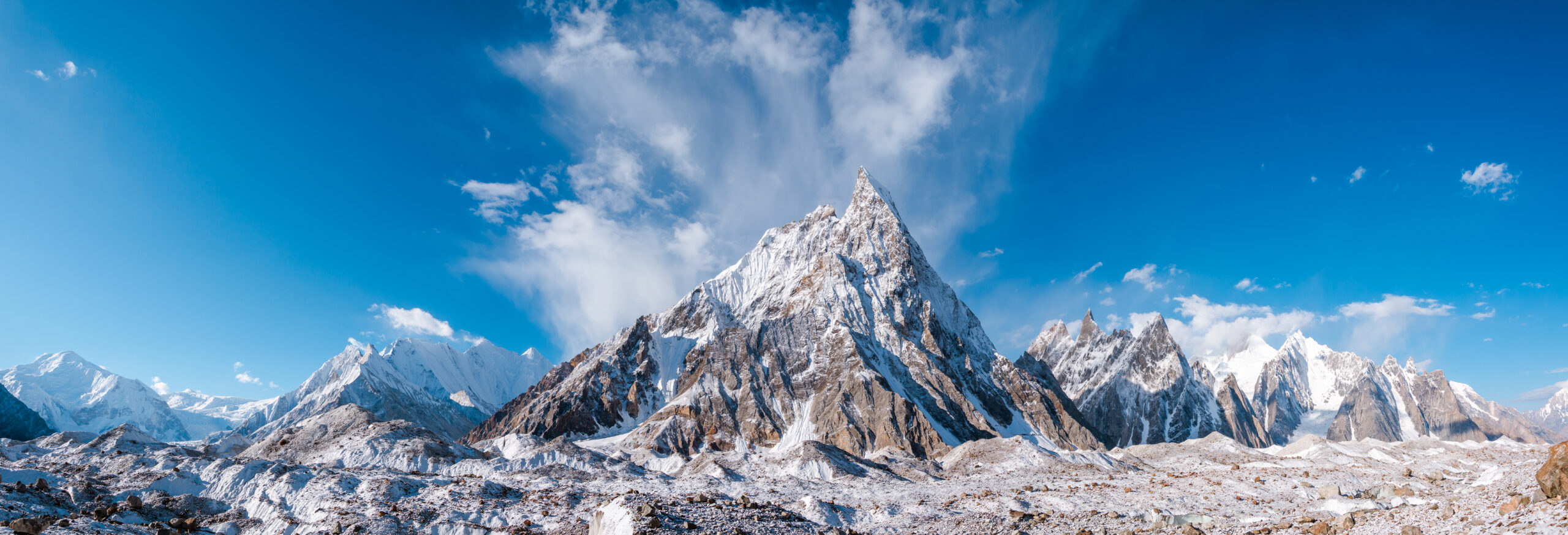
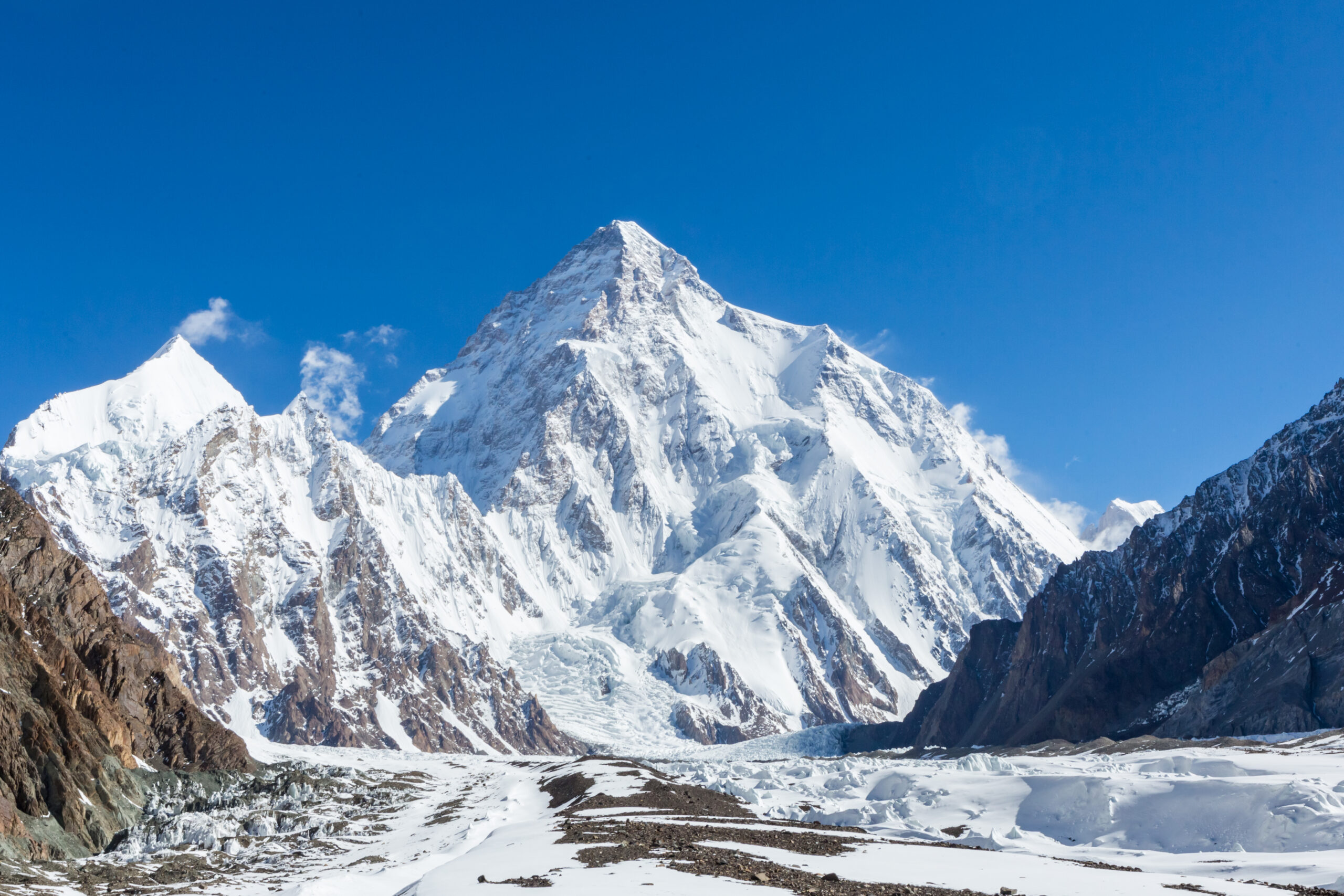
K2 sits at the head of the Baltoro, ringed by four of the world’s fourteen 8,000ers.
The approach march, stage by stage
Roughly 5–7 days up the glacier, paced for acclimatization.
The Baltoro trek is not a formality to get through – it’s built-in acclimatization, since Base Camp already sits at 5,150 m. Camps are staged to gain altitude at a survivable rate, past the granite of the Trango Towers and Masherbrum, onto the open glacier ice, and up to Concordia, where the Baltoro meets the Godwin-Austen Glacier beneath a wall of 8,000ers.
Staging town in Gilgit-Baltistan. Permits, liaison-officer meeting, NOC paperwork, and final gear and food purchasing. Flights in are weather-dependent.
Jeep from Skardu, 7–9 hours up the Braldu valley. The last village and the roadhead – porters are engaged and loads are made up here.
First camp along the Braldu river, on the walk in to the glacier snout.
Beneath the Trango Towers. Usually a rest and preparation day before stepping onto the Baltoro Glacier.
Onto the glacier, then a camp perched above the ice with sweeping views across the Baltoro.
A camp out on the open glacier ice, deep in the heart of the Karakoram.
The “Throne Room of the Mountain Gods” — the junction of the Baltoro and Godwin-Austen glaciers, ringed by K2, Broad Peak, and the Gasherbrums.
On the Godwin-Austen Glacier below the Abruzzi Spur. Home for 4–6 weeks of rotations and the wait for a summit window.
Porters, mules & loads
The Baltoro supply chain runs on human power — and how it’s run matters.
Nearly everything at K2 Base Camp arrived on a porter’s back. Expedition food, fuel, tents, oxygen, ropes, and personal duffles all move up the Baltoro by porter, with mules assisting on the lower stages. Individual porter loads are capped at roughly 25 kg under Pakistani porter regulations, so a fully supported K2 team engages a long train of porters at Askole — the single largest labour operation of the whole expedition.
How an operator treats that workforce is a fair signal of how it runs everything else. Strong ground-logistics companies pay fair porter wages, provide proper footwear, shelter, and food, and carry insurance for their staff. The porter chain is also a schedule risk: weather, glacier conditions, and porter strikes can all delay loads, which is why experienced operators build contingency into the approach rather than racing it.
Base-camp support
K2 Base Camp is home for over a month — the support there is part of the safety margin.
Unlike a quick trekking peak, a K2 expedition lives at Base Camp for four to six weeks, running acclimatization rotations up the mountain and returning to recover while waiting for weather. That makes base-camp support far more than comfort. Full-board K2 base-camp service usually includes:
| Service | What it means at 5,150 m |
|---|---|
| Mess & kitchen | A heated dining tent and a cook crew producing hot, high-calorie meals — appetite and recovery drive summit odds |
| Sleeping tents | Individual tents on prepared glacier platforms for rest between rotations |
| Power | Solar arrays and a backup generator to charge radios, sat devices, cameras, and medical kit |
| Water & sanitation | Purified meltwater, toilet and shower tents, and waste-carry-out systems required in the national park |
| Comms & weather | Satellite communications and a mountain weather feed that drives the summit-window call |
| Medical & rescue | A base-camp medical kit, staff trained in first aid, and pre-arranged evacuation contacts |
Comms, weather & rescue
Past Askole there is no phone signal — everything runs on satellite.
Mobile coverage ends at Askole. From the glacier onward, communication runs on satellite phones and messengers, with VHF radios linking Base Camp to climbers on rotations. Base camps also receive dedicated mountain weather forecasts by satellite, and on K2 that forecast is decisive: the summit window is often a single day or two of stable jet stream, and reading it correctly is a logistics function as much as a climbing one.
Rescue is the hardest link. Helicopter evacuation from the Baltoro and Base Camp is possible through Pakistani aviation providers, but it depends on weather, cloud, and the aircraft’s altitude ceiling, and it usually has to be guaranteed in advance by an insurance bond. Above Base Camp, no helicopter can reach a climber at all — high-altitude rescue is done by other climbers. That reality makes two things non-negotiable: comprehensive high-altitude rescue insurance, and a ground operator with established local rescue and evacuation contacts before you ever set foot on the glacier.
Cargo & the duffle system
What flies, what a porter carries, and what waits at Base Camp.
K2 logistics runs on a simple duffle system, and packing to it saves both porter cost and personal fatigue. In broad terms, gear splits three ways: an approach duffle of light trekking kit that porters carry to Base Camp; a base-camp duffle of expedition gear, spares, and comfort items that stays at 5,150 m for the whole climb; and a lean rotation pack for moving between high camps. Bringing heavy 8,000 m boots and down for the walk-in — instead of light trekking gear — just adds porter loads and wears you out before the climb starts. The full item-by-item breakdown is in our K2 gear list.
Permits & the liaison officer
You cannot self-permit K2 — the ground operator is a legal requirement, not a convenience.
Climbing permits in the Karakoram are issued by the Gilgit-Baltistan authorities, and they require a registered local operator to hold the permit, a mandatory liaison officer who travels with the team, insurance verification, and an environmental deposit tied to carrying waste back out. Independent climbers cannot walk up to a counter and buy a K2 permit. This is one of the core reasons even fully self-sufficient international teams contract a Pakistani ground-logistics company: the permit, the LO, the porters, and the transport are a single package that only a licensed local operator can assemble. The step-by-step process and current royalty sit in our permits & fees guide.
Who runs the ground game
The strongest K2 programs are a partnership: a summit team on top of a ground-logistics specialist.
It helps to separate two jobs that often get blurred. A summit-guiding operator supplies the climbing leadership — rope-fixing, high-altitude staff, oxygen strategy, and the decision-making that gets clients up the Abruzzi. A ground-logistics operator supplies everything beneath that: permits, transport, porters, base-camp infrastructure, comms, and rescue coordination. The strongest K2 operations combine the two, and increasingly the standard model pairs a Nepali or Western summit team with a Pakistani ground-logistics specialist who owns the Karakoram permits and the Baltoro chain. Some experienced climbers who bring their own summit team contract only the ground logistics.
Karakoram Venture — a Skardu ground-logistics specialist
After we published our K2 operators comparison, Zulfiqar Ali of Karakoram Venture wrote in from Skardu. His firm sits squarely in the “Pakistani ground-logistics specialist” category described above — on the base-camp-support side rather than summit-guiding. He described their operation on our terms, and it’s a useful, concrete example of what this layer looks like:
He called the comparison “one of the more rigorous pieces” he’d read on K2 operators — high praise from someone who runs the ground game for a living.
By the company’s own account, Karakoram Venture provides full-board base-camp support for 8,000 m Karakoram expeditions — K2, Broad Peak, and Gasherbrum I & II — with:
- A 100% local Balti team, directly employed rather than subcontracted;
- Satellite-phone communications and established Baltoro-region rescue contacts at every camp;
- Guides they describe as Alpine Club of Pakistan–certified, with base-camp trek programs across all four Karakoram 8,000ers.
Reader-submitted spotlight, not a paid placement. The details above are the company’s own description; we’ve confirmed the firm operates in the Karakoram but have not independently audited its safety record. As with any 8,000 m operator, verify current licensing with the Gilgit-Baltistan authorities, insurance and evacuation coverage, and recent client references before booking.
Same logistics, other peaks
The Baltoro chain serves four 8,000ers, not just K2.
The logistics you build for K2 are shared, almost stage for stage, with the other Karakoram 8,000ers. From Concordia, side glaciers lead to Broad Peak and the Gasherbrum base camps, and many climbers use those peaks to build Karakoram experience — the same weather, the same porter systems, the same approach — before committing to K2. Broad Peak in particular is a common K2-region acclimatizer that runs on an identical support chain; our Broad Peak climb guide covers it in full. Visiting all four base camps in one push — the “Karakoram Grand Slam” — is itself a logistics undertaking that ground specialists like the one above build as a package.
Skardu staging weather
The expedition starts here — and the flight in is the first thing weather can break.
Skardu (2,230 m) is where every K2 expedition assembles: permits, the liaison-officer meeting, and final purchasing all happen here before the jeeps leave for Askole. It’s also the first weather choke point — the Islamabad–Skardu flight cancels often, and a bad run means a two-day drive up the Karakoram Highway instead. The live forecast below is for Skardu; Base Camp at 5,150 m and the summit run far colder.
Skardu (2,230 m) — K2 staging town
Loading live data…Logistics FAQ
How do you get to K2 Base Camp?
There’s no road. Fly or drive from Islamabad to Skardu (2,230 m), jeep to Askole (~3,000 m), then trek 5–7 days up the Baltoro Glacier through Paiju, Urdukas, and Goro to Concordia (4,600 m) and on to Base Camp at 5,150 m. Everything above Askole is carried by porters.
How long is the Baltoro approach?
About 5–7 days each way from Askole, staged through Jhola, Paiju, Khoburtse or Urdukas, Goro II, and Concordia. It’s paced for acclimatization, since Base Camp already sits at 5,150 m.
What does base-camp support include?
A mess and kitchen with a cook crew, individual sleeping tents, toilet and shower tents, solar and generator power, purified water, waste carry-out, and a comms and weather-forecasting setup. On K2 this is home for 4–6 weeks, so it’s part of the safety margin.
Do porters or helicopters carry the gear?
Porters and mules carry almost everything, with loads capped around 25 kg per porter under Pakistani regulations. Helicopters are for emergencies and the occasional paid heli leg — the supply chain runs on porter power.
Is there phone signal at K2?
No mobile coverage past Askole. Communication runs on satellite phones and messengers, with VHF radios between camps, plus a satellite weather feed that drives the summit-window decision.
Can a helicopter reach K2 Base Camp in an emergency?
Sometimes, through Pakistani aviation providers, depending on weather and altitude ceiling, and usually only if guaranteed in advance by an insurance bond. Above Base Camp, no helicopter can reach a climber. Comprehensive rescue insurance and pre-arranged contacts are essential.
Do I need a Pakistani operator, or can I do it myself?
You can’t self-permit K2. Karakoram permits are issued through Gilgit-Baltistan and require a registered local operator, a liaison officer, insurance, and an environmental deposit. Even self-sufficient teams contract a Pakistani ground-logistics company for the package.
What’s the difference between a summit guide and a logistics operator?
A summit-guiding operator supplies climbing leadership, rope-fixing, high staff, and oxygen. A ground-logistics operator supplies permits, transport, porters, base-camp infrastructure, comms, and rescue coordination. Strong K2 programs combine both.
How this guide is built
Research-based. Our team has not climbed K2; this logistics picture is compiled from Gilgit-Baltistan permit guidance, published commercial-operator programs, the Alpine Club of Pakistan, and direct correspondence with a Skardu-based ground-logistics operator, cross-referenced across multiple Karakoram programs. The reader spotlight reflects a company’s own description of its services and is not an endorsement or a paid placement.
Permit rules, fees, porter regulations, flight reliability, and operator services change between seasons. Confirm current requirements with a licensed Gilgit-Baltistan operator, and confirm insurance and evacuation coverage, before booking or travelling.
Judge the ground game, not just the price
On K2, the difference between a strong program and a risky one often lives in the logistics — the porters, the base-camp support, the comms, and the rescue plan. Know the chain, then choose your operator as a safety decision first.
Compare K2 operators → Full K2 climb guide →Was this helpful?
🏔Related peaks nearby
🧭Explore & compare
Global Summit Guide is an independent mountaineering resource founded in 2026. The team combines first-hand trekking and climbing experience with in-depth research and professional health and nutrition review to help climbers choose objectives, prepare properly, and stay safe.
Health, altitude, and nutrition content is reviewed by Taylor Ludlow (Registered Nurse) and Brigg Hoopes (Nutritionist).
What We Don't Know Yet
Mountain information changes quickly. This box explains the limits of what this page can responsibly promise.
- Guide-company prices, departure dates, guide ratios, included services, and cancellation rules can change without notice.
- Weather, snowpack, avalanche risk, road access, and route conditions can change quickly and may be different on your climbing dates.
- Route conditions, trailhead access, crevasse exposure, stream crossings, and rescue access may vary from published planning guidance.
- Gear requirements can change by season, route variation, weather window, personal cold tolerance, and guide-service requirements.
- Fitness and altitude response vary by person; no guide, itinerary, or training plan can guarantee acclimatization or summit success.
Verify current conditions with official land managers, guide services, local forecasts, and current route reports before booking or climbing.
Mountaineering, rock and ice climbing, glacier travel, and high-altitude activity are inherently dangerous and can result in serious injury or death. The information on Global Summit Guide is provided for general informational and educational purposes only and is not a substitute for professional instruction, qualified guiding, proper equipment, or your own judgment and experience.
Route conditions, weather, snowpack, permits, regulations, and hazards change constantly and may differ from what is described here. Details may be incomplete, out of date, or contain errors. Always verify current information with local authorities, certified guides, and official sources before making any decision in the mountains.
Nothing on this site is medical, legal, or financial advice. Our fitness, acclimatization, altitude, and nutrition content is general in nature; consult a qualified physician before beginning any strenuous exercise program or exposing yourself to high altitude.
You are solely responsible for your own safety and decisions. To the fullest extent permitted by law, Global Summit Guide and its team accept no liability for any loss, injury, damage, or expense arising from use of, or reliance on, this information. By using this site you acknowledge these risks and accept these terms.
Some links on this site may be affiliate links. If you buy through them we may earn a small commission at no extra cost to you; this never affects our recommendations.
Global Summit Guide recommendation path
Next Best Mountain to Research
Use these recommendations to continue the right planning path instead of stopping on one page.
Use current permit, weather, route, and operator information before booking or climbing.