
Last updated September 17, 2026

K2 Winter 2021 Deaths: First Ascent, Timeline & Five Fatalities
K2 was finally climbed in winter on January 16, 2021 by 10 Nepali climbers—and every member of that summit team returned safely. But five other climbers died during the same winter season in separate accidents and a later disappearance. This page separates the historic first ascent from the fatalities that are often blurred together.

Five climbers died on K2 in winter 2020–21—but none were members of the first-winter-ascent team.
The five were Sergi Mingote of Spain, Atanas Skatov of Bulgaria, Muhammad Ali Sadpara of Pakistan, John Snorri Sigurjónsson of Iceland and Juan Pablo Mohr Prieto of Chile.
The historic first winter ascent happened on January 16, 2021, when 10 Nepali climbers from three expeditions joined forces and climbed the Abruzzi Spur to the 8,611-metre summit. All 10 descended safely to base camp. Mingote died in a separate fall lower on the mountain that same day.
Three weeks later, Skatov died in another fall during descent on February 5. Also on February 5, Ali Sadpara, Snorri and Mohr disappeared after continuing above the Bottleneck during a separate summit attempt. They were declared dead on February 18. Their bodies were located on the upper mountain in July.
The first winter ascent: 10 Nepali climbers, one shared summit
K2 had resisted winter attempts for more than three decades and was the last of the commonly recognized 14 eight-thousanders without a winter ascent.
The summit team all survived.
The successful climbers came from three different expeditions but chose to combine their effort. According to the American Alpine Journal, all 10 climbed from Camp 3 to the summit on January 16 and reached the top together.
Nirmal Purja climbed without supplemental oxygen; AAJ reports that the other nine used oxygen on summit day. The group descended safely, and reports the following day confirmed that all 10 had returned to base camp.
Mingote’s fatal fall happened elsewhere on the mountain.
Spanish climber Sergi Mingote was not one of the 10 summiters. He was descending from Camp 1 toward Advanced Base Camp when he fell and died on the same day the Nepali team made history.
That timing is why later retellings can accidentally merge the two stories. Historically, they belong to the same winter season—but not to the same climbing event.
| First winter ascent summiters | Team affiliation in contemporary reporting | Outcome |
|---|---|---|
| Nirmal Purja | Team Nimsdai | Summited; returned safely |
| Mingma David Sherpa | Team Nimsdai | Summited; returned safely |
| Mingma Tenzi Sherpa | Team Nimsdai | Summited; returned safely |
| Gelje Sherpa | Team Nimsdai | Summited; returned safely |
| Pem Chhiri Sherpa | Team Nimsdai | Summited; returned safely |
| Dawa Temba Sherpa | Team Nimsdai | Summited; returned safely |
| Mingma Gyalje Sherpa | Team Mingma G | Summited; returned safely |
| Dawa Tenjin Sherpa | Team Mingma G | Summited; returned safely |
| Kilu Pemba Sherpa | Team Mingma G | Summited; returned safely |
| Sona Sherpa | Seven Summits Trek | Summited; returned safely |

The 2021 winter ascent used the Abruzzi Spur—the standard southeast ridge.
The first-ascent team fixed and used the Abruzzi system, with a small variation above Camp 3 described in the AAJ account. The later February disappearance also unfolded on the same broad route system, making the Bottleneck and upper Abruzzi terrain central to the season’s second story.

The five K2 winter 2021 deaths
The season’s fatalities came from two documented falls and one unresolved three-person disappearance on the upper mountain.
| Climber | Nationality | Date | What happened | First-ascent team? |
|---|---|---|---|---|
| Sergi Mingote | Spain | Jan. 16 | Fatal fall while descending from Camp 1 toward Advanced Base Camp. | No |
| Atanas Skatov | Bulgaria | Feb. 5 | Fatal fall while descending near the Japanese Camp 3 area; body recovered lower that day. | No |
| Muhammad Ali Sadpara | Pakistan | Feb. 5 | Disappeared after continuing above the Bottleneck during a separate summit push; body located in July. | No |
| John Snorri Sigurjónsson | Iceland | Feb. 5 | Disappeared with Sadpara and Mohr; body located in July. | No |
| Juan Pablo Mohr Prieto | Chile | Feb. 5 | Disappeared with Sadpara and Snorri; body located in July. | No |
The precise mechanism of death for Sadpara, Snorri and Mohr is not established by a witnessed accident. Avoid assigning a specific medical cause or fall sequence that the evidence cannot prove.
K2 winter 2021: the full timeline
Putting the events in order prevents the season’s historic ascent and later tragedies from being collapsed into one “disaster.”
Mingma G’s team begins the winter climb.
AAJ’s first-person account explains that the team deliberately waited until December 21 to avoid debate over meteorological versus astronomical winter definitions. Other teams were already working on the lower Abruzzi route.
Primary source: Mingma Gyalje Sherpa, American Alpine Journal.Ten Nepali climbers make the first winter ascent.
The climbers joined forces and moved from Camp 3 to the summit, becoming the first people to stand on K2 in winter. K2 had been the final eight-thousander without a winter ascent.
AAJ records the group reaching the summit together; UIAA formally recognized and congratulated the team.Sergi Mingote dies in a separate fall.
While the summit team was making history higher on K2, Mingote was descending from Camp 1 toward Advanced Base Camp. He fell and died. He was not a member of the first winter summit team.
All 10 first-ascent summiters return safely.
Reports confirmed that the full historic summit team was back at base camp. This closes the first-ascent event itself without a fatality among the summiters.
Atanas Skatov dies while descending.
Skatov was descending near Japanese Camp 3 when he fell. Seven Summits Trek reported that the accident happened while he was changing his safety attachment between fixed ropes. His body was recovered around 5,500 metres later that day.
The expedition’s account said the fixed rope itself had not broken.Ali Sadpara, John Snorri and Juan Pablo Mohr disappear above the Bottleneck.
Ali Sadpara, his son Sajid, Snorri and Mohr had begun a summit push from high camp. Near the Bottleneck, Sajid turned back after an oxygen-regulator problem. The other three continued upward. They did not return.
No witnessed record establishes exactly what happened after Sajid turned around.Searches fail to locate the missing climbers.
Pakistan Army helicopter flights and other search efforts were constrained by winter weather, extreme altitude and the location of the upper route. On February 18, the three climbers were officially declared dead.
The bodies of the three missing climbers are located.
Summer rope-fixing teams on K2 located the remains of Ali Sadpara, John Snorri and Juan Pablo Mohr on the upper mountain in the broad zone between Camp 4, the Shoulder and Bottleneck. Contemporary reports differed on exact positions as the discoveries unfolded.
The findings confirmed the fatalities but did not produce a witnessed reconstruction of their final hours.
Ali Sadpara already knew K2—and had helped make winter history elsewhere.
Sadpara had previously climbed K2 and was part of the first winter ascent of Nanga Parbat in 2016. His final K2 attempt was not part of the January 16 first-ascent team; it was a separate February summit bid with his son Sajid, John Snorri and Juan Pablo Mohr.

Why the Bottleneck matters to the February disappearance
Sajid Sadpara’s turnaround point places the final known sequence in the most consequential zone of the standard K2 route.
The Bottleneck sits deep in the death zone.
The feature is a steep traverse and couloir system below the summit, where climbers are already severely hypoxic and every delay consumes limited physical reserve.
Sajid’s oxygen problem changed the team.
AAJ reports that Sajid descended after his regulator failed while the other three continued. That split is the last well-established change in the group’s composition.
The final upward and downward sequence is unknown.
No surviving witness followed the three climbers above that point. Body locations months later constrain possibilities but do not prove a summit or one exact accident mechanism.
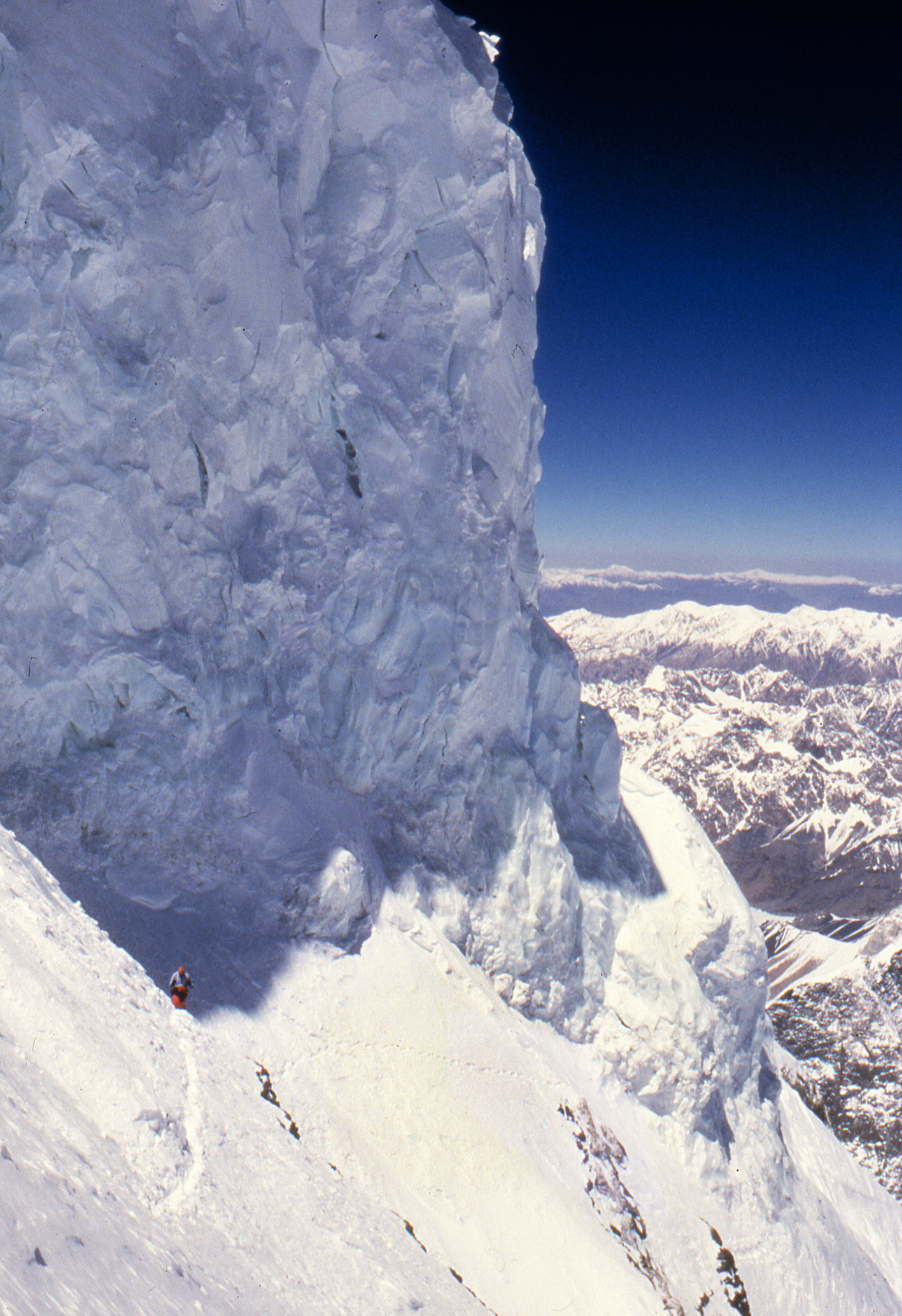
Above the Bottleneck
This 1986 photograph shows the scale and exposure of the upper route. It is historical context—not a 2021 image. Rolf Zemp / Adha65 · CC BY-SA 3.0.


The hanging serac above the route
The Bottleneck is famous for steep climbing beneath unstable ice. The 2021 disappearance cannot be assigned to serac collapse without evidence, but the terrain explains why search and recovery are exceptionally difficult. Adha65 · CC BY-SA 3.0.

Did Ali Sadpara, John Snorri and Juan Pablo Mohr reach the summit?
The responsible answer is that the available evidence does not prove it.
They continued above Sajid’s turnaround point.
- The team left high camp for a summit push.
- Sajid turned back after an oxygen-regulator problem.
- The other three continued upward.
- They failed to return.
- Their bodies were located months later on the upper route.
No surviving witness or definitive summit evidence closes the gap.
- No one witnessed all three on the summit.
- Their exact turnaround point is unknown.
- Their body locations do not prove the highest point reached.
- A precise fatal accident mechanism has not been established.
- Claims of a confirmed summit should therefore be labeled as speculation, not fact.

Ali Sadpara became one of the defining figures of modern Pakistani mountaineering.
American Alpine Journal memorial writing emphasized that Sadpara was not simply a high-altitude worker but an ambitious alpinist who wanted to strengthen Pakistan’s own climbing culture. His influence continued through younger Pakistani climbers and through his son Sajid.

2021 changed K2 history in two opposite ways
The season completed one of mountaineering’s last great winter firsts while showing why the achievement had remained undone for so long.
The last winter 8000er was finally climbed.
Before January 2021, every other recognized eight-thousander had a winter ascent. K2 alone remained unclimbed in the coldest season.
The ascent was a Nepali achievement by design.
Mingma G’s AAJ account describes national pride as a central motivation. The climbers chose to join forces rather than turn the final summit into competing individual claims.
Winter amplified normal K2 consequences.
Falls, fixed-line transitions, oxygen-system problems, cold, wind, altitude and rescue limits all became more consequential in winter conditions.
Success and fatality belonged to separate teams.
The season is often narrated as a single emotional arc, but historically the January summit and the five deaths must be counted as distinct events.
Search capability still had a hard ceiling.
Helicopters and modern communication could support the February search, but they could not erase the altitude and weather limits above 8,000 metres.
The unanswered summit question remains part of the record.
A high-quality historical page should preserve uncertainty instead of manufacturing closure where the surviving evidence does not provide it.

Before 2021, no winter team had climbed higher than about 7,650 metres.
The American Alpine Journal’s winter-history summary notes that K2 had seen repeated winter attempts from 1987–88 onward, but the previous high point remained roughly 7,650 metres. January 2021 did not improve an existing winter summit record—it completed a problem that had resisted every previous expedition.

How the 2021 winter chronology is verified
First-person and institutional mountaineering records are prioritized over later retellings, especially where later articles infer a summit or cause of death.
American Alpine Journal — first winter ascent
Mingma Gyalje Sherpa’s K2 in Winter is the primary source for the Nepali ascent, expedition structure, summit team, route, oxygen use and the season’s subsequent tragedies.
UIAA — summit recognition
The UIAA’s January 18 recognition records the January 16 first winter ascent, names the 10 summiters and separately notes Mingote’s death while descending.
Atanas Skatov accident record
Contemporary reporting published the Seven Summits Trek account of Skatov’s February 5 fall near Japanese Camp 3, including the fixed-rope transition context and same-day body recovery.
Ali Sadpara memorial record
Simone Moro’s AAJ memorial places Sadpara’s final climb inside his broader career and confirms the February 2021 K2 disappearance with Snorri and Mohr.
July 2021 body locations
Contemporary Pakistan reporting and climbing-season accounts recorded the July 26 discovery of the three bodies on the upper mountain. Exact location descriptions varied during the first hours of reporting, so this page avoids claiming one precise shared coordinate.
What this page does not infer
It does not claim the final three summited, does not assign them a specific medical cause of death, and does not merge the January first-ascent team with the season’s five fatalities. Those are separate evidence questions.

K2’s upper mountain remains consequential in both directions.
This 1986 summit-ridge photograph is not from the 2021 winter season. It is included because it shows the exposure that underlies both K2’s great ascents and many of its tragedies: climbers still have to reverse the upper mountain after reaching their highest point.

K2 winter 2021 deaths FAQ
These answers match the FAQ schema and resolve the most common confusion around the first ascent and the fatalities.
How many climbers died on K2 in winter 2021?
Five climbers died during the 2020–21 winter season: Sergi Mingote, Atanas Skatov, Muhammad Ali Sadpara, John Snorri Sigurjónsson and Juan Pablo Mohr Prieto.
Did anyone on the first winter ascent team die?
No. All 10 Nepali climbers who made the first winter ascent on January 16 returned safely to base camp. The five fatalities involved other climbers in separate accidents or a later summit attempt.
Who made the first winter ascent of K2?
Nirmal Purja, Mingma Gyalje Sherpa, Mingma David Sherpa, Mingma Tenzi Sherpa, Gelje Sherpa, Pem Chhiri Sherpa, Dawa Temba Sherpa, Dawa Tenjin Sherpa, Kilu Pemba Sherpa and Sona Sherpa.
What happened to Sergi Mingote?
Mingote died on January 16 after falling while descending from Camp 1 toward Advanced Base Camp. His accident was separate from the first-winter-ascent summit team.
What happened to Atanas Skatov?
Skatov died on February 5 after falling while descending near Japanese Camp 3. The expedition reported that the fall occurred during a fixed-rope safety transition. His body was recovered lower on the mountain later that day.
What happened to Ali Sadpara, John Snorri and Juan Pablo Mohr?
They continued above the Bottleneck after Sajid Sadpara turned back because of an oxygen-regulator problem. They never returned. They were declared dead on February 18, and their bodies were found on the upper mountain in July.
Did the missing three reach the summit?
It has not been conclusively established. No surviving witness or definitive summit evidence proves that all three reached 8,611 metres, so responsible accounts should leave the summit question unresolved.
When were their bodies found?
The bodies of Ali Sadpara, John Snorri and Juan Pablo Mohr were located on July 26, 2021 by summer teams high on K2. Contemporary reports placed them broadly near the Bottleneck / upper route above Camp 4.
Why was K2 so important in winter?
Before January 2021, K2 was the only one of the 14 eight-thousanders that had never been climbed in winter. Earlier winter expeditions had reached roughly 7,650 metres but no higher.
K2’s first winter ascent was a complete success for the 10 summiters—and the same season still cost five other climbers their lives.
Keeping those facts separate is the key to understanding 2021. The January ascent ended safely for the full Nepali summit team. Mingote and Skatov died in independent falls. Sadpara, Snorri and Mohr disappeared during a different February summit attempt whose final sequence remains unresolved. The season is both a landmark achievement and a reminder of how little margin winter K2 allows.
Continue to the K2 Disasters hubContinue through the K2 disaster, risk & season system
This child owns the 2020–21 winter chronology. The pages below own the broader fatality denominator, other disaster years, route mechanics and modern K2 season data.
Was this helpful?
🏔Related peaks nearby
🧭Explore & compare
Global Summit Guide is an independent mountaineering resource founded in 2026. The team combines first-hand trekking and climbing experience with in-depth research and professional health and nutrition review to help climbers choose objectives, prepare properly, and stay safe.
Health, altitude, and nutrition content is reviewed by Taylor Ludlow (Registered Nurse) and Brigg Hoopes (Nutritionist).
What We Don't Know Yet
Mountain information changes quickly. This box explains the limits of what this page can responsibly promise.
- Visa, passport, vaccination, border, insurance, and local transportation rules may change before your trip.
- Route conditions, snowpack, closures, and weather can change quickly after this page is updated.
- Permit rules, fees, quotas, and reservation windows may change between review cycles.
- Operator availability, pricing, guide ratios, and cancellation terms can change by season.
- Your fitness, altitude response, risk tolerance, and experience level may change what is safe or realistic.
Verify current conditions with official land managers, guide services, local forecasts, and current route reports before booking or climbing.
Mountaineering, rock and ice climbing, glacier travel, and high-altitude activity are inherently dangerous and can result in serious injury or death. The information on Global Summit Guide is provided for general informational and educational purposes only and is not a substitute for professional instruction, qualified guiding, proper equipment, or your own judgment and experience.
Route conditions, weather, snowpack, permits, regulations, and hazards change constantly and may differ from what is described here. Details may be incomplete, out of date, or contain errors. Always verify current information with local authorities, certified guides, and official sources before making any decision in the mountains.
Nothing on this site is medical, legal, or financial advice. Our fitness, acclimatization, altitude, and nutrition content is general in nature; consult a qualified physician before beginning any strenuous exercise program or exposing yourself to high altitude.
You are solely responsible for your own safety and decisions. To the fullest extent permitted by law, Global Summit Guide and its team accept no liability for any loss, injury, damage, or expense arising from use of, or reliance on, this information. By using this site you acknowledge these risks and accept these terms.
Some links on this site may be affiliate links. If you buy through them we may earn a small commission at no extra cost to you; this never affects our recommendations.
Global Summit Guide recommendation path
Next Best Mountain to Research
Use these recommendations to continue the right planning path instead of stopping on one page.
Use current permit, weather, route, and operator information before booking or climbing.