
Mountains in Utah: a climber’s guide to the Wasatch, Uintas, and Utah’s greatest peaks
Utah is one of the most underrated mountain states in the US. The state has over 200 named peaks above 11,000 feet distributed across 7+ major ranges, the highest summit (Kings Peak) reaching 13,528 feet, and a combination of Wasatch alpine terrain, Uinta high country, and southern Utah desert peaks that no other state matches. Despite this, Utah’s mountains attract less national attention than Colorado’s 14ers or California’s Sierra Nevada — which is exactly what makes them appealing for climbers seeking fewer crowds and more variety. This guide covers the major Utah ranges, the most important peaks in each, and the order most climbers approach them. For broader context see our best mountains in Utah master guide.
Utah’s mountain geography an overview
Utah sits at the intersection of the Rocky Mountains, the Colorado Plateau, and the Great Basin, producing one of the most geologically diverse mountain landscapes in the United States. The state has three distinct mountain regions:
- The Wasatch Front and Range: the north-south spine running from southern Idaho through Salt Lake City to central Utah. Contains the most-climbed peaks due to population proximity.
- The Uinta Mountains: the unusual east-west range in northeastern Utah. Contains all of Utah’s highest peaks and the state’s only “13ers” (peaks above 13,000 feet).
- The southern Utah ranges: the La Sal Mountains near Moab, the Henry Mountains, the Abajo Mountains, the Tushar Mountains, and others. Desert mountain character with dramatic views and lower visitor numbers.
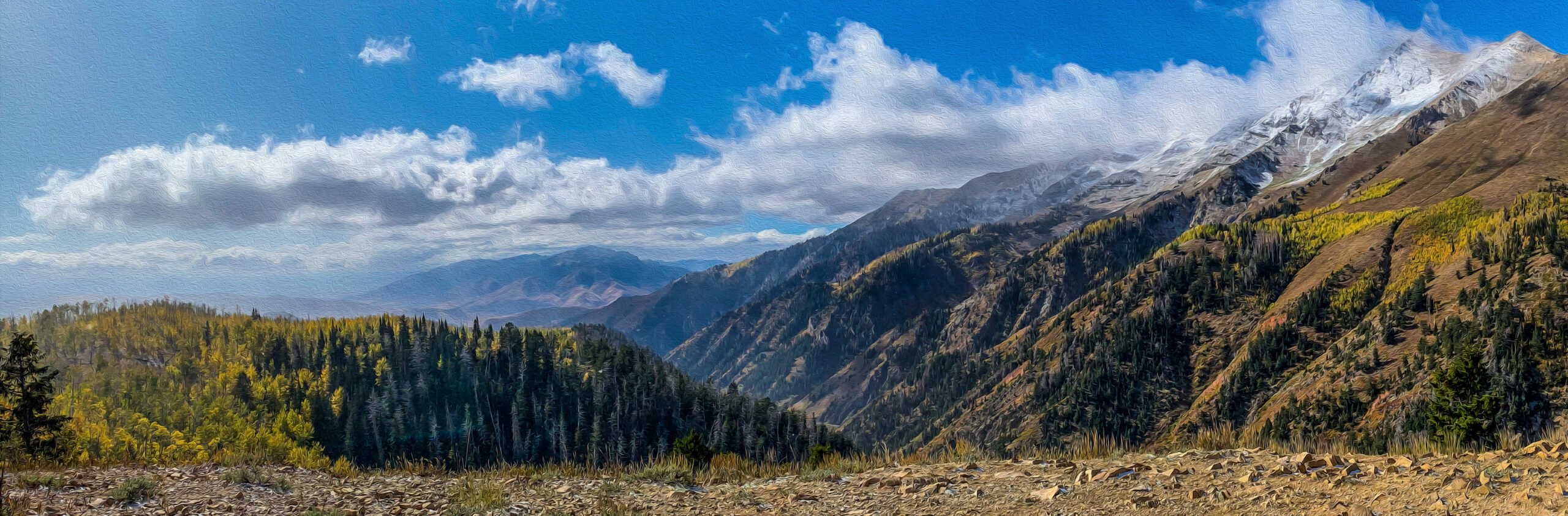
The diversity is what makes Utah unique. A climber based in Salt Lake City can spend the morning on a Wasatch Range scramble, drive 90 minutes east to backpack into the Uintas for a multi-day high peak, or drive 4 hours south to climb a desert mountain in the La Sals — all without leaving the state. No other state has this range of mountain experience packed so close together.
Utah’s highest peaks the headline mountains
Kings Peak
Kings Peak in the Uinta Mountains is the high point of Utah and one of the more unusual US state high points — it requires a 28-mile round-trip backpacking trip rather than a single-day hike. The peak sits deep in the High Uintas Wilderness with no road access closer than the Henrys Fork trailhead, 14 miles from the summit. Most climbers complete Kings Peak as a 3-day backpack, though strong parties can complete it in 2 days. The summit ridge involves class 2 scrambling on talus and is the highest peak in the entire Uinta Mountains range.
Mount Peale
Mount Peale in the La Sal Mountains is the highest peak in southern Utah and the second-highest peak in the state. The mountain sits in the La Sals range east of Moab, providing dramatic high alpine terrain rising from the surrounding red rock desert. Most climbers approach via the standard route from the La Sal Loop Road. The peak is class 2 with talus scrambling at the summit ridge and is meaningfully easier than Kings Peak due to a shorter approach and better trailhead access.
Mount Nebo
Mount Nebo is the highest peak in the Wasatch Range and the southernmost peak of the main Wasatch chain. The mountain is technically a three-summit massif with the south summit being the highest, though the north summit and middle summit are also recognized peaks. The standard route is class 2 with a long approach hike from the Wasatch foothills. Mount Nebo’s location makes it less visited than the Salt Lake City peaks but the dramatic three-summit profile and high elevation make it one of the iconic Utah objectives.
The Wasatch Range the iconic peaks
The Wasatch Range is Utah’s most visited mountain range, running north-south through northern Utah from the Idaho border to central Utah. The Wasatch Front (the western edge of the range visible from Salt Lake City and Provo) is one of the most populated mountain edges in the US. The peaks east of Salt Lake City — Mount Olympus, Twin Peaks, Lone Peak — are climbed by tens of thousands of locals each year.
Mount Timpanogos
Mount Timpanogos is the most-climbed mountain in Utah, with over 100,000 attempts annually on the standard Aspen Grove and Timpooneke trails. The mountain dominates the skyline above Utah Valley and produces dramatic views from Provo, American Fork, and Lehi. The hike is a long day (14 miles round trip) with significant elevation gain but is class 2 throughout and accessible to fit hikers. The mountain has a small glacier (the “Timpanogos Glacier” — actually more accurately a permanent snowfield) near the summit.
Mount Olympus
Mount Olympus is the most prominent peak in the Salt Lake Valley, rising directly above the city’s east bench. Despite being lower than many Utah peaks (9,026 ft), it is one of the steepest hikes in Utah — 4,100 feet of gain in just 4 miles round trip. The upper section includes class 3 scrambling on rock. Mount Olympus is the standard “test piece” for new Salt Lake hikers and the most-summited Wasatch peak by per-capita measure.
Lone Peak
Lone Peak is one of the most technically demanding Wasatch peaks accessible from Salt Lake. The standard hike to the summit involves a long approach through the granite cirque, with class 3-4 scrambling on the upper mountain. The cirque itself contains some of the best granite climbing in the Wasatch and is a popular technical climbing destination. The hike to the summit is widely considered one of the hardest day hikes in Utah.
Twin Peaks (Salt Lake)
Twin Peaks (also called Broads Fork Twin Peaks) is one of the most dramatic-looking peaks visible from Salt Lake City. The standard route via Broads Fork involves a long approach hike with class 3 scrambling on the upper section. The summit views encompass the entire Salt Lake Valley to the west and the Cottonwood Canyons high country to the east.
The Uinta Mountains Utah’s high country
The Uinta Mountains are one of the most unusual major ranges in the contiguous United States — they run east-west rather than north-south, which is unique among major American ranges. The Uintas contain all of Utah’s 13ers (peaks above 13,000 feet), and the High Uintas Wilderness is one of the largest wilderness areas in the lower 48 states. Most Uinta peaks require multi-day backpacking trips due to limited road access into the range.
Kings Peak
South Kings Peak
Gilbert Peak
Mount Emmons
Mount Lovenia
The Uintas have 17-19 named peaks above 13,000 feet depending on how subsidiary summits are counted. Climbing all of them is a multi-year project for serious Utah climbers — the remote access and limited windows of good weather make Uinta peak bagging a significantly different undertaking than Wasatch hiking. The full Kings Peak detail is in our existing Utah content.
The High Uintas have a feel unlike anywhere else in Utah — broad alpine basins, hundreds of lakes, vast tundra plateaus, and peaks rising from already-high terrain. The trade-off is that the range is genuinely remote. You will not see another person for days in many parts of the High Uintas Wilderness, but you also cannot rely on rescue capability anywhere comparable to the Wasatch or Colorado 14ers.
Southern Utah ranges desert mountain country
The southern half of Utah contains several smaller but visually dramatic mountain ranges that contrast sharply with the surrounding red rock desert. These are the most photogenic mountains in Utah and produce some of the most striking landscapes anywhere in the American West.
Mount Peale
Mount Mellenthin
Mount Tukuhnikivatz
Mount Ellen
Delano Peak
The Henry Mountains deserve special mention — they were the last named mountain range in the lower 48 United States, mapped only in the 1870s. Mount Ellen and the rest of the Henry Mountains are among the most remote major peaks in the country and offer climbers a meaningfully different experience than the more developed Wasatch and La Sals.
Utah mountains compared to other Western states
| State | Highest peak | Named 14ers | vs Utah character |
|---|---|---|---|
| Utah | Kings Peak 13,528 ft | 0 | Diverse — Wasatch + Uintas + desert |
| Colorado | Mt Elbert 14,440 ft | 58 | Higher concentration of major peaks, but less variety |
| California | Mt Whitney 14,505 ft | 12 | Higher peaks, longer approaches, Sierra Nevada granite |
| Wyoming | Gannett Peak 13,810 ft | 0 | Wind River Range, more remote |
| New Mexico | Wheeler Peak 13,167 ft | 0 | Sangre de Cristo southern terminus |
| Arizona | Humphreys Peak 12,633 ft | 0 | Single major range (San Francisco Peaks) |
| Nevada | Boundary Peak 13,140 ft | 0 | Basin and Range character |
Utah does not have the highest peaks (Colorado, California, Wyoming all have higher summits) and does not have 14ers. But Utah’s combination of accessible Wasatch peaks, remote Uinta high country, and southern Utah desert mountains provides a variety of mountain experience that no other state matches. The full broader Western state context is in our best mountains in the USA guide.
When to climb Utah mountains seasonal framework
| Season | Wasatch peaks | Uinta peaks | Southern Utah ranges |
|---|---|---|---|
| March-April | Snow on high terrain | Closed (deep snow) | Approaching season |
| May | Snow lingers above 9,000 ft | Still closed | Excellent (cool desert) |
| June | Snow patches retreating | Snow still extensive | Hot in lower elevations |
| July | Prime season | Standard season opens | Hot but accessible |
| August | Prime season | Prime season | Best for high La Sals/Henrys |
| September | Excellent — fewer crowds | Excellent — best window | Excellent |
| October | First snow possible | Snow returns | Cooler, excellent |
| Nov-Feb | Winter mountaineering | Closed | Winter desert climbing |
The single biggest seasonal factor in Utah is the Uintas — they have a meaningfully shorter climbing season than the Wasatch or southern ranges because of the higher base elevation and east-west orientation that holds snow longer. Late July through mid-September is the reliable window for Uinta high peaks. The Wasatch can be climbed earlier and later, and southern Utah peaks are often best in spring and fall when high-country routes are too snowy. The full Wasatch winter context is in our existing Kings Peak content.
Who Utah mountains are good for honest fit assessment
Utah is excellent for you if…
- You live in or visit Salt Lake City, Provo, or the Wasatch Front and want frequent mountain access
- You enjoy mountain variety — alpine, high country, desert peaks all within driving distance
- You appreciate less crowded peaks than Colorado 14ers or California Sierras
- You can backpack for multi-day Uinta objectives
- You want to combine mountain trips with Utah’s national parks (Zion, Bryce, Arches, Canyonlands)
- You are interested in winter mountaineering — the Wasatch has world-class backcountry skiing and ski mountaineering
Utah might not fit if…
- Your primary goal is 14ers — go to Colorado instead
- You want technical alpine climbing — California Sierra granite or Cascade volcanoes are better matches
- You strongly prefer single-day peak access without multi-day trips
- You want lots of guided commercial expedition options — Utah’s guide service density is lower than Colorado or California
A Utah mountain progression how climbers typically approach the state
For climbers building toward Utah peak bagging or just exploring Utah’s mountains seriously, the typical progression looks like this:
- Year 1 — Wasatch Front intro: Mount Olympus, Mount Wire, Twin Peaks (the Pfeifferhorn variant). Build comfort with Wasatch-style steep hiking.
- Year 1-2 — Mount Timpanogos: the standard Utah peak. Test fitness on a long Wasatch day.
- Year 2 — Lone Peak and Mount Nebo: harder Wasatch objectives. Class 3-4 scrambling, longer days, real route-finding.
- Year 2-3 — First Uinta backpack: Kings Peak as the introduction to multi-day Uinta climbing. The state high point in 2-3 days.
- Year 3+ — Uinta 13er project: systematic Uinta high peaks. Most climbers complete this over 3-5 years of summer backpacking trips.
- Year 3+ — Southern Utah peaks: Mount Peale, Mount Mellenthin, Mount Ellen. Combine with national park trips.
- Winter mountaineering: Wasatch backcountry skiing and ski mountaineering as a winter complement to summer hiking.
Beyond hiking and peak bagging, Utah is one of the best technical climbing destinations in the world. Indian Creek splitter cracks, Zion big walls, Wasatch granite cirques, and the Castle Valley desert towers near Moab represent some of the best rock climbing anywhere. Climbers seriously building toward technical alpinism often spend time in Utah for the rock climbing as well as the peak bagging.
Getting to Utah mountains practical access
| Destination | Driving from | Time |
|---|---|---|
| Wasatch Front peaks | Salt Lake City | 15-45 min |
| Mount Timpanogos | Salt Lake City | 1 hour |
| Mount Nebo | Salt Lake City | 1.5 hours |
| Uintas (Henrys Fork) | Salt Lake City | 2.5-3 hours |
| La Sal Mountains | Moab | 30-45 min |
| La Sals from Salt Lake | Salt Lake City | 4 hours |
| Henry Mountains | Salt Lake City | 4.5 hours |
| Tushar Mountains | Salt Lake City | 3 hours |
Salt Lake City International Airport (SLC) is the standard arrival point for Utah climbing trips, with rental cars and direct access to the Wasatch Front. Many Utah peaks can be climbed as day trips from Salt Lake, though the Uintas and southern ranges typically require longer trips. The Utah Department of Transportation maintains good road access to most major trailheads year-round, though high-elevation roads close in winter.
The full Utah mountain framework
Detailed peak profiles, route guides, and the complete framework for climbing in Utah.
Master guide →The bottom line on Utah mountains
Utah has over 200 named peaks above 11,000 feet distributed across seven major mountain ranges, including all 17-19 of the state’s “13ers” in the Uinta Mountains and the iconic Wasatch peaks accessible from Salt Lake City and Provo. Kings Peak at 13,528 feet is the state high point. Mount Timpanogos is the most-climbed peak. Mount Olympus is the most visible from population centers. The state combines Wasatch alpine terrain, Uinta high country, and southern Utah desert peaks in a way no other state matches. While Utah lacks 14ers and the absolute highest peaks belong to Colorado and California, the variety, accessibility, and lower visitor numbers make Utah one of the most rewarding mountain states for climbers who appreciate diverse mountain experience over pure altitude. The full peak-by-peak framework is in our best mountains in Utah master guide.
Frequently asked questions
What is the highest mountain in Utah?
Kings Peak in the Uinta Mountains is the highest mountain in Utah at 13,528 feet (4,123 meters). Kings Peak is the high point of the entire Uinta Mountains range and one of only a handful of US state high points that requires a multi-day backpacking trip rather than a single-day hike. Mount Peale in the La Sal Mountains near Moab at 12,726 feet is the second-highest peak in Utah. The Uinta Mountains contain Utah’s highest peaks while the Wasatch Range contains the most-visited peaks due to proximity to Salt Lake City.
What are the main mountain ranges in Utah?
Utah has several major mountain ranges: the Wasatch Range (running north-south through northern Utah, containing peaks like Mount Timpanogos and Mount Nebo and the Salt Lake City area mountains), the Uinta Mountains (running east-west in northeastern Utah, containing Kings Peak), the La Sal Mountains (near Moab in southeast Utah), the Henry Mountains (south-central Utah), the Abajo Mountains (southeastern Utah), the Tushar Mountains (south-central Utah), and several smaller ranges. The Wasatch is the most populated and accessed, while the Uintas contain the highest peaks.
What is the most famous mountain in Utah?
Mount Timpanogos in the Wasatch Range at 11,752 feet is widely considered the most famous mountain in Utah, with over 100,000 hikers attempting it annually. The mountain is visible from much of Utah Valley and is the dominant peak in the Provo area. Mount Olympus near Salt Lake City is also extremely well known due to its prominence above the Salt Lake Valley. Kings Peak is famous as the state high point but is less visited due to its remote location. Mount Nebo at 11,933 feet is the highest peak in the Wasatch Range and a popular climbing objective.
How many mountain peaks are in Utah?
Utah has thousands of named mountain peaks across its various ranges. Counts depend on the inclusion criteria, but Utah has approximately 18 named peaks above 13,000 feet (all in the Uinta Mountains) and over 200 named peaks above 11,000 feet across the Wasatch, Uintas, and other ranges. The Wasatch Range alone contains over 50 named peaks above 10,000 feet. Mountain peak counts in Utah are dominated by the Uinta Mountains for highest elevation peaks and the Wasatch for total number of significant climbing objectives.
Are there 14ers in Utah?
No, Utah does not have any 14ers (peaks above 14,000 feet). The highest peak in Utah, Kings Peak in the Uinta Mountains, is 13,528 feet — just shy of the 14,000-foot threshold. Utah does have 13ers (peaks above 13,000 feet) — all of them located in the Uinta Mountains. The 14er distinction belongs primarily to Colorado (58 peaks), California (12 peaks), and Alaska. Utah’s high peaks are typically classified as 13ers and 12ers, with the Uintas containing all the 13ers and the Wasatch and southern ranges containing most of the 12ers.
What is the best mountain to climb in Utah?
The best mountain to climb in Utah depends on your goals. For most hikers, Mount Timpanogos in the Wasatch Range is the best Utah peak — accessible from Salt Lake City and Provo, dramatic terrain, and good views. For peak baggers, Kings Peak as the state high point is the iconic Utah objective. For a quick mountain day near Salt Lake City, Mount Olympus offers steep accessible hiking. For technical climbers, the granite walls of Lone Peak and the Cottonwood Canyons offer significant climbing. Each peak serves different climber profiles.
When is the best time to climb mountains in Utah?
The best time to climb most Utah mountains is July through early October. Snow lingers in the high country (Uintas, upper Wasatch) until late June or July in most years. The peak hiking season is July-August with stable weather and mostly dry conditions, though afternoon thunderstorms are common. September often produces the most stable weather and fewer crowds. Lower-elevation peaks in southern Utah (La Sals, Henry Mountains) have longer seasons. Winter mountaineering in Utah is significant, particularly in the Wasatch Range backcountry.
Leave a Reply